


 Close
Close
 9th February 2024
Adrenal gland
Overview
The adrenal gland produces several types of steroids, including:
18-carbon steroids: – Oestrogen
19-carbon steroids: – Androgen
21-carbon steroids: – Progesterone (precursor of all the other 21-carbon steroids)
– Glucocorticoid (hydroxylation at C-17)
– Mineralocorticoid (hydroxylation at C-21)

Image Source: Wikimedia Commons (2014). Adrenal Steroids Pathways, Licensed under a creative commons licence. Available for free at: https://upload.wikimedia.org/wikipedia/commons/f/f8/Adrenal_Steroids_Pathways.svg(Accessed: 4 January 2024).
The adrenal cortex is divided into three distinct zones, each producing a different hormone.
The zona glomerulosa secretes aldosterone, and ACTH controls its secretion, increasing potassium levels and the renin-angiotensin system ( reduced perfusion pressure stimulates renin secretion that induces aldosterone secretion via angiotensin II). At the distal convoluted tubules, aldosterone stimulates sodium reabsorption and potassium excretion. This leads to a net increase in circulating plasma volume by osmosis.
Glucocorticoids like cortisol and cortisone are produced within the zona fasciculata. These hormones circulate within the body bound to corticosteroid-binding globulin. Its circulation follows a circadian rhythm with the highest levels during the day. ACTH mediates its secretion but exerts a negative feedback effect on the pituitary gland to reduce the level of ACTH secreted. Glucocorticoids act to increase serum glucose concentration via increased glycolysis, lipolysis, gluconeogenesis and protein catabolism. It is also an anti-inflammatory mediator and can result in immunosuppression.
The sex hormones are produced mainly within the zona reticularis, the deepest portion of the adrenal cortex. Androstenedione and testosterone are produced within the adrenal cortex, while the final production of dihydrotestosterone and oestradiol occurs in the peripheral tissues.
Below are the pathophysiology of disorders affecting the adrenal cortex:
| Adrenal disorder | Features | Hormone levels |
|---|---|---|
| Addison’s disease
(Primary adrenal insufficiency) |
Hyperpigmentation, decreased pubic and axillary hair in women, weakness, weight loss, N&V, hypoglycaemia, hyperkalaemia, metabolic acidosis, | Reduced cortisol → Increased ACTH
∴Treat by glucocorticoids and mineralocorticoid replacement |
| Cushing’s syndrome
(e.g., exogenous steroids, primary adrenal hyperplasia) |
Central obesity, moon face, buffalo hump, striae, hypertension, hyperglycaemia, muscle wasting | Increased cortisol → Reduced ACTH |
| Cushing’s disease
(Overproduction of ACTH) |
Similar features to Cushing’s syndrome | Increased ACTH
∴ Treat by removal of ACTH-secreting tumour |
| Conn’s syndrome
(Aldosterone-secreting tumour) |
Hypertension, hypokalaemia, metabolic alkalosis | Increased aldosterone → Reduced Renin |
| 21β-Hydroxylase deficiency | Symptoms of glucocorticoids & and mineralocorticoids deficiency
Virilisation of women, early growth of pubic and axillary hair |
Reduced glucocorticoids & mineralocorticoids → Increased ACTH
∴ Treat by glucocorticoids and mineralocorticoid replacement Increased androgens |
| 17α-Hydroxylase deficiency | Symptoms of glucocorticoid deficiency and mineralocorticoid excess
Lack of pubic and axillary hair |
Reduced glucocorticoids (and adrenal androgens) → Increased ACTH
Increased mineralocorticoids ∴ Treat by glucocorticoid replacement and aldosterone antagonist |
The adrenal medulla is the deepest region of the adrenal gland and is generally made of chromaffin cells. This region of the adrenal gland secretes catecholamines. The preganglionic sympathetic nerves stimulate the secretion of catecholamines. The catecholamines will result in increased glycogenolysis, gluconeogenesis and lipolysis.
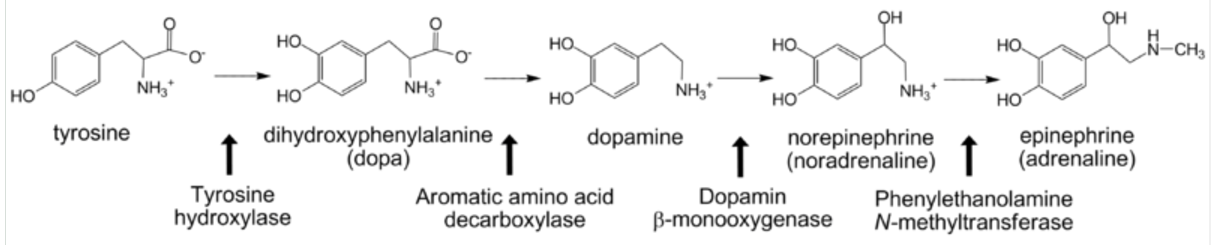
Image Source: Wikimedia Commons (2009). Catecholamine biosynthesis, Licensed under a creative commons licence. Available for free at: https://upload.wikimedia.org/wikipedia/commons/8/8d/Catecholamine_biosynthesis.png (Accessed: 4 January 2024).
References
Tortora, G. J., & Derrickson, B. (2017). Tortora’s principles of anatomy and physiology. John Wiley and Sons.
Kumar, P. and Clark, M., (2012). Kumar & Clark’s clinical medicine. 8th ed.
Complete Guide to Clinical Genetics ST3 Application and Recruitment (2027)
Written by Medibuddy. Last updated: October 2026. Clinical Genetics is

Complete Guide to Clinical Radiology ST3 Application and Recruitment (2027)
Recruitment paused: NHS England is not running Clinical Radiology ST3+ recru

Complete Guide to Paediatric Surgery ST3 Application and Recruitment in United Kingdom (2026)
Written by Medibuddy. Last updated: October 2026. If you’re planning


Take your subscriptions with you
Our mobile app allows you to access your interview and exam question banks wherever you are.

