


 Close
Close
 9th February 2024
Classification of hormones
Hormones are chemical messengers produced by cells, glands or organs into the circulation, exerting their effects elsewhere in the body.
Classification of hormones is according to their chemical composition:
- Polypeptides – E.g. the hypothalamic and pituitary hormones, growth hormones
- Monoamines (i.e., single amino acid) – E.g. catecholamines (adrenaline and noradrenaline), thyroxine, serotonin
- Steroids – E.g. aldosterone, sex hormones
Comparing and contrasting the three classifications:
| Polypeptides | Monoamines | Steroids |
|---|---|---|
| Stored prior to release | Catecholamines and serotonin are stored prior to release
Thyroxine is bound to thyroglobulin |
Released immediately |
| Generally polar and water-soluble | Some are polar (e.g., adrenaline), whilst others are carried by proteins. | Lipophilic and hydrophobic, so it requires a carrier protein for transport in circulation. |
| Bind to transmembrane protein, causing transduction and amplification of signals via cAMP (second messenger) | Adrenaline binds to membrane receptors.
Thyroid binds to nuclear receptors. |
Bind to intracellular receptor, resulting in gene transcription. |
| Fast-acting | Catecholamines are fast-acting
Thyroid hormones are slow-acting (due to its action in gene transcription) |
Slow-acting |
Mechanism of hormone action
Hormones exert their action via receptors on cell membranes, mainly G-protein receptors. G protein-coupled receptors are transmembrane proteins with an extracellular site to which hormone binds and an intracellular site to which G protein attaches.
G proteins couple hormones to second messenger systems such as cAMP, IP3 and Ca2+-calmodulin to carry out physiological actions. G proteins are heterotrimeric, i.e., consist of 3 subunits: α, β and γ. G proteins can be bound to GTP (guanosine triphosphate) or GDP (guanosine diphosphate).
Hormone diffuses through the cell membrane and binds to intracellular receptors. This complex of hormone and receptor then enters the nucleus, altering DNA transcription and protein synthesis.

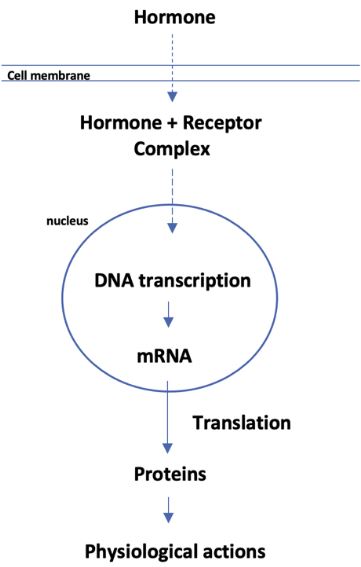
Hormones are classified according to their mechanism of action:
| Adenylate cyclase | IP3/Ca2+ | Steroid hormone | Other mechanisms |
|---|---|---|---|
| ↑cAMP
ACTH ADH (V2 receptor) β1, β2 adrenoceptor TSH PTH LH FSH ↓cAMP α2 adrenoceptor |
Angiotensin II
ADH (V1 receptor) α1 adrenoceptor TRH Oxytocin |
Oestrogen
Progesterone Testosterone Glucocorticoids Aldosterone Thyroid hormone |
Tyrosine Kinase
Insulin Growth hormone cGMP Nitric oxide ANP |
Regulation of hormones
Regulation of hormone secretion can be achieved by the negative feedback mechanism or the positive feedback mechanism.
Complete Guide to Clinical Genetics ST3 Application and Recruitment (2027)
Written by Medibuddy. Last updated: October 2026. Clinical Genetics is

Complete Guide to Clinical Radiology ST3 Application and Recruitment (2027)
Recruitment paused: NHS England is not running Clinical Radiology ST3+ recru

Complete Guide to Paediatric Surgery ST3 Application and Recruitment in United Kingdom (2026)
Written by Medibuddy. Last updated: October 2026. If you’re planning


Take your subscriptions with you
Our mobile app allows you to access your interview and exam question banks wherever you are.

