


 Close
Close
 9th February 2024
Anterior pituitary hormones
The anterior pituitary gland secretes multiple hormones. We summarise the action of each hormone below.
Adrenocorticotropic hormone (ACTH)
ACTH and melanocyte-stimulating hormone (MSH) are derived from a common precursor molecule, pro-opiomelanocortin (POMC), synthesised in the hypothalamus and cleaved in the anterior pituitary. Its secretion is mediated by the corticotropin-releasing hormone released by the hypothalamus (via negative feedback control from cortisol).
The hormone levels follow a circadian rhythm due to diurnal variation of cortisol levels (lowest at midnight and highest at 0800). It serves to increase the secretion of cortisol and cholesterol concentration, which will, in turn, increase the cortisol level.
High levels of ACTH are typically seen in Cushing’s and Addison’s disease. Low ACTH levels are typically seen in secondary and tertiary adrenal insufficiency.
Luteinising hormone (LH) and Follicle-stimulating hormone (FSH)
LH, FSH and TSH originate from the same glycoprotein family. All these hormones have two subunits; an α subunit is identical in LH, FSH and TSH, whilst the β subunit is unique and specific to each hormone.
The secretion of FSH and LH is mediated by hypothalamic gonadotropin-releasing hormone (GnRH). The secretion of GnRH is mediated by circulating androgen levels ( oestrogen and testosterone). FSH levels are high in the follicular phase (to develop follicles) and fall just preceding ovulation. Both LH and FSH peak at mid-ovulatory cycle (LH more so than FSH), triggering ovulation.
LH acts on the Leydig cell receptor, controls the development of corpus luteum and secretes progesterone in females and testosterone production in males. FSH acts on the Sertoli cell receptor, and it controls the development and maturation of Graafian follicles in females, the growth of seminiferous tubules, and the development of sperm in males.
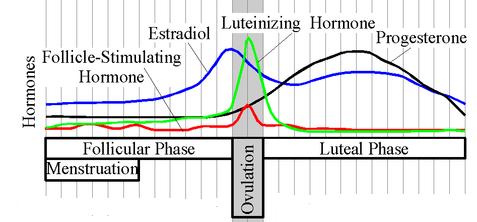
Image Source: Wikimedia Commons (2006). Estradiol Cycle, Licensed under a creative commons licence. Available for free at: https://upload.wikimedia.org/wikipedia/commons/c/c7/Estradiol.Cycle.jpg (Accessed: 4 January 2024).
High levels of LH and FSH can be seen in post-menopause and primary gonadal failure. Low levels of FSH and LH can be seen in hypopituitarism.
Thyroid-stimulating hormone (TSH)
TSH is a glycoprotein and is made up of α subunits and β subunits. The thyrotropin-releasing hormone controls its release (via negative feedback control of free T4 and T3). Its secretion will increase the release of T4 and T3 hormones and encourage the growth of the thyroid gland.
Growth hormone (GH)
GH is a single-chain polypeptide with a structure similar to prolactin. It is secreted in a pulsatile manner and is controlled by growth hormone-releasing hormone (GHRH). GHRH stimulates the synthesis and secretion of growth hormone and somatostatin, inhibiting the secretion of GH. Somatomedins are produced when GH acts on the target tissue. It inhibits the secretion of GH via its direct action on the anterior pituitary and by stimulating somatostatin secretion.
Stimuli for the secretion of GH include sleep, stress, vigorous exercise, starvation, hypoglycaemia and bromocriptine. Its secretion is inhibited by somatostatin, hyperglycaemia, obesity and increased cortisol.
GH stimulates lipolysis, protein synthesis and growth of bone, cartilage and connective tissue. It also stimulates hyperglycaemia by reducing glucose uptake into tissues. Growth hormone deficiency results in short stature and delayed puberty. Growth hormone excess can result in gigantism (childhood) or acromegaly (after puberty), increasing organ and periosteal bone growth.
Prolactin
Prolactin is a single-chain polypeptide structurally similar to growth hormone. It displays a pulsatile secretion with its peak serum concentration at night and nadir during the morning. Its secretion is stimulated by pregnancy (oestrogen), breast-feeding, thyrotropin-releasing hormone, dopamine antagonists and stress. Its secretion is inhibited by dopamine, dopamine agonist (bromocriptine), and prolactin.
Prolactin has a vital role in lactogenesis and breast development. It also inhibits ovulation and spermatogenesis. Prolactin deficiency can result from disruption to the anterior pituitary gland, reducing lactation. Prolactin hypersecretion occurs due to prolactinomas and hypothalamic disorders, and this presents with galactorrhoea, ovulation failure and amenorrhoea.
Complete Guide to Clinical Genetics ST3 Application and Recruitment (2027)
Written by Medibuddy. Last updated: October 2026. Clinical Genetics is

Complete Guide to Clinical Radiology ST3 Application and Recruitment (2027)
Recruitment paused: NHS England is not running Clinical Radiology ST3+ recru

Complete Guide to Paediatric Surgery ST3 Application and Recruitment in United Kingdom (2026)
Written by Medibuddy. Last updated: October 2026. If you’re planning


Take your subscriptions with you
Our mobile app allows you to access your interview and exam question banks wherever you are.

