


 Close
Close
 16th January 2024
Eosinophilic granulomatosis with polyangiitis (EGPA)
Background
Epidemiology
Eosinophilic granulomatosis with polyangiitis (EGPA) is another type of autoimmune ANCA associated small and medium vessel vasculitis. This condition was previously known as Churg-Strauss syndrome and is the least common of the ANCA associated vasculitides referenced in the previous section. It is also classed as one of several hypereosinophilic diseases.
It is a multi-system disease; however, the most commonly involved organ is the lung. The estimated incidence is 1-3 cases per 1 million people in the UK, but higher in the asthmatic population. Presentation typically occurs in asthmatic patients who are 40 to 60 years of age, with slightly higher incidence in patients of male sex compared to female sex. It rarely occurs in children or those older than 65 years of age. The 5-year survival rate with appropriate treatment can be up to 100% in some cases.
References
- Jacobs, K. and Kligerman, S. (2019) “Immune-mediated lung diseases,” Seminars in Ultrasound, CT and MRI, 40(3), pp. 213–228. Available at: https://doi.org/10.1053/j.sult.2018.11.011.
- Keogh, K. (2022) Eosinophilic granulomatosis with polyangiitis (Churg-Strauss syndrome), Eosinophilic granulomatosis with polyangiitis (Churg-Strauss syndrome) – Symptoms, diagnosis and treatment | BMJ Best Practice. Available at: https://bestpractice.bmj.com/topics/en-gb/942 (Accessed: January 15, 2023).
- King Jr, T. and Paul Dieffenbach (2022) Epidemiology, pathogenesis, and pathology of eosinophilic granulomatosis with polyangiitis (Churg-Strauss), UpToDate. Edited by K. Flaherty, R. Glassock, and B. Bochner. UpToDate. Available at: https://www.uptodate.com/contents/epidemiology-pathogenesis-and-pathology-of-eosinophilic-granulomatosis-with-polyangiitis-churg-strauss?search=egpa&source=search_result&selectedTitle=3~143&usage_type=default&display_rank=3 (Accessed: January 15, 2023).
Pathophysiology
As with the other autoimmune vasculitides, the exact aetiology and pathophysiology of EGPA are unknown. It has been proposed that exposure to environmental triggers, e.g., infection, results in raised serum immunoglobulin (IgE), TH1 and TH2 cytokines (interleukin 4, 5 and 13) levels. Th2 cytokines contribute to the maturation and activation process of eosinophils, which directly release toxic proteins. These proteins drive inflammation; therefore, raised levels of eosinophils due to raised IL-5 results in higher levels of toxic protein release and, hence, more inflammation. Levels of regulatory T cells, which protect against autoimmune disease development, have been found to be lower in those with EGPA.
As with GPA, ANCA is also thought to play a role in this disease, likely via development of vessel inflammation due to neutrophil activation. Genetic factors may also be involved; for example, the interleukin (IL)10 gene and HLA class of immune cells are both associated with EGPA.
It has been suggested that omalizumab and leukotriene receptor antagonists use can reveal undiagnosed cases of EGPA if they improve asthma symptoms to the point that oral steroid weaning can occur, and clinical manifestations of EGPA then become apparent.
References
- Keogh, K. (2022) Eosinophilic granulomatosis with polyangiitis (Churg-Strauss syndrome), Eosinophilic granulomatosis with polyangiitis (Churg-Strauss syndrome) – Symptoms, diagnosis and treatment | BMJ Best Practice. Available at: https://bestpractice.bmj.com/topics/en-gb/942 (Accessed: January 15, 2023).
- King Jr, T. and Paul Dieffenbach (2022) Epidemiology, pathogenesis, and pathology of eosinophilic granulomatosis with polyangiitis (Churg-Strauss), UpToDate. Edited by K. Flaherty, R. Glassock, and B. Bochner. UpToDate. Available at: https://www.uptodate.com/contents/epidemiology-pathogenesis-and-pathology-of-eosinophilic-granulomatosis-with-polyangiitis-churg-strauss?search=egpa&source=search_result&selectedTitle=3~143&usage_type=default&display_rank=3 (Accessed: January 15, 2023).
Presentation
It has been proposed that EGPA presentations can be split into three different phases, depending on clinical symptoms and signs at the time of diagnosis. The three phases are summarised below:
- Phase 1: Prodrome – tends to begin between the ages of 20 and 30 and precedes the final phase by about a decade. The features of this phase are asthma symptoms, e.g., wheeze, with sinusitis and allergic rhinitis.
- Phase 2: Eosinophilia – involves eosinophilic infiltration of the organs, especially the lungs.
- Phase 3: Organ-specific vasculitis – small to medium vessel vasculitis develops. Other symptoms like fatigue and weight loss can occur concurrently with this final phase, and asthma exacerbations often increase with greater severity.
Patients typically present with a history of asthma and associated symptoms e.g., cough and wheeze. They may also have a number of other associated signs and symptoms depending on their stage of disease, including:
- Purulent/bloody nasal discharge (due to sinusitis/allergic rhinitis)
- Haemoptysis
- Symptoms of PE or DVT – EGPA increases the risk of VTE.
- Orthopnoea, crackles and peripheral oedema may be present if heart failure secondary to vasculitis-induced cardiomyopathy has developed – cardiac involvement in EGPA has high mortality and poor prognosis.
- Abdominal pain and change in bowel habit
- Renal insufficiency and glomerulonephritis – occur in about a quarter of patients with EGPA, also indicates poor prognosis.
- Peripheral neuropathy and weakness
- New-onset motor deficits, e.g., foot drop
- Arthralgia and myalgia
- Fatigue
- Purpuric skin rash and nodules on extensor surfaces
- Lymphadenopathy
References
- Keogh, K. (2022) Eosinophilic granulomatosis with polyangiitis (Churg-Strauss syndrome), Eosinophilic granulomatosis with polyangiitis (Churg-Strauss syndrome) – Symptoms, diagnosis and treatment | BMJ Best Practice. Available at: https://bestpractice.bmj.com/topics/en-gb/942 (Accessed: January 15, 2023).
- King Jr, T. (2022) Clinical features and diagnosis of eosinophilic granulomatosis with polyangiitis (Churg-Strauss), UpToDate. Edited by K. Flaherty et al. UpToDate. Available at: https://www.uptodate.com/contents/clinical-features-and-diagnosis-of-eosinophilic-granulomatosis-with-polyangiitis-churg-strauss?search=egpa&source=search_result&selectedTitle=1~143&usage_type=default&display_rank=1#H17 (Accessed: January 15, 2023).
Diagnosis
The American College of Rheumatology (ACR) have proposed an updated 2022 classification criteria for EGPA; however, this was only intended to distinguish between vasculitides rather than for diagnostic use.
The table below summarises some investigations used to diagnose EGPA, with the expected associated findings.
| Investigation | Results/findings |
|---|---|
| Urinalysis | Microscopic haematuria or proteinuria may be present, indicative of glomerulonephritis. |
| Lung function | Demonstrates reversible airway obstruction, in line with an asthma presentation. |
| Blood tests | Eosinophil count is usually more than 10% of the total white cell count (WCC), ESR and CRP can help evaluate inflammation levels but are non-specific for EGPA, deranged U&Es may indicate glomerulonephritis, proBNP will be raised if concurrent heart failure is present, serum IgE is usually raised. p-ANCA/MPO-ANCA is positive in at least one-third of patients with EGPA on immunoassay. |
| Imaging | Chest X-ray may show consolidation and nodules (consistent with granulomas) – these findings can be transient and migratory. Any abnormalities should be further evaluated with a dedicated HRCT of the chest, which can show centrilobular nodules, ground glass opacification and bronchial wall thickening. Bronchoscopy is usually performed in those with opacities to rule out alveolar haemorrhage and malignancy. CT pulmonary angiography may be needed if pulmonary embolism is suspected.
Transthoracic echocardiography (TTE) should be performed to evaluate symptoms of heart failure – wall motion abnormalities are common in EGPA. |
| Biopsy | Skin lesions are usually easily sampled, but renal and/or lung biopsies can also be obtained if severe and progressive disease is apparent. Histology typically shows a mixture of granulomas, eosinophilic infiltrates and vasculitis. |
Table 3: Summary of investigations performed to investigate suspected EGPA. Adapted from: Keogh, K. (2022) Eosinophilic granulomatosis with polyangiitis (Churg-Strauss syndrome), Eosinophilic granulomatosis with polyangiitis (Churg-Strauss syndrome) – Symptoms, diagnosis and treatment | BMJ Best Practice. Available at: https://bestpractice.bmj.com/topics/en-gb/942 (Accessed: January 15, 2023) and King Jr, T. (2022) Clinical features and diagnosis of eosinophilic granulomatosis with polyangiitis (Churg-Strauss), UpToDate. Edited by K. Flaherty et al. UpToDate. Available at: https://www.uptodate.com/contents/clinical-features-and-diagnosis-of-eosinophilic-granulomatosis-with-polyangiitis-churg-strauss?search=egpa&source=search_result&selectedTitle=1~143&usage_type=default&display_rank=1#H17 (Accessed: January 15, 2023).
References
- Grayson, P.C. et al. (2022) “2022 American College of Rheumatology/European Alliance of Associations for Rheumatology classification criteria for eosinophilic granulomatosis with polyangiitis,” Annals of the Rheumatic Diseases, 81(3), pp. 309–314. Available at: https://doi.org/10.1136/annrheumdis-2021-221794.
- Jacobs, K. and Kligerman, S. (2019) “Immune-mediated lung diseases,” Seminars in Ultrasound, CT and MRI, 40(3), pp. 213–228. Available at: https://doi.org/10.1053/j.sult.2018.11.011.
- Keogh, K. (2022) Eosinophilic granulomatosis with polyangiitis (Churg-Strauss syndrome), Eosinophilic granulomatosis with polyangiitis (Churg-Strauss syndrome) – Symptoms, diagnosis and treatment | BMJ Best Practice. Available at: https://bestpractice.bmj.com/topics/en-gb/942 (Accessed: January 15, 2023).
- King Jr, T. (2022) Clinical features and diagnosis of eosinophilic granulomatosis with polyangiitis (Churg-Strauss), UpToDate. Edited by K. Flaherty et al. UpToDate. Available at: https://www.uptodate.com/contents/clinical-features-and-diagnosis-of-eosinophilic-granulomatosis-with-polyangiitis-churg-strauss?search=egpa&source=search_result&selectedTitle=1~143&usage_type=default&display_rank=1#H17 (Accessed: January 15, 2023).
Differential diagnoses
A number of conditions can present similarly to EGPA, including those that also present with eosinophilia. Some of these conditions and their key differences to EGPA are summarised below.
- Hypereosinophilic syndrome (HES) – in HES, asthma and vasculitis complications do not occur. Additionally, specific gene mutations can be tested for that can be present in HES but would not be present in EGPA.
- Allergic bronchopulmonary aspergillosis (ABPA) – ABPA does not present with vasculitis and tends to affect only the upper and lower airways rather than any other organ systems. Positive allergy and specific serum IgE testing for Aspergillosis fumigatus would support a diagnosis of ABPA over EGPA.
- Microscopic polyangiitis (MPA) – asthma and peripheral eosinophilia are absent, as are lung infiltrates and nodules. Lung function is usually normal.
- Granulomatosis with polyangiitis (GPA) – GPA does not present with asthma; lung function will likely be normal. Additionally, alveolar haemorrhage and glomerulonephritis are common in GPA but not in EGPA. Those with GPA are likely to have a positive c-ANCA/PR3-ANCA result, compared to those with EGPA, who tend to have a positive p-ANCA/MPO-ANCA result instead.
References
- Keogh, K. (2022) Eosinophilic granulomatosis with polyangiitis (Churg-Strauss syndrome), Eosinophilic granulomatosis with polyangiitis (Churg-Strauss syndrome) – Symptoms, diagnosis and treatment | BMJ Best Practice. Available at: https://bestpractice.bmj.com/topics/en-gb/942 (Accessed: January 15, 2023).
- King Jr, T. (2022) Clinical features and diagnosis of eosinophilic granulomatosis with polyangiitis (Churg-Strauss), UpToDate. Edited by K. Flaherty et al. UpToDate. Available at: https://www.uptodate.com/contents/clinical-features-and-diagnosis-of-eosinophilic-granulomatosis-with-polyangiitis-churg-strauss?search=egpa&source=search_result&selectedTitle=1~143&usage_type=default&display_rank=1#H17 (Accessed: January 15, 2023).
Management
As with GPA, steroids and immunosuppressive medications are the mainstay of treatment for EGPA. Similar to GPA management, the initial treatment offered also focuses on inducing remission and then maintaining it. The exact approach taken will depend on whether the patient’s disease is classed as severe (organ and/or life-threatening) or non-severe.
Remission induction
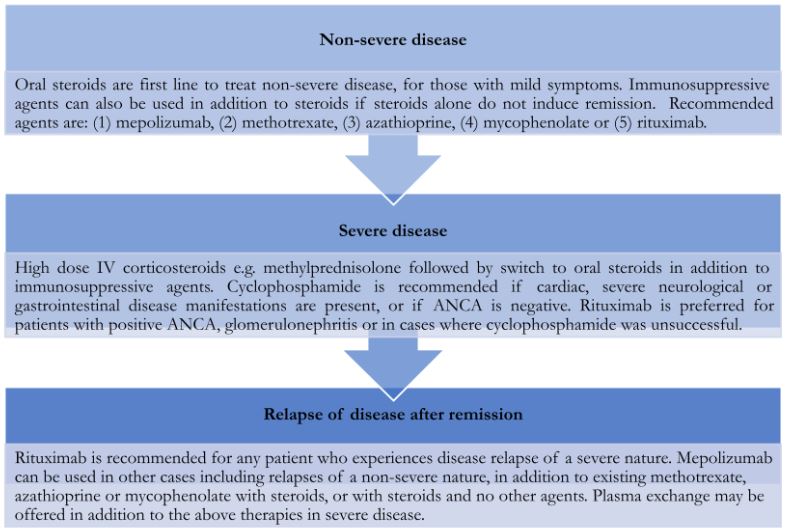
Adapted from: Keogh, K. (2022) Eosinophilic granulomatosis with polyangiitis (Churg-Strauss syndrome), Eosinophilic granulomatosis with polyangiitis (Churg-Strauss syndrome) – Symptoms, diagnosis and treatment | BMJ Best Practice. Available at: https://bestpractice.bmj.com/topics/en-gb/942 (Accessed: January 15, 2023).
Remission maintenance
For patients who required steroids alone to successfully induce remission, depending on their symptoms and clinical parameters, e.g., CRP, steroids can usually be gradually weaned down. This can take many months and will be guided by the clinical presentation when the dose is reviewed. Some patients may never be able to be fully weaned and require a lifelong low dose of steroids to keep symptoms under control. Some patients needing a maintenance dose may be offered immunosuppressive therapy too, to facilitate a lower maintenance steroid dose.
Any patient who needed an immunosuppressive agent alongside steroid therapy to successfully induce remission normally needs to continue this dual regime to maintain remission. The agent used to induce remission can normally be continued into maintenance unless it was rituximab. For this group of patients, it is recommended that for maintenance, they switch to methotrexate, azathioprine or mycophenolate instead – contraindications to any of these medications would need to be explored prior to deciding which would be recommended. Cyclophosphamide is not used for long-term maintenance due to toxicity issues; therefore, these patients should also switch to one of the three other agents mentioned above.
Immunosuppressive agents are typically continued for up to 18 months to maintain remission, although some patients need longer courses or indefinite immunosuppression if they have multiple relapses. Steroids can still be tapered as they would be if they were used as a monotherapy, guided by the patient’s symptoms and response.
Monitoring recommendations and other treatment considerations
These are the same as those for GPA, e.g., considering osteoporosis screening due to long-term steroid treatment exposure. As in GPA, methotrexate should not be given to those with an eGFR <60mL/min and is contraindicated in pregnancy.
References
- Berger, A. (2000) “Science commentary: Th1 and th2 responses: What are they? ” BMJ, 321(7258), pp. 424–424. Available at: https://doi.org/10.1136/bmj.321.7258.424.
- Chung, S.A. et al. (2021) “2021 American College of Rheumatology/Vasculitis Foundation guideline for the management of Antineutrophil cytoplasmic antibody–associated vasculitis,” Arthritis & Rheumatology, 73(8), pp. 1366–1383. Available at: https://doi.org/10.1002/art.41773.
- Gioffredi, A. et al. (2014) “Eosinophilic granulomatosis with polyangiitis: An overview,” Frontiers in Immunology, 5. Available at: https://doi.org/10.3389/fimmu.2014.00549.
- Keogh, K. (2022) Eosinophilic granulomatosis with polyangiitis (Churg-Strauss syndrome), Eosinophilic granulomatosis with polyangiitis (Churg-Strauss syndrome) – Symptoms, diagnosis and treatment | BMJ Best Practice. Available at: https://bestpractice.bmj.com/topics/en-gb/942 (Accessed: January 15, 2023).
- King Jr, T. (2022) Eosinophilic granulomatosis with polyangiitis (Churg-Strauss): Treatment and prognosis, UpToDate. Edited by K. Flaherty et al. UpToDate. Available at: https://www.uptodate.com/contents/eosinophilic-granulomatosis-with-polyangiitis-churg-strauss-treatment-and-prognosis?search=egpa&source=search_result&selectedTitle=2~143&usage_type=default&display_rank=2#H1409426116
Complete Guide to Clinical Genetics ST3 Application and Recruitment (2027)
Written by Medibuddy. Last updated: October 2026. Clinical Genetics is

Complete Guide to Clinical Radiology ST3 Application and Recruitment (2027)
Recruitment paused: NHS England is not running Clinical Radiology ST3+ recru

Complete Guide to Paediatric Surgery ST3 Application and Recruitment in United Kingdom (2026)
Written by Medibuddy. Last updated: October 2026. If you’re planning


Take your subscriptions with you
Our mobile app allows you to access your interview and exam question banks wherever you are.

