


 Close
Close
 17th January 2024
Management
As with GPA, steroids and immunosuppressive medications are the mainstay of treatment for EGPA. Similar to GPA management, the initial treatment offered also focuses on inducing remission and then maintaining it. The exact approach taken will depend on whether the patient’s disease is classed as severe (organ and/or life-threatening) or non-severe.
Remission induction
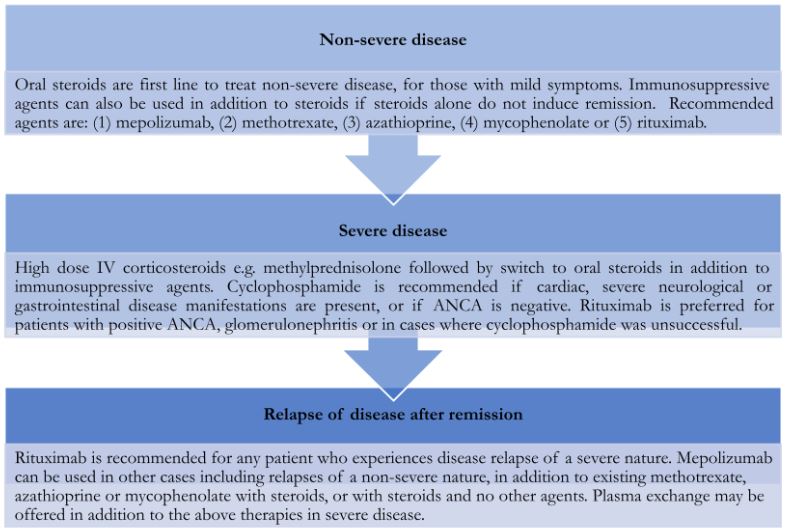
Adapted from: Keogh, K. (2022) Eosinophilic granulomatosis with polyangiitis (Churg-Strauss syndrome), Eosinophilic granulomatosis with polyangiitis (Churg-Strauss syndrome) – Symptoms, diagnosis and treatment | BMJ Best Practice. Available at: https://bestpractice.bmj.com/topics/en-gb/942 (Accessed: January 15, 2023).
Remission maintenance
For patients who required steroids alone to successfully induce remission, depending on their symptoms and clinical parameters, e.g., CRP, steroids can usually be gradually weaned down. This can take many months and will be guided by the clinical presentation when the dose is reviewed. Some patients may never be able to be fully weaned and require a lifelong low dose of steroids to keep symptoms under control. Some patients needing a maintenance dose may be offered immunosuppressive therapy too, to facilitate a lower maintenance steroid dose.
Any patient who needed an immunosuppressive agent alongside steroid therapy to successfully induce remission normally needs to continue this dual regime to maintain remission. The agent used to induce remission can normally be continued into maintenance unless it was rituximab. For this group of patients, it is recommended that for maintenance, they switch to methotrexate, azathioprine or mycophenolate instead – contraindications to any of these medications would need to be explored prior to deciding which would be recommended. Cyclophosphamide is not used for long-term maintenance due to toxicity issues; therefore, these patients should also switch to one of the three other agents mentioned above.
Immunosuppressive agents are typically continued for up to 18 months to maintain remission, although some patients need longer courses or indefinite immunosuppression if they have multiple relapses. Steroids can still be tapered as they would be if they were used as a monotherapy, guided by the patient’s symptoms and response.
Monitoring recommendations and other treatment considerations
These are the same as those for GPA, e.g., considering osteoporosis screening due to long-term steroid treatment exposure. As in GPA, methotrexate should not be given to those with an eGFR <60mL/min and is contraindicated in pregnancy.
Complete Guide to Clinical Genetics ST3 Application and Recruitment (2027)
Written by Medibuddy. Last updated: October 2026. Clinical Genetics is

Complete Guide to Clinical Radiology ST3 Application and Recruitment (2027)
Recruitment paused: NHS England is not running Clinical Radiology ST3+ recru

Complete Guide to Paediatric Surgery ST3 Application and Recruitment in United Kingdom (2026)
Written by Medibuddy. Last updated: October 2026. If you’re planning


Take your subscriptions with you
Our mobile app allows you to access your interview and exam question banks wherever you are.

