


 Close
Close
 16th January 2024
Granulomatosis with polyangiitis (GPA)
Background
Epidemiology
This rare condition was previously termed ‘Wegener’s disease’ and has also been referred to as necrotising respiratory granulomatosis. It is the most common of the above ANCA associated vasculitides, and the vasculitis involved affects small and medium-sized vessels. Incidence of GPA varies between countries, but in the UK, approximately 700 people are diagnosed with GPA annually. The condition is autoimmune in nature, with onset most commonly occurring in those aged between 40 and 60 years. It is rare for the condition to occur in children. People of any ethnicity or sex can develop GPA, although there is evidence the condition is more common in those of Caucasian descent.
References
- Comarmond, C. and Cacoub, P. (2014) “Granulomatosis with polyangiitis (Wegener): Clinical aspects and treatment,” Autoimmunity Reviews, 13(11), pp. 1121–1125. Available at: https://doi.org/10.1016/j.autrev.2014.08.017.
- Falk, R., Merkel, P. and King Jr, T. (2022) Granulomatosis with polyangiitis and microscopic polyangiitis: Clinical manifestations and diagnosis, UpToDate. Edited by R. Glassock et al. Available at: https://www.uptodate.com/contents/granulomatosis-with-polyangiitis-and-microscopic-polyangiitis-clinical-manifestations-and-diagnosis?search=gpa&source=search_result&selectedTitle=1~150&usage_type=default&display_rank=1 (Accessed: January 15, 2023).
- Kubaisi, B., Abu Samra, K. and Foster, C.S. (2016) “Granulomatosis with polyangiitis (Wegener’s disease): An updated review of Ocular disease manifestations,” Intractable & Rare Diseases Research, 5(2), pp. 61–69. Available at: https://doi.org/10.5582/irdr.2016.01014.
- Molloy, E. (2022) BMJ Best Practice Granulomatosis with polyangiitis. Available at: https://bestpractice.bmj.com/topics/en-gb/327/pdf/327/Granulomatosis%20with%20polyangiitis.pdf (Accessed: January 15, 2023).
- Pearce, F.A. et al. (2016) “The incidence, prevalence and mortality of granulomatosis with polyangiitis in the UK clinical practice research datalink,” Rheumatology [Preprint]. Available at: https://doi.org/10.1093/rheumatology/kew413.
- Qasim, A. and Patel, J. (2022) Anca positive vasculitis – statpearls – NCBI bookshelf, ANCA Positive Vasculitis. StatPearls. Available at: https://www.ncbi.nlm.nih.gov/books/NBK554372/ (Accessed: February 12, 2023).
Pathophysiology
The exact pathophysiology of GPA is unclear, although it has been suggested that exposure to an environmental agent, e.g., silica, or another agent such as infection, initiates excessive cytokine production, leading to granuloma formation, which can occlude vessels and cause necrosis. Alongside this, neutrophils are activated by ANCA, which release cellular products, resulting in vessel damage and inflammation. B cells are also thought to be involved in these processes. No immune complexes are deposited, which helps differentiate this condition from others with similar clinical presentations, e.g., Systemic Lupus Erythematosus (SLE).
Additionally, genetic factors may play a part in disease manifestation via association with genes such as HLA-DP and HLA-DQ. Currently, the condition is believed to be immune-mediated for a number of reasons. Firstly, it is associated with other immune-mediated conditions, and secondly, patients demonstrate good response to immunosuppressive treatment.
References
- Comarmond, C. and Cacoub, P. (2014) “Granulomatosis with polyangiitis (Wegener): Clinical aspects and treatment,” Autoimmunity Reviews, 13(11), pp. 1121–1125. Available at: https://doi.org/10.1016/j.autrev.2014.08.017.
- Kubaisi, B., Abu Samra, K. and Foster, C.S. (2016) “Granulomatosis with polyangiitis (Wegener’s disease): An updated review of Ocular disease manifestations,” Intractable & Rare Diseases Research, 5(2), pp. 61–69. Available at: https://doi.org/10.5582/irdr.2016.01014.
- Molloy, E. (2022) BMJ Best Practice Granulomatosis with polyangiitis. Available at: https://bestpractice.bmj.com/topics/en-gb/327/pdf/327/Granulomatosis%20with%20polyangiitis.pdf (Accessed: January 15, 2023).
- National Institute for Health and Care Excellence (NICE) (2021) Final scope for the appraisal of avacopan for treating anti-neutrophil cytoplasmic autoantibody- associated vasculitis [ID1581]. National Institute for Health and Care Excellence (NICE). Available at: https://www.nice.org.uk/guidance/ta825 (Accessed: January 15, 2023).
- National Organization for Rare Disorders (NORD) (2020) Granulomatosis with polyangiitis – national organisation for rare disorders, Granulomatosis with Polyangiitis. National Organization for Rare Disorders (NORD). Available at: https://rarediseases.org/rare-diseases/granulomatosis-with-polyangiitis/ (Accessed: January 15, 2023).
- Vasculitis UK (2019) Granulomatosis with polyangiitis (GPA), Vasculitis UK. Available at: https://www.vasculitis.org.uk/about-vasculitis/gpa-granulomatosis-with-polyangiitis (Accessed: January 15, 2023).
Presentation
As this condition demonstrates multi-organ system involvement, people may present with a wide variety of clinical symptoms and signs. Normally, at least two organ systems are involved at the time of diagnosis, with 90% of patients with GPA experiencing symptoms and signs indicating involvement of the respiratory tract consistent with diagnoses such as LRTI or pneumonia. The table below summarises the different systems that can be involved with some of the associated signs and symptoms that may be present.
| Affected organ/system | Symptoms | Signs |
|---|---|---|
| Eyes | Double vision, pain, blurry vision (as part of a presentation of scleritis or episcleritis) | Erythema, corneal ulcerations, reduced visual acuity, retinal haemorrhage. |
| Nervous system | Headaches, seizures (rare), altered limb sensation, e.g., burning. | Focal weakness, peripheral sensorimotor neuropathy on examination. |
| Upper respiratory tract (ear, nose, throat) | Ear and/or sinus pain, hearing loss, hoarse voice. | Epistaxis, nasal discharge, crusting, perforated tympanic membrane, saddle nose deformity. |
| Lower respiratory tract | Shortness of breath, cough, chest pain, haemoptysis (due to alveolar haemorrhage). | Stridor, wheeze, focal dullness and crackles on examination, reduced air entry on auscultation. |
| Skin | Pain/discomfort/itching over lesion sites. | Lower limb purpura, subcutaneous nodules, oral ulcers. |
| Musculoskeletal | Joint and muscle pain and/or stiffness. | Joint swelling and muscle weakness, signs of DVT. |
| Other | Fatigue, night sweats. | Fever, weight loss, asymptomatic haematuria (as part of a presentation of glomerulonephritis). |
Table 1: Summary table of the most common organs/systems affected in GPA, with associated signs and symptoms that can be seen in GPA. Adapted from: Falk, R., Merkel, P. and King Jr, T. (2022) Granulomatosis with polyangiitis and microscopic polyangiitis: Clinical manifestations and diagnosis, UpToDate. Edited by R. Glassock et al. Available at: https://www.uptodate.com/contents/granulomatosis-with-polyangiitis-and-microscopic-polyangiitis-clinical-manifestations-and-diagnosis?search=gpa&source=search_result&selectedTitle=1~150&usage_type=default&display_rank=1 (Accessed: January 15, 2023) and Molloy, E. (2022) BMJ Best Practice Granulomatosis with polyangiitis. Available at: https://bestpractice.bmj.com/topics/en-gb/327/pdf/327/Granulomatosis%20with%20polyangiitis.pdf (Accessed: January 15, 2023).
References
- Comarmond, C. and Cacoub, P. (2014) “Granulomatosis with polyangiitis (Wegener): Clinical aspects and treatment,” Autoimmunity Reviews, 13(11), pp. 1121–1125. Available at: https://doi.org/10.1016/j.autrev.2014.08.017.
- Falk, R., Merkel, P. and King Jr, T. (2022) Granulomatosis with polyangiitis and microscopic polyangiitis: Clinical manifestations and diagnosis, UpToDate. Edited by R. Glassock et al. Available at: https://www.uptodate.com/contents/granulomatosis-with-polyangiitis-and-microscopic-polyangiitis-clinical-manifestations-and-diagnosis?search=gpa&source=search_result&selectedTitle=1~150&usage_type=default&display_rank=1 (Accessed: January 15, 2023).
- Garlapati P, Qurie A. (2022) Granulomatosis with Polyangiitis. Available at: https://pubmed.ncbi.nlm.nih.gov/32491759/ (Accessed: January 15, 2023).
- Kubaisi, B., Abu Samra, K. and Foster, C.S. (2016) “Granulomatosis with polyangiitis (Wegener’s disease): An updated review of Ocular disease manifestations,” Intractable & Rare Diseases Research, 5(2), pp. 61–69. Available at: https://doi.org/10.5582/irdr.2016.01014.
- Molloy, E. (2022) BMJ Best Practice Granulomatosis with polyangiitis. Available at: https://bestpractice.bmj.com/topics/en-gb/327/pdf/327/Granulomatosis%20with%20polyangiitis.pdf (Accessed: January 15, 2023).
Diagnosis
Although GPA is a rare condition, it should be considered in any patient with atypical or persistent pneumonia. Several classification systems exist but were not intended for diagnostic use; therefore, they have not been included. The main investigations which should be performed as part of confirming a diagnosis are summarised below.
| Investigation | Findings in keeping with GPA |
|---|---|
| Urinalysis | Microscopic haematuria, proteinuria, and red blood cell casts can be seen in renal involvement. |
| Bloods | Normocytic normochromic anaemia can occur. Creatinine, CRP and/or ESR may be elevated, but serum albumin may be low. LFTs tend to be normal in GPA.
Up to 75% of patients with GPA are c-ANCA/PR3-ANCA positive on immunoassay testing, and in conjunction with typical symptoms and signs, this is usually sufficient for diagnosis. A negative result does not exclude GPA as a diagnosis, and ANCA negative patients can become positive over time. |
| Imaging | Chest CT has higher sensitivity than plain film; cavitating nodules, opacification (particularly alveolar) and pleural effusion may be seen. Depending on the clinical presentation, other area-specific imaging may also be required. |
| Biopsy of the affected organ | This is recommended where possible to ensure confirmation of diagnosis prior to treatment initiation. It is also useful in cases where patients are ANCA negative, but GPA remains suspected. Common sample sites are skin, kidney or lung. In positive cases, skin biopsy shows vasculitis in small skin vessels, kidney biopsy shows glomerulonephritis and occasionally granulomas, and lung biopsy shows granulomatous inflammation. |
Table 2: Summary of investigations used in diagnosis of GPA, with explanation of findings. Adapted from: Falk, R., Merkel, P. and King Jr, T. (2022) Granulomatosis with polyangiitis and microscopic polyangiitis: Clinical manifestations and diagnosis, UpToDate. Edited by R. Glassock et al. Available at: https://www.uptodate.com/contents/granulomatosis-with-polyangiitis-and-microscopic-polyangiitis-clinical-manifestations-and-diagnosis?search=gpa&source=search_result&selectedTitle=1~150&usage_type=default&display_rank=1 (Accessed: January 15, 2023) and Molloy, E. (2022) BMJ Best Practice Granulomatosis with polyangiitis. Available at: https://bestpractice.bmj.com/topics/en-gb/327/pdf/327/Granulomatosis%20with%20polyangiitis.pdf (Accessed: January 15, 2023).
Depending on the symptoms present, other investigations may be needed e.g., lung function or bronchoscopy may be needed to further explore signs like shortness of breath and haemoptysis, to rule out other conditions such as PE.
Moreover, a positive ANCA result on immunoassay can also occur in other disorders, e.g., IBD, infective endocarditis and malignancy. A careful history and examination are needed when considering GPA as a diagnosis, and if there is clinical suspicion of alternative disease/conditions, these should be excluded with further investigations if needed.
References
- Comarmond, C. and Cacoub, P. (2014) “Granulomatosis with polyangiitis (Wegener): Clinical aspects and treatment,” Autoimmunity Reviews, 13(11), pp. 1121–1125. Available at: https://doi.org/10.1016/j.autrev.2014.08.017.
- Falk, R., Merkel, P. and King Jr, T. (2022) Granulomatosis with polyangiitis and microscopic polyangiitis: Clinical manifestations and diagnosis, UpToDate. Edited by R. Glassock et al. Available at: https://www.uptodate.com/contents/granulomatosis-with-polyangiitis-and-microscopic-polyangiitis-clinical-manifestations-and-diagnosis?search=gpa&source=search_result&selectedTitle=1~150&usage_type=default&display_rank=1 (Accessed: January 15, 2023).
- Molloy, E. (2022) BMJ Best Practice Granulomatosis with polyangiitis. Available at: https://bestpractice.bmj.com/topics/en-gb/327/pdf/327/Granulomatosis%20with%20polyangiitis.pdf (Accessed: January 15, 2023).
- Qurratulain, Q., Ahmed, A. and Jones, Q. (2021) “Lesson of the Month: Severe granulomatosis with polyangiitis (GPA): A Diagnostic Challenge during the COVID-19 pandemic,” Clinical Medicine, 21(1), pp. 79–80. Available at: https://doi.org/10.7861/clinmed.2020-0793.
Differential diagnoses
A number of other conditions can present similarly to GPA. Some of these are summarised in the diagram below.
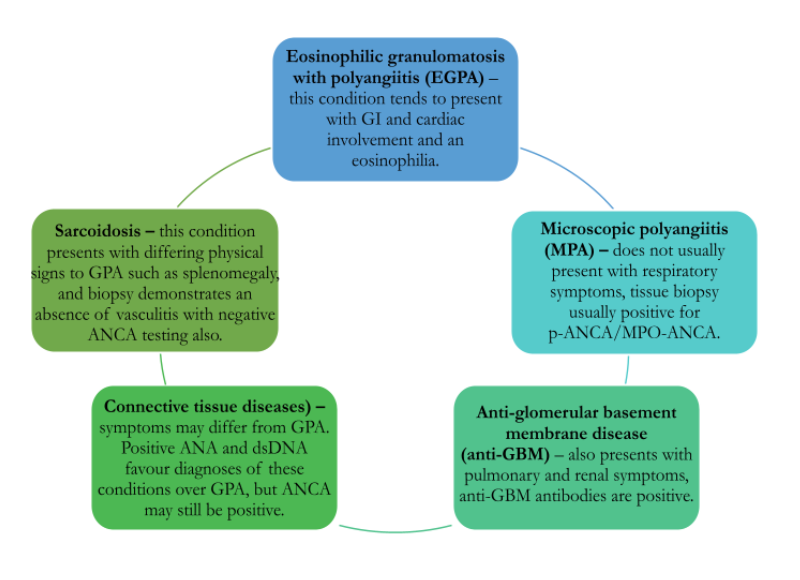
Adapted from: Falk, R., Merkel, P. and King Jr, T. (2022) Granulomatosis with polyangiitis and microscopic polyangiitis: Clinical manifestations and diagnosis, UpToDate. Edited by R. Glassock et al. Available at: https://www.uptodate.com/contents/granulomatosis-with-polyangiitis-and-microscopic-polyangiitis-clinical-manifestations-and-diagnosis?search=gpa&source=search_result&selectedTitle=1~150&usage_type=default&display_rank=1 (Accessed: January 15, 2023) and Molloy, E. (2022) BMJ Best Practice Granulomatosis with polyangiitis. Available at: https://bestpractice.bmj.com/topics/en-gb/327/pdf/327/Granulomatosis%20with%20polyangiitis.pdf (Accessed: January 15, 2023).
References
- Falk, R., Merkel, P. and King Jr, T. (2022) Granulomatosis with polyangiitis and microscopic polyangiitis: Clinical manifestations and diagnosis, UpToDate. Edited by R. Glassock et al. Available at: https://www.uptodate.com/contents/granulomatosis-with-polyangiitis-and-microscopic-polyangiitis-clinical-manifestations-and-diagnosis?search=gpa&source=search_result&selectedTitle=1~150&usage_type=default&display_rank=1 (Accessed: January 15, 2023).
- Molloy, E. (2022) BMJ Best Practice Granulomatosis with polyangiitis. Available at: https://bestpractice.bmj.com/topics/en-gb/327/pdf/327/Granulomatosis%20with%20polyangiitis.pdf (Accessed: January 15, 2023).
Management
Untreated GPA has a poor prognosis; therefore, it is vital a diagnosis is made quickly and treatment begun. The first stage of treatment focuses on achieving remission from the disease, and the second stage focuses on maintaining remission and preventing disease relapse.
It is recognised that during active disease, irreversible damage to various organs may have occurred and will remain regardless of treatment. Therefore, the goal of remission is instead to ensure resolution of symptoms and signs, accepting that some measured parameters may permanently remain abnormal or take significant time to improve. Any recurrence of clinical symptoms/signs would be deemed indicative of relapse, regardless of the organ affected.
Achieving remission
Several medications are required to induce remission for people with GPA, as monotherapy is usually ineffective. Steroids such as prednisolone plus further immunosuppressive medications are the mainstay of this stage of treatment. For severe disease, remission can take up to 6 months to achieve after treatment begins; if remission does not occur, an alternative medication regimen should be trialled.
The induction regime used depends on the status of disease: non-severe, severe or refractory to treatment. Non-severe disease is defined by no evidence of organ or life-threatening disease, e.g., lack of evidence of progressive neuropathy or active bleeding in any organ. Severe disease is defined as disease-causing an active threat to organs or life, e.g., pulmonary or GI haemorrhage, active glomerulonephritis, pericarditis, etc. Refractory disease is disease that has failed to effectively respond to an approved induction therapy regime. The induction regimes commonly used to achieve remission in GPA are detailed below.

Adapted from: Molloy, E. (2022) BMJ Best Practice Granulomatosis with polyangiitis. Available at: https://bestpractice.bmj.com/topics/en-gb/327/pdf/327/Granulomatosis%20with%20polyangiitis.pdf (Accessed: January 15, 2023) and Merkel, P., Kaplan, A. and Falk, R. (2022) Granulomatosis with polyangiitis and microscopic polyangiitis: Induction and maintenance therapy. Edited by G. Appel et al. Up To Date. Available at: https://www.uptodate.com/contents/granulomatosis-with-polyangiitis-and-microscopic-polyangiitis-induction-and-maintenance-therapy?search=gpa&source=search_result&selectedTitle=2~150&usage_type=default&display_rank=2 (Accessed: January 15, 2023).
Maintaining remission
Patients can be commenced on an appropriate maintenance therapy regime of immunotherapy agents, usually initially with steroids. The regime used will be decided on how successful and tolerated the medications used during the induction phase of treatment were.
Suitable medications to maintain remission are rituximab, methotrexate or azathioprine. IV cyclophosphamide is only used to induce remission, so patients on this medication will need to be switched to an alternative medication to maintain remission about 6 months after their last intravenous dose. If methotrexate was used to induce remission, it can be continued for maintenance as well. Mycophenolate is usually only commenced/continued for remission for those who cannot tolerate other immunosuppressive medications or those with resistant disease.
Duration of therapy needed can vary, and current evidence suggests maintenance treatment should be continued for at least 2 years after remission is achieved. If any disease relapse occurs, lifelong maintenance therapy is advised, even if only one has occurred. To treat a relapse, another remission induction regime will need to be commenced until the GPA is controlled again.
The steroids started during the induction period can be slowly weaned down if symptoms remain well controlled, but this must take place over a significant period of time. It is preferable for patients to remain on a low-dose maintenance steroid if needed to reduce risk of relapse if no contraindications to this are present and suitable monitoring can take place.
Monitoring recommendations
Full blood count, renal and liver function, plus inflammatory markers and urinalysis, should be tested to monitor for side effects from treatment and any evidence of recurring disease approximately every 3 months. Some of the potential conditions that can develop as a result of the above immunosuppressive medications and steroids are osteoporosis, bone marrow toxicity, renal failure and infection.
Other treatment considerations
All of the treatment agents discussed in this section have toxicity risks, especially cyclophosphamide, which can have a number of serious side effects, such as increased risk of bladder cancer. It is also known to contribute to infertility; therefore, for those wishing to preserve their fertility, rituximab should be offered instead in the induction phase of treatment. Any patient receiving rituximab or cyclophosphamide should also be commenced on pneumocystis jirovecii prophylactic medication to prevent pneumocystis jirovecii pneumonia (PCP). Patients on a daily steroid dose of 20 milligrams or more, alongside methotrexate, azathioprine or mycophenolate therapy, should also be considered for PCP prophylaxis.
Methotrexate should not be given to those with an eGFR <60mL/min and is contraindicated in pregnancy. Azathioprine could be a suitable alternative agent in these cases.
References
- Garlapati P, Qurie A. (2022) Granulomatosis with Polyangiitis. Available at: https://pubmed.ncbi.nlm.nih.gov/32491759/ (Accessed: January 15, 2023).
- Kubaisi, B., Abu Samra, K. and Foster, C.S. (2016) “Granulomatosis with polyangiitis (Wegener’s disease): An updated review of Ocular disease manifestations,” Intractable & Rare Diseases Research, 5(2), pp. 61–69. Available at: https://doi.org/10.5582/irdr.2016.01014.
- Merkel, P., Kaplan, A. and Falk, R. (2022) Granulomatosis with polyangiitis and microscopic polyangiitis: Induction and maintenance therapy. Edited by G. Appel et al. Up To Date. Available at: https://www.uptodate.com/contents/granulomatosis-with-polyangiitis-and-microscopic-polyangiitis-induction-and-maintenance-therapy?search=gpa&source=search_result&selectedTitle=2~150&usage_type=default&display_rank=2 (Accessed: January 15, 2023).
- Molloy, E. (2022) BMJ Best Practice Granulomatosis with polyangiitis. Available at: https://bestpractice.bmj.com/topics/en-gb/327/pdf/327/Granulomatosis%20with%20polyangiitis.pdf (Accessed: January 15, 2023).
Complete Guide to Clinical Genetics ST3 Application and Recruitment (2027)
Written by Medibuddy. Last updated: October 2026. Clinical Genetics is

Complete Guide to Clinical Radiology ST3 Application and Recruitment (2027)
Recruitment paused: NHS England is not running Clinical Radiology ST3+ recru

Complete Guide to Paediatric Surgery ST3 Application and Recruitment in United Kingdom (2026)
Written by Medibuddy. Last updated: October 2026. If you’re planning


Take your subscriptions with you
Our mobile app allows you to access your interview and exam question banks wherever you are.

