


 Close
Close
 24th February 2024
Mendelian inheritance
Complications in inheritance
Mendelian inheritance refers to the inheritance of genetic disorders predominantly through the inheritance of a single gene. This can be through the autosomal or sexual chromosomes, leading to the four main classes of inheritance: autosomal dominant, autosomal recessive, X-linked dominant and X-linked recessive.
Genetic inheritance can be complicated by several factors, making the pattern of inheritance less clear:
- Pleiotropy – A single gene mutation results in phenotypes affecting multiple organ systems. This can result in one gene mutation presenting as seemingly unrelated symptoms.
- Penetrance – The degree to which a genotype is expressed towards an individual’s phenotype, resulting in some carriers not displaying the mutation’s phenotype.
- Variable expressivity – The degree to which a phenotype is expressed for a given genotype, resulting in different severity of symptoms between patients with a similar genotype.
Autosomal dominant
Autosomal dominant traits can present themselves in individuals with the heterozygous genotype. A vertical pedigree will be observed, with most generations having at least one affected individual. Each affected individual will have one parent affected by the same condition. Male-to-male transmission is possible with equal incidence between males and females within the family tree. Each child will have a 1 in 2 chance of inheriting the mutation if one partner is unaffected by the condition.
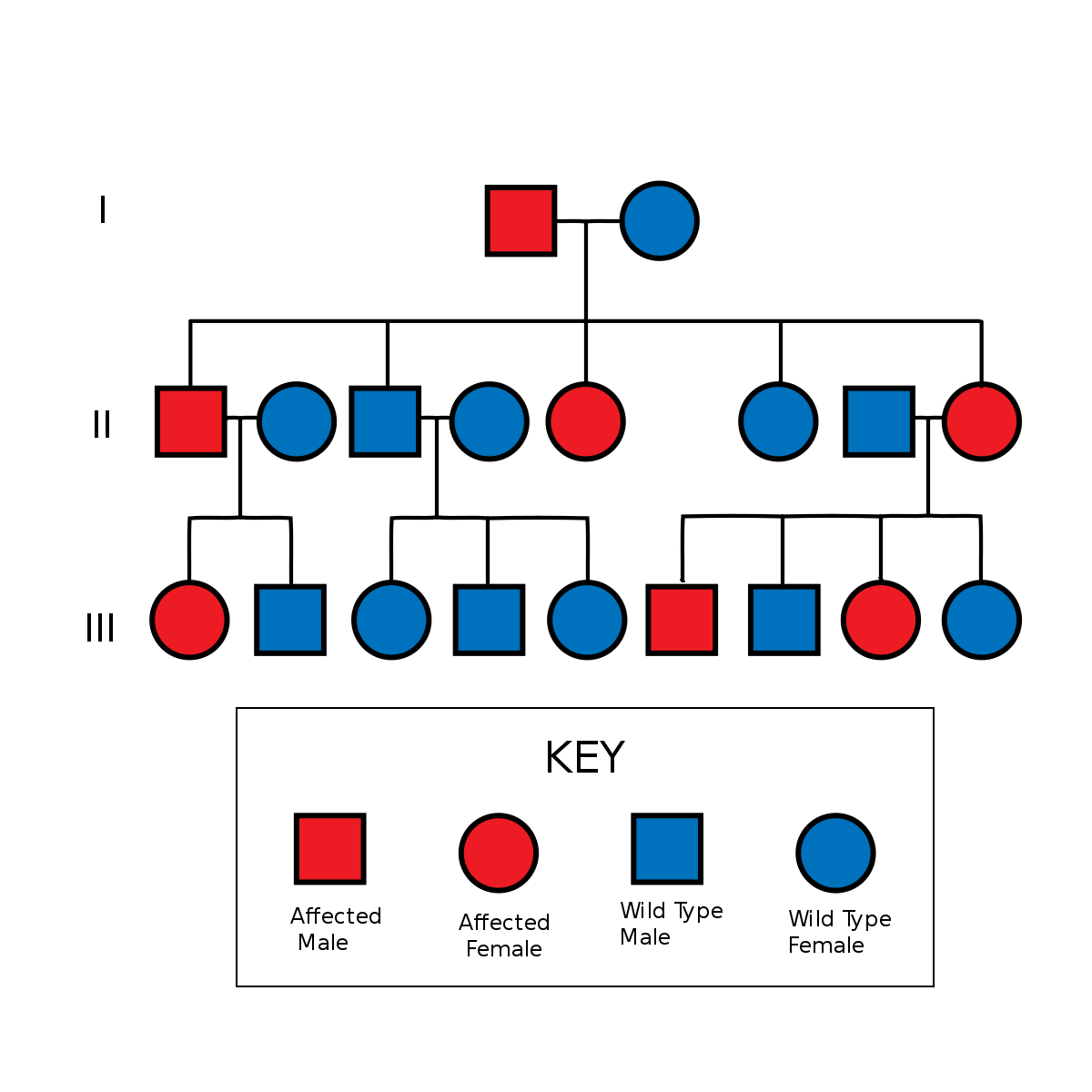 Image Source: Wikimedia Commons (2006). Autosomal Dominant Pedigree Chart, Licensed under a creative commons licence. Available for free at: https://commons.wikimedia.org/wiki/File:Autosomal_Dominant_Pedigree_Chart.svg (Accessed: 5 January 2024).
A homozygous autosomal dominant genotype is possible, and this typically presents with a more severe phenotype than the heterozygous genotype.
Autosomal recessive
Recessive traits only present themselves in the homozygous genotype. Heterozygote genotypes will typically not display the phenotype of the condition and will serve as carriers for the condition. In a typical pedigree, the parents of the affected patient will not show the phenotype of the condition. In addition, there will be equal incidence between male and female patients. The condition will typically present within a single-family unit without affecting other family units within the family tree. Heterozygote parents will have a 1 in 4 chance of having a child affected by the condition. A recessive condition can be amplified within a consanguineous relationship due to the higher chances of the recessive alleles pairing up.
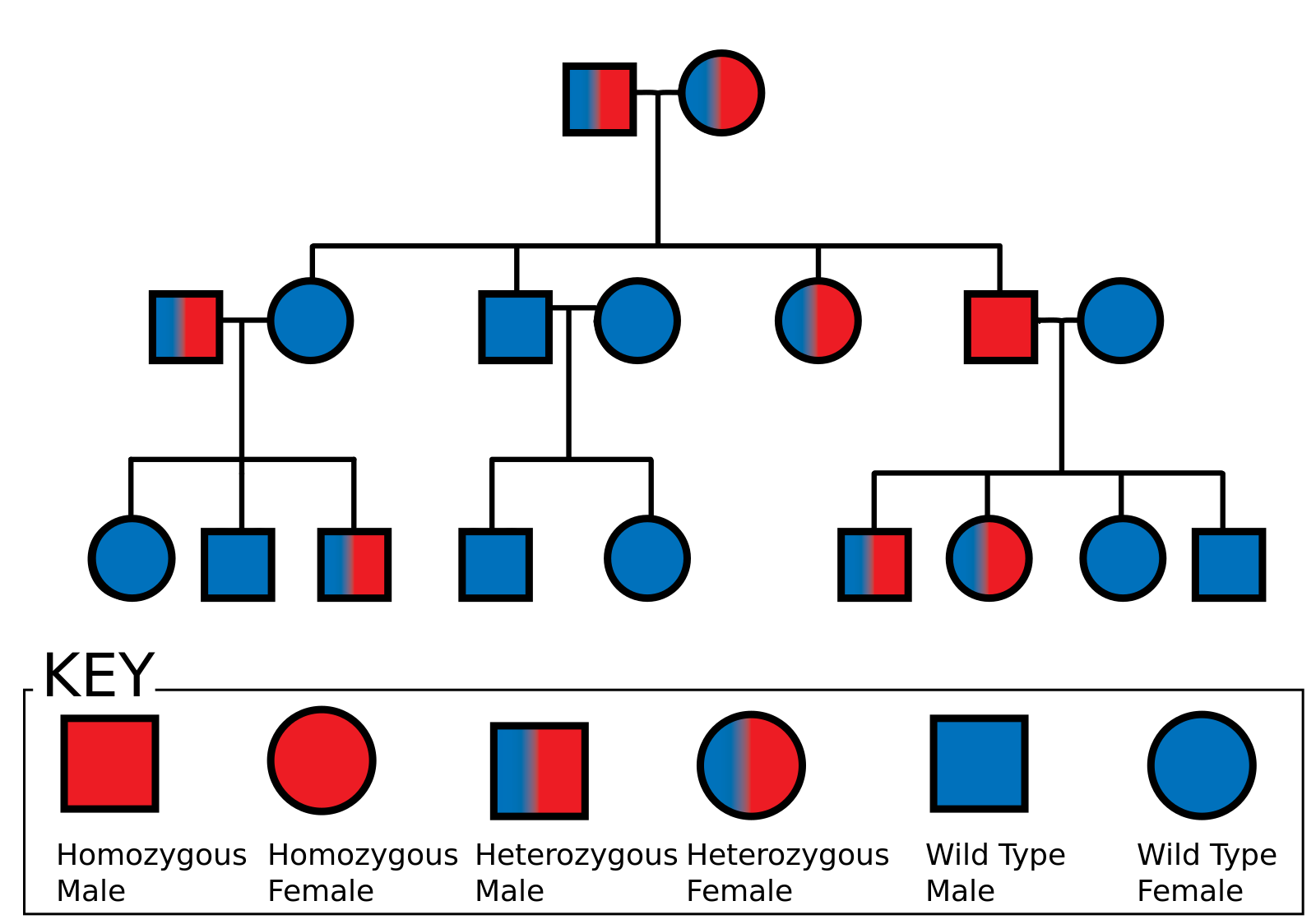
Image Source: Wikimedia Commons (2006). Autosomal Recessive Pedigree Chart, Licensed under a creative commons licence. Available for free at: https://commons.wikimedia.org/wiki/File:Autosomal_Recessive_Pedigree_Chart.svg (Accessed: 5 January 2024).
X-linked dominant
The sex chromosomes ( X and Y chromosomes) are the primary chromosomes that determine the sex of the developing embryo. Males only possess one copy of the X chromosome, while female somatic cells undergo the process of X-inactivation, creating mosaicism for the X-chromosome activity in females.
The X-linked dominant condition presents similarly to an autosomal dominant pedigree due to the heterozygote genotype being sufficient to produce the phenotype. Due to the impact of mosaicism, females will typically present with a milder phenotype. Males usually have a more severe phenotype with only one X chromosome copy, and some conditions may result in a lethal phenotype.
Affected males will not pass on their genotype to their male children, while all female children will be affected. Affected females will have a 50% chance of passing the condition to both male and female children.

Image Source: Wikimedia Commons (2019). Drawing – X-Linked Dominant (1), Licensed under a creative commons licence. Available for free at: https://commons.wikimedia.org/wiki/File:Wiki_Drawing_-_X- Linked_Dominant_(1).svg (Accessed: 5 January 2024).
X-linked recessive
X-linked recessive conditions are more commonly seen in males, with females often acting as carriers for the gene mutations. Males cannot pass on the mutation to their male children, but females will always act as carriers. A pedigree can show affected males in the generation above the index case. Female carriers will have a 50% chance of bearing a male affected by the condition or a female acting as a carrier for the condition.
Females can occasionally display the diseases’ phenotype through skewed X-inactivation ( X-inactivation favouring the expression of the mutant allele) or if they are homozygous for the mutant allele. Variable expressivity secondary to mosaicism, variable penetrance, and de novo mutations within X-linked mutations can result in an atypical pedigree, preventing the visualisation of a clear inheritance pattern.
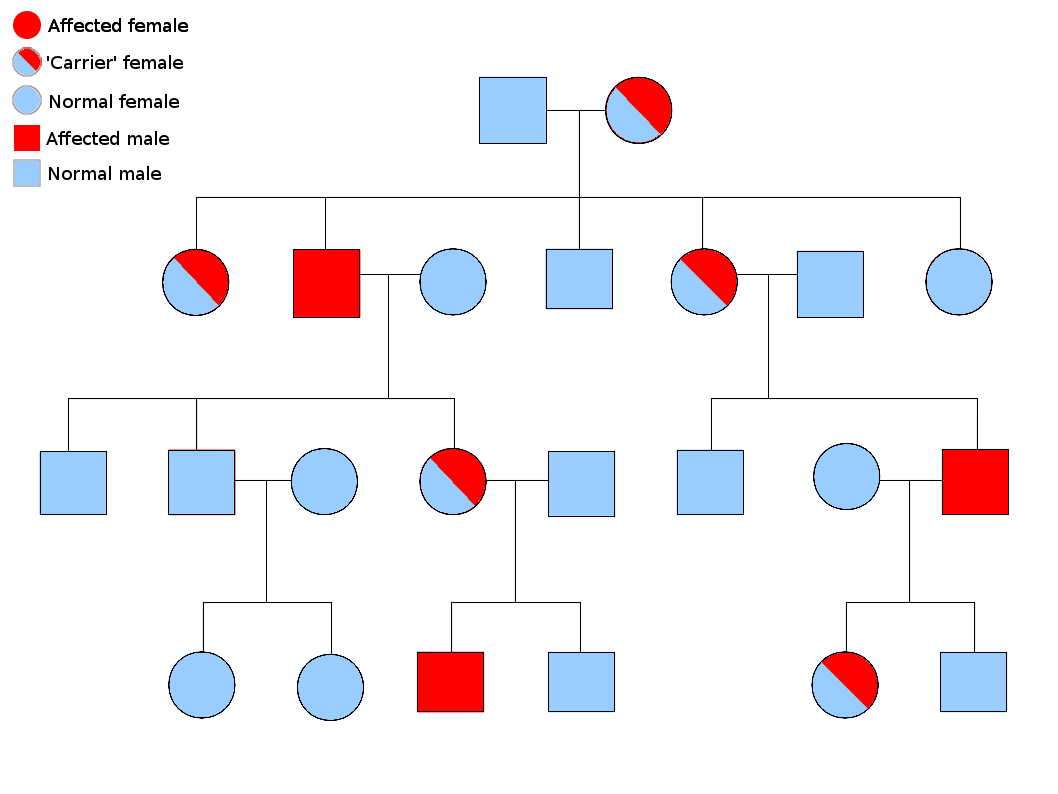 Image Source: Wikimedia Commons (2013). Sex linked inheritance, Licensed under a creative commons licence. Available for free at: https://commons.wikimedia.org/wiki/File:Sex_linked_inheritance.png (Accessed: 5 January 2024).
Mitochondrial
Mitochondrial disorders are unique due to mitochondrial DNA mutations acting as the driver for the phenotype. Mitochondrial DNA displays high mutation rates, and mutant mitochondria populations can vary between cells and tissues, resulting in significant variability in phenotypic expression between affected individuals.
Mitochondrial conditions typically show an exclusive maternal inheritance because embryonic mitochondria are derived from the ovum. Male and female children are equally affected. An affected male will not pass the condition to any children.
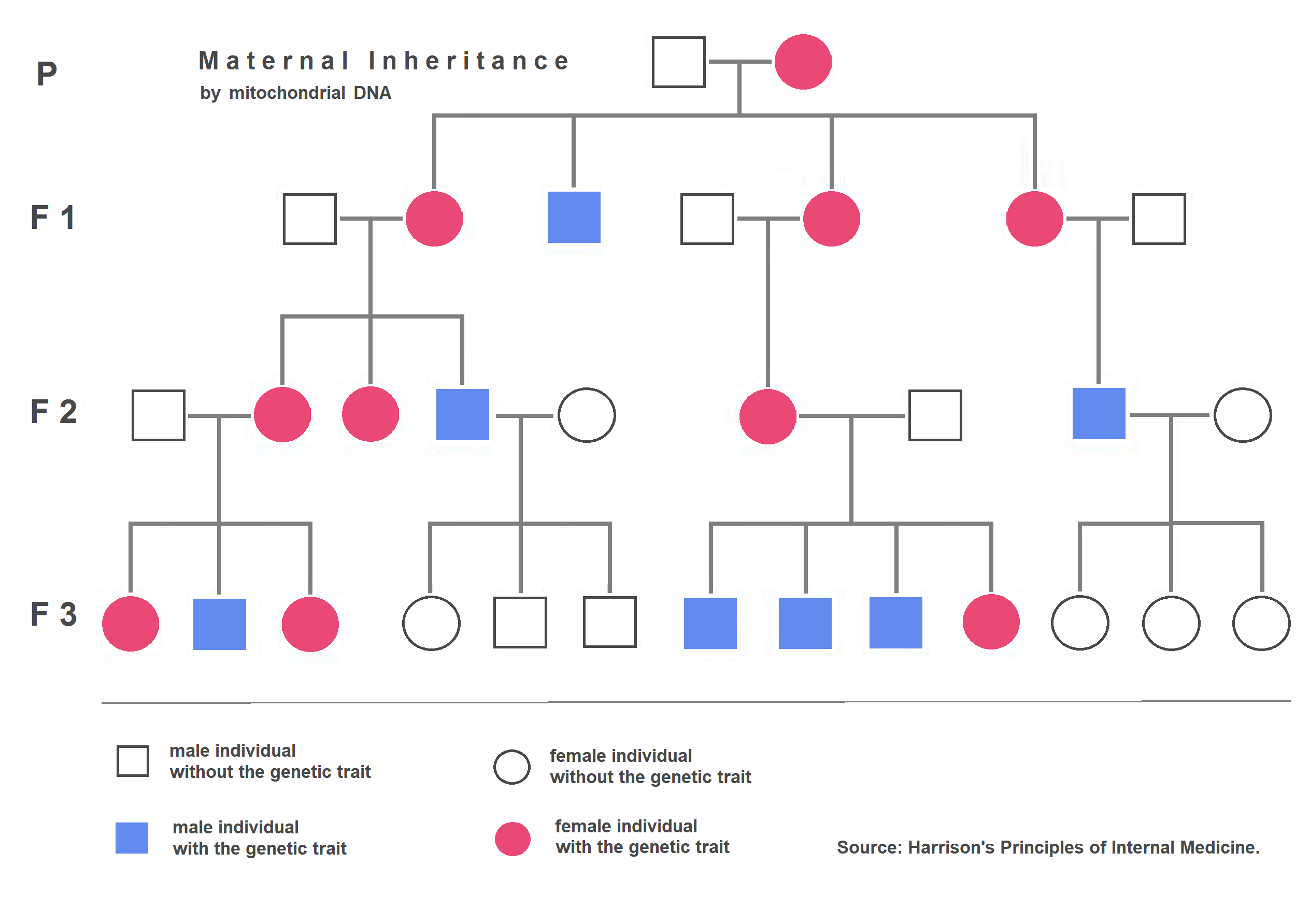 Image Source: Wikimedia Commons (2019). Maternal Inheritance – mitochondrial DNA, Licensed under a creative commons licence. Available for free at: https://upload.wikimedia.org/wikipedia/commons/7/76/Maternal_Inheritance_-_mitochondrial_DNA.png (Accessed: 5 January 2024).
References
- Turnpenny, P. D., & Ellard, S. (2017). Patterns of inheritance. In Emery’s Elements of Medical Genetics. China: Elsevier.
- Read, A., & Donnai, D. (2021). Chapter 1: What can we learn from family history? In New Clinical Genetics: A guide to genomic medicine (4th ed.). United Kingdom: Scoin Publishing Limited.
- Mensink, K. A., & Highsmith, W. E. (2009). Chapter 5 – Basic Concepts in Human Molecular Genetics. In W. B. Coleman & G. J. Tsongalis (Eds.), Molecular Pathology (pp. 89–107). San Diego: Academic Press.
- Jorde, L. B., Carey, J. C., & Bamshad, M. J. (2016). Chapter 4: Autosomal Dominant and Recessive Inheritance. In Medical Genetics (5th ed.). United States: Elsevier.
Complete Guide to Clinical Genetics ST3 Application and Recruitment (2027)
Written by Medibuddy. Last updated: October 2026. Clinical Genetics is

Complete Guide to Clinical Radiology ST3 Application and Recruitment (2027)
Recruitment paused: NHS England is not running Clinical Radiology ST3+ recru

Complete Guide to Paediatric Surgery ST3 Application and Recruitment in United Kingdom (2026)
Written by Medibuddy. Last updated: October 2026. If you’re planning


Take your subscriptions with you
Our mobile app allows you to access your interview and exam question banks wherever you are.

