


 Close
Close
 25th January 2024
Depression
It is defined as at least 2 weeks of low mood in conjunction with varied emotional, physical, behavioural, and cognitive symptoms. It can be classified as mild, moderate, or severe according to the nature and number of the associated symptoms, duration and the degree of functional and social impairment caused.
Depressive illness reduces the quality of life for those afflicted as well as their families and carers, in addition to increasing the morbidity and mortality of comorbid conditions such as diabetes mellitus and coronary heart disease. Depression also increases rates of self-injurious behaviour, substance misuse and social problems.
Suicide is the main cause of increased mortality in those affected.
More than 50% of those affected will recover within 6 months; however, recurrence rates are high and chronic depressive illness develops in up to 27% of patients.
Pathophysiology
The cause is unknown, but depression evolves from a complex interaction of biological, social, and psychological factors.
Factors that increase risk include:
- Chronic comorbidities (e.g., COPD, thyroid disorders)
- Medicines (e.g., corticosteroids, ß-blockers)
- Female sex
- Older age
- Recent childbirth
- Psychosocial issues (e.g., unemployment, bereavement, poverty, divorce)
- Personal or family history of depression
- Adverse early experiences (e.g., childhood physical abuse)
- Past head injury
Symptoms
The following have all been described as symptoms of depression:
| Core symptoms | Additional symptoms | Somatic symptoms |
|---|---|---|
|
|
|
Source: NICE. (2021). Depression | CKS | NICE. Retrieved July 6, 2022, from https://cks.nice.org.uk/topics/depression/
WHO. (2019). ICD-10 Version: 2019. In ICD-10 Version: 2019. Retrieved from https://icd.who.int/browse10/2019/en#/V
Definitions
- Subthreshold depressive symptoms: When a patient has some of the core symptoms, but their number or severity is insufficient to meet the criteria for full diagnosis.
- Persistent subthreshold depressive symptoms: previously known as dysthymia, the persistence of subthreshold symptoms for more than 2 years.
- Recurrent depressive disorder: repeated episodes of depression without a history of episodes of elation and increased energy (mania).
- Cyclothymia: a persistent instability of mood in which the patient experiences periods of mild depression and mild elation, which are not severe enough to be classed as bipolar affective disorder or recurrent depressive disorder.
- Atypical depression: involves abnormal symptoms such as weight gain, hyperphagia, hypersomnia, mood reactivity (improved mood upon exposure to positive stimuli), leaden paralysis (an unusually heavy feeling in the arms or legs), rejection sensitivity (feeling anxious and hyper-reactive to rejection or perceived rejection).
Severity grading
- Mild depression: at least 2 symptoms present; the patient is distressed by their symptoms but usually able to continue with activities
- Moderate depression: at least 4 symptoms present; the patient will have considerable difficulty continuing with activities
- Severe depression without psychotic symptoms: several marked, distressing symptoms present, often with somatic symptoms and/or suicidal ideation, without psychotic symptoms. The patient is often unable to continue normal activities
- Severe depression with psychotic symptoms: also termed psychotic depression; an episode of severe depression with symptoms of psychosis such as hallucinations, delusions, psychomotor retardation, or stupor
Diagnosis
Depression is diagnosed using the Diagnostic and Statistical Manual of Mental Disorders 5ᵗʰ edition (DSM-5) or International Classification of Diseases 10ᵗʰ revision (ICD-10) criteria.
In order to make a diagnosis, patients must have at least 1 core symptom that has been present most of the time, on most days of the week, for at least 2 weeks.
There are various validated measures to assess patients presenting with depressive symptoms; these include:
- Patient Health Questionnaire-9 (PHQ-9) (https://www.mdcalc.com/calc/1725/phq-9-patient-health-questionnaire-9)
- Hamilton Depression Rating Scale (HAM-D) (https://www.mdcalc.com/calc/10043/hamilton-depression-rating-scale-ham-d)
- Major Depression Index (MDI) (https://www.mdcalc.com/calc/1844/major-depression-index-mdi)
- DSM-5 Criteria for Major Depressive Disorder (https://www.mdcalc.com/calc/10195/dsm-5-criteria-major-depressive-disorder)
Investigations are not routinely indicated but may be necessary to exclude other causes of depression or conditions that are known to be associated with depression. Any of these may co-exist with depression, and the presence of one does not exclude the possibility of another.
Investigations
- Blood glucose
- Hyperglycaemia suggesting diabetes mellitus
- Urea, electrolytes & creatinine
- Normal values suggesting electrolyte imbalances
- Low eGFR, high creatinine suggesting renal dysfunction
- ESR & CPR
- Raised suggesting infection or inflammation
- Liver function
- LFTs suggestive of hepatic dysfunction
- High GGT suggesting high alcohol intake
- Thyroid function
- High T4 / low TSH indicating hyperthyroidism
- Low T4 / high TSH indicating hypothyroidism
- Calcium Levels
- Abnormal values indicative of hyper or hypocalcaemia
- Full blood count
- Low Hb indicating anaemia
- Urine drug screen
- Suggesting substance use/misuse
Differential diagnosis
- Anxiety disorders
- Can present with a wide range of physical and affective abnormalities, including fatigability, sleep disturbance, cognitive dysfunction, and unwanted thoughts.
- These may present with physical symptoms not seen in depression, such as panic attacks, cognitive distortions, and muscle tension.
- Neurological conditions (such as Parkinson’s disease, Multiple Sclerosis, dementia)
- Neurodegenerative and neurological diseases can be associated with affective symptoms, changes to behaviour and cognitive function, such as memory and attention. However, depression does not cause focal neurological signs, and the presence of these should alert to the possibility of other pathology.
- Substance misuse
- Pharmacologic agents can have physiological effects on mood and behaviour
- Substance abuse can often produce similar symptoms to depression, such as feelings of guilt or worthlessness, appetite changes, psychosis, and suicidal ideation
- The substance use should pre-date the depressive symptoms in order to diagnose substance-induced depression
- Diabetes mellitus
- Depression and diabetes share symptoms such as weight loss, fatigue, and low mood. However, the key difference is the blood glucose dysregulation defining diabetes.
- Chronic Obstructive Pulmonary Disorder
- Physiological abnormalities such as hypoxaemia and hypercapnia can present with similar symptoms to depression, such as lethargy, impaired concentration, and irritability.
- The presence of physiological changes in COPD, such as alterations to lung function, can help set the diagnoses apart.
- Hypothyroidism or hyperthyroidism
- Endocrine disorders can produce changes similar to depressive disorders, such as lethargy, weight changes, and mood disturbance. However, endocrine diseases have distinct laboratory abnormalities to help identify them.
- Obstructive Sleep Apnoea Syndrome
- Often produces feelings of fatigue, insomnia, cognitive deficits and decreased libido.
- This is more common among patients with obesity and can be diagnosed using the aid of polysomnography.
- Infectious and inflammatory disorders
- Many infectious and inflammatory disorders can produce neuropsychiatric signs and symptoms; however, they usually have other associated pathology that can be used to help identify them, such as sensory loss or biomarkers in the form of antibodies.
Always consider suicide and self-harm risk in patients with suspected depressive disorders.
Management
All patients should be provided information about the nature and course of their illness.
Important principles in the management of depressive illness include recognising that people have a right to decline treatment and that the most appropriate, least intrusive, and resource-intensive treatment should be tried first.
If capacious patients do not want an intervention, use a watchful waiting approach, offering a follow-up in 2 weeks.
The image below outlines the NICE recommendations for patients who want treatment based on illness severity. They are listed in order of the Committee’s interpretation of clinical and cost-effectiveness.
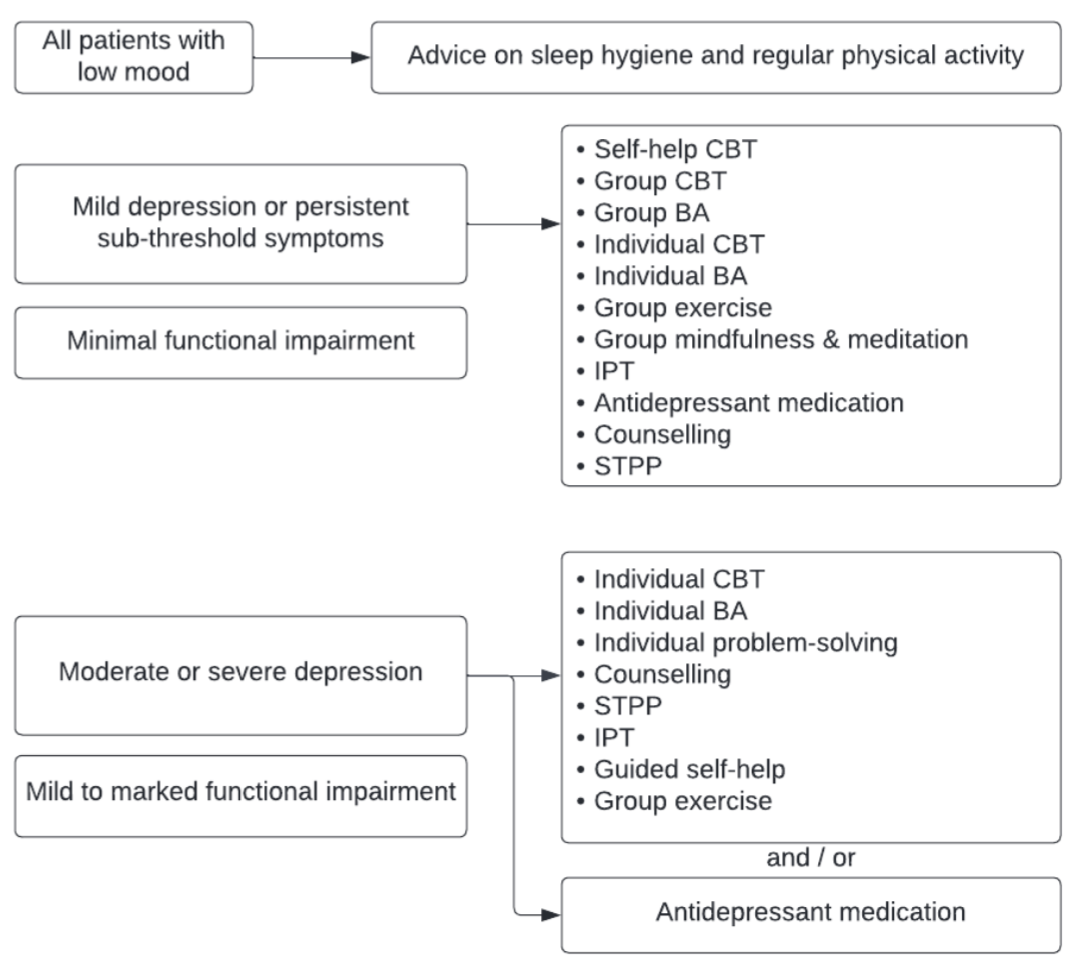
Source: Adapted from (NICE, 2022c)(NICE, 2022a)(NICE, 2022b)
CBT: Cognitive Behavioural Therapy
BA: Behavioural Activation
IPT: Interpersonal Psychotherapy
STPP: Short-term Psychodynamic Psychotherapy
For a full explanation of these therapies, see https://www.nice.org.uk/guidance/ng222/chapter/recommendations#more-severe-depression
References:
- NICE. (2022a). Depression in adults: discussing first-line treatments for less severe depression. NICE Guidance. NICE.
- NICE. (2022b). Depression in adults: treatment and management. Retrieved July 11, 2022, from https://www.nice.org.uk/guidance/ng222/chapter/Recommendations
- NICE. (2022c). Recommendations | Depression in adults. Retrieved July 4, 2022, from https://www.nice.org.uk/guidance/ng222/chapter/Recommendations#recognition-and-assessment
Anti-depressant medication
No antidepressant is recommended above all others, and drugs should be chosen judicially based on patient factors (such as comorbidities, suicide risk, current medications) and side-effect profiles. SSRIs are often first-line as they are often safer in overdose and better tolerated than other classes.
In general:
| Scenario | Consider |
|---|---|
| First episode depression | SSRI |
| Recurrent episode | An antidepressant with a previous good response |
| Aged ≤ 16 years | Fluoxetine |
| Recent MI | Sertraline |
Below is a list of common antidepressants and key considerations in their use. This list is not exhaustive.
| Class | Examples | Considerations |
|---|---|---|
| SSRIs
(Selective Serotonin Reuptake Inhibitors) |
Fluoxetine, Sertraline, Citalopram, Paroxetine |
|
| SNRIs
(Serotonin & Noradrenaline Reuptake Inhibitors) |
Venlafaxine, Duloxetine |
|
| NaSSAs
(Noradrenergic & Specific Serotonergic Antidepressants) |
Mirtazapine |
|
| TCAs
(Tricyclic Antidepressants) |
Amitriptyline, Imipramine, Clomipramine |
|
| MAOIs
(Monoamine Oxidase Inhibitors) |
Phenelzine, Selegiline |
|
References
- NICE. (2022b). Depression in adults: treatment and management. Retrieved July 11, 2022, from https://www.nice.org.uk/guidance/ng222/chapter/Recommendations
- NICE. (2021). Depression | CKS | NICE. Retrieved July 6, 2022, from https://cks.nice.org.uk/topics/depression/
- Pompili, M., Serafini, G., Innamorati, M., Ambrosi, E., Giordano, G., Girardi, P., … Lester, D. (2010). Antidepressants and Suicide Risk: A Comprehensive Overview. Pharmaceuticals, 3(9), 2861. https://doi.org/10.3390/PH3092861
- NICE. (n.d.). Antidepressant drugs | Treatment summaries. Retrieved July 4, 2022, from https://bnf.nice.org.uk/treatment-summaries/antidepressant-drugs/
Follow-up and treatment cessation
Initial review should occur 2 weeks after commencing medication unless there is an increased risk of self-harm or the patient is aged < 30 years, in which case they should be reviewed after 1 week. This is due to disturbances that may occur on initiation, such as over-stimulation, agitation, anxiety, psychosis, and increased impulsivity.
Regular reviews should then be scheduled every 2-4 weeks. To reduce the risk of relapse, the minimum recommended treatment duration is 6 months, but patients may safely continue treatment beyond this.
If no benefit is seen after 2 weeks, check adherence and consider increasing the dose, switching class of antidepressant, or adding psychological therapies.
Caution must be exercised when switching between antidepressants – specific guidance can be found in The Maudsley prescribing guidelines in psychiatry (authored by Taylor and Barnes, 2018).
Antidepressants should be reduced slowly over an average of 4 weeks to minimise discontinuation symptoms.
Discontinuation symptoms may include:
- Restlessness
- Problems sleeping
- Diaphoresis
- Abdominal symptoms
- Altered sensations (paraesthesia, electric shock feelings)
- Altered mood (irritability, anxiety, confusion)
- Headache
Discontinuation symptoms tend to start within a few days of treatment cessation and are self-limiting, resolving within 2 weeks in most cases.
If depression is treatment-resistant, Electroconvulsive Therapy (ECT) or lithium augmentation may be considered.
Electroconvulsive Therapy
ECT is a therapy in which generalised seizure activity is induced by an electric current passed through the patient’s brain via scalp electrodes. The patient is placed under general anaesthesia and is given muscle relaxants to prevent muscle spasms.
Risks include retrograde and anterograde amnesia, status epilepticus, laryngospasm, and headache.
Most patients will undertake a course of twice-weekly sessions for 6 weeks.
ECT should only be used to achieve rapid improvement in severe symptoms after other treatment options have failed or when the condition is considered life-threatening.
Situations in which ECT may be used:
- Treatment-resistant depression
- Life-threatening depression
- Catatonia
- Prolonged or severe manic episodes
- Psychotic depression
References
- Davidson, J. R. T., Miller, R. D., Turnbull, C. D., & Sullivan, J. L. (2006). Atypical Depression. Archives of General Psychiatry, 39(5), 527–534. https://doi.org/10.1001/archpsyc.1982.04290050015005
- NICE. (n.d.). Antidepressant drugs | Treatment summaries. Retrieved July 4, 2022, from https://bnf.nice.org.uk/treatment-summaries/antidepressant-drugs/
- NICE. (2021). Depression | CKS | NICE. Retrieved July 6, 2022, from https://cks.nice.org.uk/topics/depression/
- NICE. (2022). Depression in adults: discussing first-line treatments for more severe depression. NICE Guidance. NICE.
- NICE. (2022). Depression in adults: treatment and management. Retrieved July 11, 2022, from https://www.nice.org.uk/guidance/ng222/chapter/Recommendations
- NICE. (2009). Guidance on the use of electroconvulsive therapy. NICE. Retrieved from https://www.nice.org.uk/guidance/ta59/chapter/1-Guidance
- NICE. (2022). Recommendations | Depression in adults. Retrieved July 4, 2022, from https://www.nice.org.uk/guidance/ng222/chapter/Recommendations#recognition-and-assessment
- Pompili, M., Serafini, G., Innamorati, M., Ambrosi, E., Giordano, G., Girardi, P., … Lester, D. (2010). Antidepressants and Suicide Risk: A Comprehensive Overview. Pharmaceuticals, 3(9), 2861. https://doi.org/10.3390/PH3092861
- WHO. (2019). ICD-10 Version: 2019. In ICD-10 Version: 2019. Retrieved from https://icd.who.int/browse10/2019/en#/V
Complete Guide to Clinical Genetics ST3 Application and Recruitment (2027)
Written by Medibuddy. Last updated: October 2026. Clinical Genetics is

Complete Guide to Clinical Radiology ST3 Application and Recruitment (2027)
Recruitment paused: NHS England is not running Clinical Radiology ST3+ recru

Complete Guide to Paediatric Surgery ST3 Application and Recruitment in United Kingdom (2026)
Written by Medibuddy. Last updated: October 2026. If you’re planning


Take your subscriptions with you
Our mobile app allows you to access your interview and exam question banks wherever you are.

