


 Close
Close
 26th January 2024
Management
All patients should be provided information about the nature and course of their illness.
Important principles in the management of depressive illness include recognising that people have a right to decline treatment and that the most appropriate, least intrusive, and resource-intensive treatment should be tried first.
If capacious patients do not want an intervention, use a watchful waiting approach, offering a follow-up in 2 weeks.
The image below outlines the NICE recommendations for patients who want treatment based on illness severity. They are listed in order of the Committee’s interpretation of clinical and cost-effectiveness.
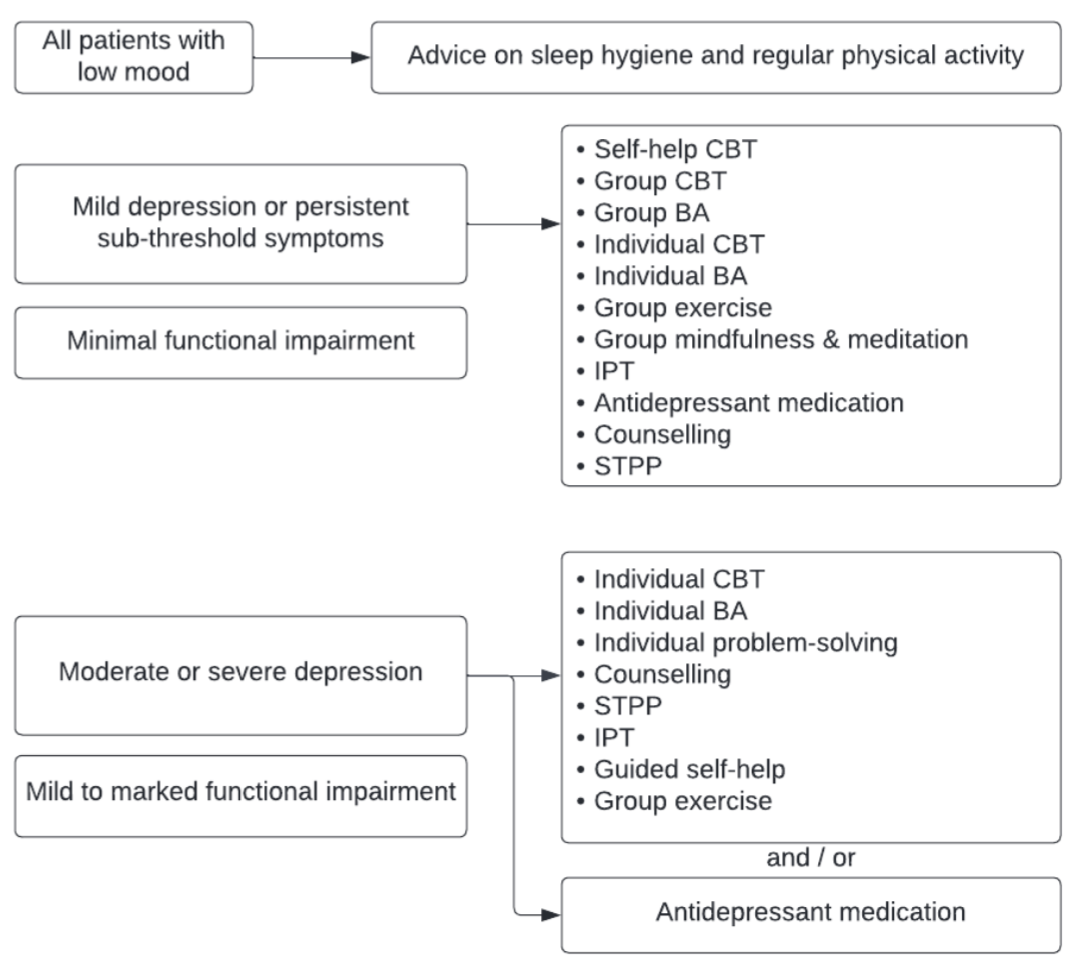
Source: Adapted from (NICE, 2022c)(NICE, 2022a)(NICE, 2022b)
CBT: Cognitive Behavioural Therapy
BA: Behavioural Activation
IPT: Interpersonal Psychotherapy
STPP: Short-term Psychodynamic Psychotherapy
For a full explanation of these therapies, see https://www.nice.org.uk/guidance/ng222/chapter/recommendations#more-severe-depression
References:
- NICE. (2022a). Depression in adults: discussing first-line treatments for less severe depression. NICE Guidance. NICE.
- NICE. (2022b). Depression in adults: treatment and management. Retrieved July 11, 2022, from https://www.nice.org.uk/guidance/ng222/chapter/Recommendations
- NICE. (2022c). Recommendations | Depression in adults. Retrieved July 4, 2022, from https://www.nice.org.uk/guidance/ng222/chapter/Recommendations#recognition-and-assessment
Anti-depressant medication
No antidepressant is recommended above all others, and drugs should be chosen judicially based on patient factors (such as comorbidities, suicide risk, current medications) and side-effect profiles. SSRIs are often first-line as they are often safer in overdose and better tolerated than other classes.
In general:
| Scenario | Consider |
|---|---|
| First episode depression | SSRI |
| Recurrent episode | An antidepressant with a previous good response |
| Aged ≤ 16 years | Fluoxetine |
| Recent MI | Sertraline |
Below is a list of common antidepressants and key considerations in their use. This list is not exhaustive.
| Class | Examples | Considerations |
|---|---|---|
| SSRIs
(Selective Serotonin Reuptake Inhibitors) |
Fluoxetine, Sertraline, Citalopram, Paroxetine |
|
| SNRIs
(Serotonin & Noradrenaline Reuptake Inhibitors) |
Venlafaxine, Duloxetine |
|
| NaSSAs
(Noradrenergic & Specific Serotonergic Antidepressants) |
Mirtazapine |
|
| TCAs
(Tricyclic Antidepressants) |
Amitriptyline, Imipramine, Clomipramine |
|
| MAOIs
(Monoamine Oxidase Inhibitors) |
Phenelzine, Selegiline |
|
References
- NICE. (2022b). Depression in adults: treatment and management. Retrieved July 11, 2022, from https://www.nice.org.uk/guidance/ng222/chapter/Recommendations
- NICE. (2021). Depression | CKS | NICE. Retrieved July 6, 2022, from https://cks.nice.org.uk/topics/depression/
- Pompili, M., Serafini, G., Innamorati, M., Ambrosi, E., Giordano, G., Girardi, P., … Lester, D. (2010). Antidepressants and Suicide Risk: A Comprehensive Overview. Pharmaceuticals, 3(9), 2861. https://doi.org/10.3390/PH3092861
- NICE. (n.d.). Antidepressant drugs | Treatment summaries. Retrieved July 4, 2022, from https://bnf.nice.org.uk/treatment-summaries/antidepressant-drugs/
Follow-up and treatment cessation
Initial review should occur 2 weeks after commencing medication unless there is an increased risk of self-harm or the patient is aged < 30 years, in which case they should be reviewed after 1 week. This is due to disturbances that may occur on initiation, such as over-stimulation, agitation, anxiety, psychosis, and increased impulsivity.
Regular reviews should then be scheduled every 2-4 weeks. To reduce the risk of relapse, the minimum recommended treatment duration is 6 months, but patients may safely continue treatment beyond this.
If no benefit is seen after 2 weeks, check adherence and consider increasing the dose, switching class of antidepressant, or adding psychological therapies.
Caution must be exercised when switching between antidepressants – specific guidance can be found in The Maudsley prescribing guidelines in psychiatry (authored by Taylor and Barnes, 2018).
Antidepressants should be reduced slowly over an average of 4 weeks to minimise discontinuation symptoms.
Discontinuation symptoms may include:
- Restlessness
- Problems sleeping
- Diaphoresis
- Abdominal symptoms
- Altered sensations (paraesthesia, electric shock feelings)
- Altered mood (irritability, anxiety, confusion)
- Headache
Discontinuation symptoms tend to start within a few days of treatment cessation and are self-limiting, resolving within 2 weeks in most cases.
If depression is treatment-resistant, Electroconvulsive Therapy (ECT) or lithium augmentation may be considered.
Electroconvulsive Therapy
ECT is a therapy in which generalised seizure activity is induced by an electric current passed through the patient’s brain via scalp electrodes. The patient is placed under general anaesthesia and is given muscle relaxants to prevent muscle spasms.
Risks include retrograde and anterograde amnesia, status epilepticus, laryngospasm, and headache.
Most patients will undertake a course of twice-weekly sessions for 6 weeks.
ECT should only be used to achieve rapid improvement in severe symptoms after other treatment options have failed or when the condition is considered life-threatening.
Situations in which ECT may be used:
- Treatment-resistant depression
- Life-threatening depression
- Catatonia
- Prolonged or severe manic episodes
- Psychotic depression
References
- Davidson, J. R. T., Miller, R. D., Turnbull, C. D., & Sullivan, J. L. (2006). Atypical Depression. Archives of General Psychiatry, 39(5), 527–534. https://doi.org/10.1001/archpsyc.1982.04290050015005
- NICE. (n.d.). Antidepressant drugs | Treatment summaries. Retrieved July 4, 2022, from https://bnf.nice.org.uk/treatment-summaries/antidepressant-drugs/
- NICE. (2021). Depression | CKS | NICE. Retrieved July 6, 2022, from https://cks.nice.org.uk/topics/depression/
- NICE. (2022). Depression in adults: discussing first-line treatments for more severe depression. NICE Guidance. NICE.
- NICE. (2022). Depression in adults: treatment and management. Retrieved July 11, 2022, from https://www.nice.org.uk/guidance/ng222/chapter/Recommendations
- NICE. (2009). Guidance on the use of electroconvulsive therapy. NICE. Retrieved from https://www.nice.org.uk/guidance/ta59/chapter/1-Guidance
- NICE. (2022). Recommendations | Depression in adults. Retrieved July 4, 2022, from https://www.nice.org.uk/guidance/ng222/chapter/Recommendations#recognition-and-assessment
- Pompili, M., Serafini, G., Innamorati, M., Ambrosi, E., Giordano, G., Girardi, P., … Lester, D. (2010). Antidepressants and Suicide Risk: A Comprehensive Overview. Pharmaceuticals, 3(9), 2861. https://doi.org/10.3390/PH3092861
- WHO. (2019). ICD-10 Version: 2019. In ICD-10 Version: 2019. Retrieved from https://icd.who.int/browse10/2019/en#/V
Complete Guide to Clinical Genetics ST3 Application and Recruitment (2027)
Written by Medibuddy. Last updated: October 2026. Clinical Genetics is

Complete Guide to Clinical Radiology ST3 Application and Recruitment (2027)
Recruitment paused: NHS England is not running Clinical Radiology ST3+ recru

Complete Guide to Paediatric Surgery ST3 Application and Recruitment in United Kingdom (2026)
Written by Medibuddy. Last updated: October 2026. If you’re planning


Take your subscriptions with you
Our mobile app allows you to access your interview and exam question banks wherever you are.

