


 Close
Close
 26th January 2024
Presentation
Background
There is large variability in clinical presentation of OA between individuals and different joints affected in the same person. The diagnosis of OA is largely clinical and can be made in patients with suggestive features without the need for further investigations. The most common symptoms are joint pain and stiffness, although patients often present with functional impairment. The knees, hips and small joints of the hands, namely the proximal interphalangeal (PIP) and distal interphalangeal (DIP) joints, and the spine (particularly lumbar and cervical regions) are most commonly affected. OA is an unlikely diagnosis in patients with ankle or wrist symptoms, and other differentials should be considered.
Symptoms
- Joint pain:
- Exacerbated by activity/weight-bearing
- Relieved by rest (except in advanced disease where rest and night pain can occur)
- Typically, only one or a few joints are affected at any given point
- Develops over months or years
- Joint stiffness:
- Occurs usually in the morning for less than 30 minutes or after rest
- Typically resolves in a few minutes with motion of the joint
- Functional impairment
Signs
- Bony swelling and joint deformity (due to osteophytes)
- Joint effusion (can occur in the knee)
- Reduced range of movement in the joint
- Pain at extremes of joint movement
- Tenderness/warmth around the joint
- Joint instability
- Muscle weakness or wasting around affected joint
- Crepitus – grating/crunching sound, commonly felt on passive or active movement of joint, caused by friction between bone and cartilage
- Absence of systemic features, e.g. rash, fever
The specific presentation of OA depends on the affected joint, and a detailed history and examination can reveal the following features:
| Hand OA | |
|---|---|
| History | Examination |
| Pain can radiate towards the thumb or wrist and distal forearm. Often exacerbated by strong grip | Typically affects the first carpometacarpal (CMC) joint at the base of the thumb, the DIP joints and the PIP joints |
| Reduced grip or pinch strength, which can cause difficulties with tasks such as opening jars, turning keys, fastening buttons, writing, etc | Fixed flexion deformity of CMC joint, with hyperextension of the distal joints |
| Wasting of thenar muscles | |
| Heberden’s nodes: bony nodules on the DIP joints
Bouchard’s nodes: bony nodules on the PIP joints |
|
| Pain/warmth/redness/swelling of affected joints | |
| Ulnar or radial deviation at affected joints | |
| Painful mucous-filled cysts on the dorsum of the finger | |
| “Squaring” at the base of the thumb caused by partial dislocation of CMC joint | |
Table 1: Possible clinical features of hand osteoarthritis
Adapted from: National Institute for Health and Care Excellence (NICE) Clinical Knowledge Summaries: Osteoarthritis [Internet]. Cks.nice.org.uk. 2021 [cited 12 August 2022]. Available from: https://cks.nice.org.uk/topics/osteoarthritis/diagnosis/diagnosis/

Image Source: Wikimedia Commons (2006). Heberden-Arthrose, Licensed under a creative commons licence. Available for free at: https://commons.wikimedia.org/wiki/File:Heberden-Arthrose.JPG#globalusage (Accessed: 24 June 2021).
| Hip OA | |
|---|---|
| History | Examination |
| Pain felt in the groin and anterior/lateral thigh. Can also be referred to the knee or the testicle on the affected side in males | Painful restriction of internal rotation with hip flexed |
| Difficulty walking, climbing stairs, driving, painful sexual intercourse | Antalgic gait
Trendelenburg gait in advanced disease – towards affected hip with reduced time weight-bearing on that side; pelvis tilting down on unaffected side due to wasting and weakness of gluteal and anterior thigh muscles |
| Shortening of the lower limb | |
Table 2: Possible clinical features of hip osteoarthritis
Adapted from: National Institute for Health and Care Excellence (NICE) Clinical Knowledge Summaries: Osteoarthritis [Internet]. Cks.nice.org.uk. 2021 [cited 12 August 2022]. Available from: https://cks.nice.org.uk/topics/osteoarthritis/diagnosis/diagnosis/
| Knee OA | |
|---|---|
| History | Examination |
| Usually, bilateral pain, felt in and around the knee. Unilateral symptoms usually secondary to pre-existing trauma or disease | Varus (bow-legged) or valgus (knock-knee) deformities |
| Difficulty walking, particularly when going down the stairs if patellofemoral involvement | Locking (inability to straighten knee due to loose meniscal cartilage in the joint |
| Progressive pain on sitting, relieved by standing | Crepitus or joint line tenderness |
| Sensation of knee ‘giving way’ due to weak quadriceps and altered load-bearing | Small to moderate effusions |
| Bony swelling around knee in advanced disease | |
| Antalgic gait – towards affected hip with reduced time weight-bearing on that side; pelvis is in neutral position | |
Table 3: Possible clinical features of knee osteoarthritis
Adapted from: National Institute for Health and Care Excellence (NICE) Clinical Knowledge Summaries: Osteoarthritis [Internet]. Cks.nice.org.uk. 2021 [cited 12 August 2022]. Available from: https://cks.nice.org.uk/topics/osteoarthritis/diagnosis/diagnosis/
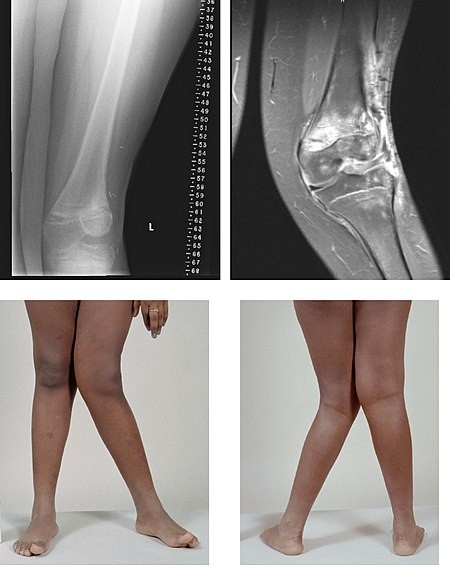
Image Source: Wikimedia Commons (2007). Valgus, Licensed under a creative commons licence. Available for free at: https://commons.wikimedia.org/wiki/File:Valgus.jpg (Accessed: 24 June 2021).
References
- Conaghan PG, Dickson J, Grant RL. Care and management of osteoarthritis in adults: summary of NICE guidance. Bmj. 2008 Feb 28;336(7642):502-3.
- National Institute for Health and Care Excellence (Great Britain).Osteoarthritis: care and management. National Institute for Health and Care Excellence (NICE); 2014
- Arden N, Blanco F, Cooper C, Guermazi A, Hayashi D, Hunter D, Javaid MK, Rannou F, Roemer F, Reginster JY. Atlas of osteoarthritis. Springer Healthcare Limited; 2014.
- Osteoarthritis | Health topics A to Z | CKS | NICE [Internet]. Cks.nice.org.uk. 2021 [cited 12 August 2022]. Available from: https://cks.nice.org.uk/topics/osteoarthritis/diagnosis/diagnosis/
Complete Guide to Clinical Genetics ST3 Application and Recruitment (2027)
Written by Medibuddy. Last updated: October 2026. Clinical Genetics is

Complete Guide to Clinical Radiology ST3 Application and Recruitment (2027)
Recruitment paused: NHS England is not running Clinical Radiology ST3+ recru

Complete Guide to Paediatric Surgery ST3 Application and Recruitment in United Kingdom (2026)
Written by Medibuddy. Last updated: October 2026. If you’re planning


Take your subscriptions with you
Our mobile app allows you to access your interview and exam question banks wherever you are.

