


 Close
Close
 7th January 2024
Background
Introduction
Pain is a very common symptom associated with a range of conditions. Across cancer as a whole, 75% of patients will experience pain; 1/3 have one pain, 1/3 have two pains, and 1/3 have three or more pains. Knowing about pain management will not only help you in the exam – being confident in this will help in clinical practice.
This will focus on management of pain in the palliative care setting as distinct from management of acute pain and chronic pain conditions such as Fibromyalgia. Although this mainly focuses on management of cancer pain, it is worth acknowledging that palliative care physicians increasingly work in the non-malignant setting. Many of the principles will be applicable across both settings.
Pain physiology
Nociceptive pain
This is a physiological process resulting from a painful stimulus. Nociceptors are the pain receptors within the body which can be activated by damage, temperature, or chemicals released from inflamed and injured tissue. These are carried quickly in type A and slowly in type C axons to the dorsal horn, where they are transmitted in the spinothalamic tract to the brain. Not all nociception causes pain, and there is significant variability between nociception and the experience of pain (see ‘Total pain”).
Nociceptors are widespread in the skin and the peripheries, but organs themselves have few. This explains why we typically think that malignant tissue itself is not painful; patients can have liver metastasis, for instance, without experiencing abdominal pain. However, the visceral liver capsule does have nociceptors. In liver disease, where the liver capsule is stretched, this can cause tissue damage, nociceptor activation, and the sensation of pain. This is not limited to the liver and can occur with the visceral pleura of the lung, luminal blockade in the bowel, the peritoneum and other areas. Nociceptive pains can, as such, be subdivided into ‘visceral pain’ in cases like these or ‘somatic pain’ affecting a somatic structure such as muscle or bone.
Pain descriptors may be helpful in identifying the underlying pain syndrome. There is often overlap in the descriptors used, and patients can find it difficult or impossible to describe their pain, particularly where there is an associated delirium or cognitive impairment. That said, somatic pain may be described as ‘aching,’ ‘stabbing,’ ‘throbbing’, or ‘sharp,’ particularly on movement of the affected structure. Visceral pain can also be ‘stabbing’ but is often ‘aching,’ ‘dull,’ or ‘heavy.’ Pain from a luminal blockade, such as bowel obstruction, may be ‘cramping’ or ‘gnawing’ due to visceral nociception and smooth muscle spasm.
Since this is a physiological sensation, nociceptive pain is dependent on a normally functioning and undamaged nervous system. Normal pain physiology interacts with the autonomic system as part of the body’s modulation of pain, creating the classical phenotype of a tachycardic, tachypnoeic, sweaty patient in pain. Patients with chronic pain can lose this autonomic pain modulation, which can worsen their experience of pain. Not ‘looking as though they are in pain’ may be a factor in suboptimal pain management for these patients – don’t be fooled! Acute paroxysms of pain may still produce an autonomic response.
Neuropathic pain
On the other hand, neuropathic pain refers to pain arising from nerve damage within the central or peripheral nervous system. The resulting abnormal function of the nervous system can be painful.
The peripheral nervous system has a complex anatomy. Nerve roots exit the spinal cord. In the extremities, these coalesce to form the brachial plexus in the upper limb and the lumbosacral plexus in the lower limb. There is also the cervical plexus supplying the head and neck and the celiac plexus intra-abdominally. Nerves emerge from plexi. Pathology can affect different parts of the peripheral nervous system, giving rise to different pain syndromes:
- Radiculopathy affects the nerve root, often through compression by malignancy or a herniated disc. This gives a radiating pain in the dermatome supplied by that nerve root.
- Plexopathy will give sensory loss and pain, distributed dermotomal dependent on the area of the plexus affected. This can be due to diabetic amyotrophy or direct invasion of malignant tissue, such as with the celiac plexus in pancreatic cancer. Weakness is also a feature.
- Mononeuropathy will give pain in the distribution of the nerve affected. Post-herpetic neuralgia may cause this pain.
- Length-dependent polyneuropathy is associated with a glove and stocking distribution of sensory loss and pain. This is associated with diabetes and thyroid dysfunction, among many other medical conditions, but also with paraneoplastic phenomena (particularly in lung, breast, or ovarian cancer) or chemotherapy (particularly platinum-based).

Source: Wikimedia Commons (2016). Dermatoms alt, Licensed under a creative commons licence. Available for free at: https://commons.wikimedia.org/wiki/File:Dermatoms_alt.svg (Accessed: 20 February 2022).
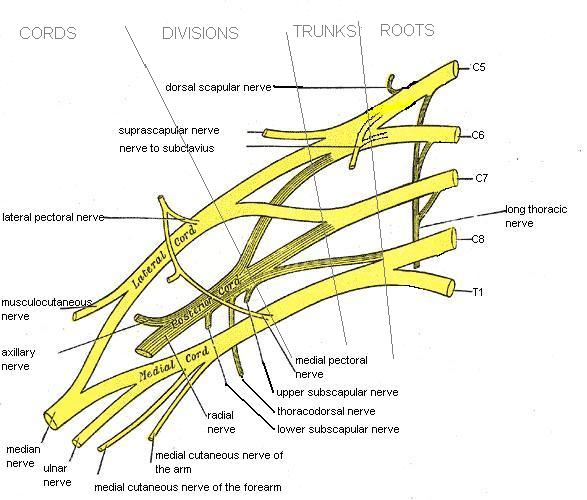
Source: Wikimedia Commons (2008). Brachial plexus, Licensed under a creative commons licence. Available for free at: https://commons.wikimedia.org/wiki/File:Brachial_plexus.jpg (Accessed: 20 February 2022).

Source: Wikimedia Commons (2010). Lumbar plexus, Licensed under a creative commons licence. Available for free at: https://commons.wikimedia.org/wiki/File:Lumbar_plexus.svg (Accessed: 20 February 2022).

Source: Wikimedia Commons (2007). Gray828, Licensed under a creative commons licence. Available for free at: https://commons.wikimedia.org/wiki/File:Gray828.png (Accessed: 20 February 2022).
Central neuropathic pain will arise from damage within the central nervous system. Intracranial causes include stroke, in which there is pain within an area of sensory loss. Spinal cord compression from a tumour can also cause neuropathic pain and sensory loss.
Neuropathic pain is often described differently to nociceptive pain, although, as caveated before, this can be challenging in clinical practice. ‘Dysesthesias,’ or abnormal sensations, including ‘burning,’ ‘shooting,’ ‘stabbing,’ or ‘electrical’ type pains may be reported. Due to the nerve damage, there may be other associated neurological symptoms. As outlined above, sensory loss in the affected area is common, and autonomic function may be impaired. Allodynia (painful touch sensation) and hyperalgesia (excessive response to pain) are also features suggestive of nerve injury.
Total pain
Although a physical symptom, pain is a subjective experience variable from patient to patient. There can be significant psychological, spiritual, and social elements to the sensation of pain, not only the physical problem. These should be considered as part of pain management. Where these factors are all implicated, this is what is known as ‘total pain.’ Managing this requires good communication skills to identify the contributing factors and an MDT approach, including clinical psychology, complementary therapy, and specialist spiritual care.
References
- Twycross R, Wilcock A. Introducing Palliative Care 5th edition 2016. 81-85
- Martini F, Nath J, Bartholomew E. Fundamentals of Anatomy & Physiology 9th edition 2012. 498-499
- Mischkowski D, Palacios-Barrios EE, Banker L, Dildine TC, Atlas LY. Pain or nociception? Subjective experience mediates the effects of acute noxious heat on autonomic responses. Pain. 2018;159(4):699-711.
- Pelosof LC, Gerber DE. Paraneoplastic syndromes: an approach to diagnosis and treatment. Mayo Clinic Proceedings. 2010;85(9):838-854.
- UpToDate [Internet]. Uptodate.com 2021 [Cited 20/2/2022]. Available from: https://www.uptodate.com/contents/overview-of-cancer-pain-syndromes?search=cancer%20pain%20management&source=search_result&selectedTitle=5~150&usage_type=default&display_rank=5#H15
- UpToDate [Internet]. Uptodate.com 2021 [Cited 20/2/2022]. Available from: https://www.uptodate.com/contents/assessment-of-cancer-pain?search=cancer%20pain%20management&source=search_result&selectedTitle=8~150&usage_type=default&display_rank=8#H3
Complete Guide to Clinical Genetics ST3 Application and Recruitment (2027)
Written by Medibuddy. Last updated: October 2026. Clinical Genetics is

Complete Guide to Clinical Radiology ST3 Application and Recruitment (2027)
Recruitment paused: NHS England is not running Clinical Radiology ST3+ recru

Complete Guide to Paediatric Surgery ST3 Application and Recruitment in United Kingdom (2026)
Written by Medibuddy. Last updated: October 2026. If you’re planning


Take your subscriptions with you
Our mobile app allows you to access your interview and exam question banks wherever you are.

