


 Close
Close
 27th June 2023
Reproductive Health
Contraception
UK Contraceptive Options
The prescribing of contraceptives requires a consideration of multiple factors, including the person’s preferences, family aspirations, and lifestyle. Without contraception, 85% of premenopausal women would conceive within one year of regular unprotected intercourse.
Before a contraceptive method is chosen, the efficacy of each choice, as well as common adverse effects, should be discussed. Some contraceptives have interactions with other medications; for example, the enzyme-inducing agent rifampicin lessens the effectiveness of the combined oral contraceptive pill (COCP).
The Faculty of Sexual and Reproductive Healthcare has provided guidance in the form of the ‘UKMEC Summary of Hormonal and Intrauterine Contraception’ – this provides an easy cross-reference tool for clinicians to assess the suitability of a contraceptive based on a patient’s characteristics and comorbidities. The guidance rating is given as a number ranging from 1-4, with a 1 being no contraindications, a 2 being benefits outweigh risks, 3 suggesting risks may outweigh benefits, and 4 meaning that the use of the contraceptive poses an unacceptable health risk.
Barrier Methods
Male and female condoms provide a physical barrier to ejaculate, pre-ejaculate and cervicovaginal secretions entering the uterus. Fertilisation is prevented and the risk of transmission of sexually transmitted infections (STIs) is greatly reduced. No fitting is required (unlike other barrier methods) but care should be taken to ensure the patient is aware of the risks of failure. In practice, this is 18% for male condoms, meaning 18 in 100 women relying solely on this method of contraception will conceive within the first year, and 21% for female condoms.
Diaphragms and cervical caps both prevent sperm from reaching the cervix but do not prevent direct contact between the penis and vagina and so do not offer the same protection against STIs. Both diaphragms and caps need fitting, including resizing after childbirth due to the change in the cervix, and should be used in conjunction with spermicide (a chemical barrier to sperm entering the cervix). Failure rates for both when used in practice are at least 12%.
Combined Hormonal Contraceptives (CHCs)
CHCs contain oestrogen and progesterone, which works on the hypothalamo-pituitary axis to reduce the production of luteinizing hormone (LH) and follicle-stimulating hormone (FSH), thereby inhibiting ovulation. Additionally, CHCs affect the cervical mucus and endometrium to give a hostile environment for implantation.
Three CHC methods are available: a once-daily pill, a 7-day transdermal patch, and a 21-day vaginal ring. All the methods can be used ‘off label’ without a contraception-free interval, which prevents the withdrawal bleed. The efficacy of all three methods is similar, with in-practice use showing a 9% failure rate. Before starting a CHC, the UKMEC guidance should be carefully consulted with regards to smoking, age, obesity, and migraines with aura.
Progesterone-only methods
Methods include the once-daily pill (POP), the injection (which is given either 8- or 13-weekly depending on type) and the long-acting implant, which can be changed every three years. All methods work similarly to prevent conception in multiple ways, including increasing the thickness of cervical mucus and making the endometrium hostile to implantation. Additionally, ovulation is suppressed by preventing the midcycle peaks of LH and FSH.
All methods can be used while breastfeeding (injectable is UKMEC 2), can be used in patients with a previous venous thrombosis (UKMEC 2) and are safe in patients with a BMI >35. There is evidence to suggest that the POP reduces dysmenorrhea and mid-cycle ovulation pain.
All methods are associated with unscheduled menstrual bleeding, and the injectable can have up to a 1-year delay in fertility returning to normal once stopped. The injectable is also associated with weight gain and loss of bone mineral density, although this is usually recovered after discontinuation.
Intrauterine Contraception
There are two types of these long-acting contraceptives currently available in the UK: the copper intrauterine device (IUD) and the levonorgestrel intrauterine system (IUS). Both are inserted via the cervix and sit in the uterus with threads into the vagina (which allow the presence of the contraception to be checked after each menstrual cycle).
The copper IUD prevents fertilisation due to copper’s toxicity to ova and sperm. The IUS uses progestogenic effects within the endometrium to prevent implantation of the fertilised ova and thickens cervical mucus preventing sperm from entering the uterus; both methods are 99.2% effective. The IUS needs to be replaced every 3-5 years and can be used as a treatment for menorrhagia; disadvantages include the risk of expulsion and perforation of the uterus wall on insertion. The copper IUD is replaced every 5-10 years and is hormone-free, so it is safe for women with a history of blood clots and breast cancer. It can be associated with heavier menstrual bleeding, but this is not a contraindication.
Natural Family Planning
Natural contraceptive methods are less reliable than other methods but are widely acceptable and can be effective when taught to couples by trained providers. Fertility indicators are monitored during a woman’s cycle to prompt a change in sexual behaviours to prevent pregnancy. Fertility awareness methods (FAM) rely on monitoring signs such as basal body temperature, consistency of cervical secretions and changes in the cervix. It requires a woman to have a regular menstrual cycle to allow accurate prediction of ovulation. The lactational amenorrhea method (LAM) relies on a woman being less than six months postpartum, breastfeeding at least 85% of baby’s intake and complete amenorrhea; lactation stops ovulation by delaying gonadotrophin release.
Emergency Contraception
These methods are used when a person has had unprotected sexual intercourse (UPSI), including failure of contraceptive, for example ‘missed pill’, and does not wish to conceive. They should be considered if UPSI has occurred on any day of a natural menstrual cycle, if a hormonal method has been used incorrectly, from 21 days postpartum unless lactational amenorrhea criteria have been met, or 5 days from a miscarriage, abortion, or ectopic pregnancy.
Options include oral levonorgestrel, oral ulipristal acetate and the copper IUD. Both oral methods work by delaying or preventing ovulation, so are less effective if taken late in the cycle after ovulation has occurred. The copper IUD relies on its toxic effects on ova and sperm, so it is effective at any point in the cycle. Emergency contraception should be given as close to the UPSI as possible, with the more effective method being the copper IUD – this can be placed up to 5 days from UPSI. Ulipristal acetate is licensed for 5 days following UPSI, and levonorgestrel for 72 hours.
Sterilisation
Sterilisation for women is tubal occlusion and for men a vasectomy. Both are considered permanent methods of contraception, and the NHS does not routinely offer reversal. Both methods require a small surgical procedure. Female sterilisation is carried out laparoscopically and requires a general anaesthesia, which has associated risks.
Vasectomy has a failure rate of 0.05%, but a post-procedure sperm analysis (usually at 12 weeks) is required to confirm azoospermia, and additional contraceptives should be used until this time. Tubal occlusion has a failure rate of 0.5%. Tubal occlusion is associated with a slight protective effect against developing ovarian cancer; by contrast, vasectomy is associated with a slight increased risk of prostate cancer, although the relationship is not thought to be causal.
Pelvic pain and dyspareunia
Pelvic Pain
Chronic pelvic pain is defined by the Green-Top Guidelines produced by the Royal College of Obstetricians and Gynaecologists as “Intermittent or constant pain in the lower abdomen or pelvis of a woman of at least six months in duration, not occurring exclusively with menstruation or intercourse and not associated with pregnancy. It is a symptom not a diagnosis.” Pain is a sensory experience affected by physical, emotional, and social factors. In unpicking the pain, it is key to consider pelvic pain as multifactorial and not suggest that it is purely one contributing factor when there are likely several.
Endometriosis and adenomyosis
Characteristic symptoms are dysmenorrhea, dyspareunia and chronic pelvic pain varying markedly over the menstrual cycle. Endometriosis is a condition where tissue similar to endometrium is found growing outside the uterus; adenomyosis is the growth of endometrial tissue in the muscular walls of the uterus. Ovarian suppression with ‘the Pill’ or Goserelin (injectable gonadotrophin releasing hormone agonist) may be effective in these cyclical pain conditions.
Adhesions
Adhesions may be caused by previous surgery, previous infection (such as Pelvic Inflammatory Disease) and endometriosis. Pelvic pain may be made worse by stretching or movement, but not all adhesions are symptomatic. Adhesiolysis (the surgical cutting of adhesions) is of limited benefit to improve pain in all but the densest of vascular adhesions.
Alternative Causes of Pelvic Pain
It is important when considering pelvic pain to assess the relationship of the pain to bowel movements (irritable bowel syndrome), urinary frequency or association with urination (cystitis) or possible relationship to past or ongoing psychological trauma, such as past sexual abuse. Pelvic joints can be involved in musculoskeletal pain, and nerve entrapment in the pelvic region can also cause pelvic pain.
One distinct cause of transitory pelvic pain is Mittelschmerz – this is mid-cycle menstrual pain associated with ovulation; it is most common in teenagers and older women.
Dyspareunia
Dyspareunia is pain during or after activity over a period of at least six months; it is more common in women. Pain may be superficial – felt in the vulva or around the entrance to the vagina or deeper where it is felt on deeper penetration. Primary dyspareunia has been present since first intercourse, while secondary dyspareunia develops later. Risk factors include younger age, operative (as opposed to vaginal) delivery, stress, and pelvic infections. Pain should be investigated, including ruling out infection and malignant causes, and a detailed history should be taken. Once physical causes have been fully treated, it is appropriate for the management to involve both partners and should take a multidisciplinary approach.
Post-coital and intermenstrual bleeding
Intermenstrual bleeding (IMB) is any bleeding (other than post-coital) happening outside the usual menstrual cycle. Post-coital bleeding (PCB) is non-menstrual bleeding happening immediately after intercourse. Both are symptoms rather than diagnoses and should be thoroughly investigated to rule out the most concerning cause: malignancy.
Post-coital bleeding
There are many causes of PCB, and 8% of women have at least one episode of bleeding after intercourse in any 2-year period. In 50% of women investigated for PCB, no identifiable cause will be found. Possible causes include a cervical ectropion which are small friable areas on the external cervix – these are the result of columnar epithelial cells usually found in the cervical canal being present on the external cervix within the vagina, typically cells here are squamous. Cervical ectropion is particularly common in women taking the combined oral contraceptive pill. Other causes include cervical polyps, infections, or cancers.
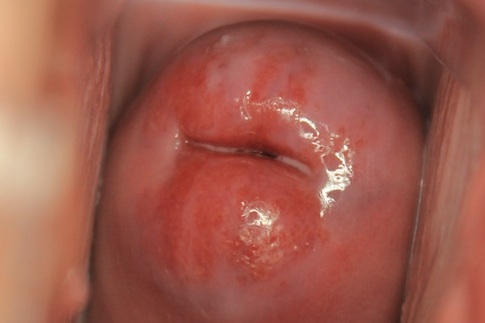
Cervical ectropion.
Image Source: Wikimedia Commons (2016). Licensed under a creative commons licence. Available for free at: https://commons.wikimedia.org/wiki/File:%D0%AD%D1%80%D0%BE%D0%B7%D0%B8%D1%8F_%D1%88%D0%B5%D0%B9%D0%BA%D0%B8_%D0%BC%D0%B0%D1%82%D0%BA%D0%B8.jpg (Accessed on: 13 February 2023).
Intermenstrual bleeding
The cause of IMB may become obvious from the history. One important cause to rule out is ectopic pregnancy or (less commonly) gestational trophoblastic disease – both would be associated with a positive pregnancy test. Causes can be grouped by the site of the reproductive tract involved, for example, polyps can be uterine or cervical. Fibroids are a common cause occurring in 25% of women of reproductive age.
Iatrogenic causes should be considered, including:
- Tamoxifen – an anti-oestrogen drug typically used in pre- and peri-menopausal women with oestrogen-receptor positive breast cancer
- Poor adherence to the taking of oral contraceptive pills
- Drugs affecting clotting, including serotonin selective reuptake inhibitors (SSRIs), anticoagulants and corticosteroids
Erectile Dysfunction
Definition
NICE defines erectile dysfunction (ED) as the persistent inability to attain and maintain an erection sufficient to permit satisfactory sexual performance. The causes are usually multifactorial but can be considered as primarily organic or primarily psychogenic. Medications may also contribute. ED is a common disorder with incidence and prevalence increasing with age. ED affects the physical, emotional, and psychosocial health of the sufferer, and interestingly there is also a significant increase in the risk of cardiovascular disease (CVD) among men with ED.
Organic causes
Vascular causes account for most organic ED presentations. Risk factors are the same as for the development of CVD and include hypertension, dyslipidaemia, and diabetes mellitus. Major pelvic surgery can also affect blood supply, including prostate-cancer surgeries and radiotherapy to the pelvis or retroperitoneum.
Neurogenic causes may be central or peripheral. Central causes include degenerative diseases, such as Parkinson’s disease, stroke, trauma, and central nervous system tumours. Peripheral causes include diabetes and chronic renal disease.
Hormonal imbalance can cause ED; hyperprolactinaemia, Cushing’s and hyper/hypothyroidism are all potential causes to rule out.
Psychogenic causes
These can be considered as generalised, for example, the inability to become aroused, or situational, where it may be partner or time specific. Stress and psychiatric illness, for example, anxiety or depression, all contribute to the development of ED.
Common drug related causes
A drug cause should be considered if erectile dysfunction began within two weeks of starting a new medication; on stopping the drug, ED symptoms should resolve; however, many of the medications are essential to treat or prevent serious illness, so it may not always be practicable to stop treatments.
Potential drug causes of ED include:
- Antihypertensives such as beta-blockers, verapamil, and clonidine
- Antidepressants, including SSRIs and tricyclics
- Antiarrhythmics: digoxin and amiodarone
- Diuretics, especially thiazide-type and spironolactone
- H2-antagonists such as cimetidine and ranitidine
- Recreational drugs, including alcohol, cannabis, heroin, cocaine, methadone, and anabolic steroids.
Pharmacological Management
For most men, phosphodiesterase-5 (PD5) inhibitors, as required, are appropriate – these can now be bought over the counter in the UK, as well as prescribed. They should be avoided in men with severe coronary artery disease, those who have had a stroke in the last six months or myocardial infarction in the last three months. They are not suitable for men who have severe hepatic impairment, and the dose should be reduced for those with significant renal impairment. There are many drug interactions, including with cytochrome p450 inhibitors, as clearance of PD5-inhibitors relies on this pathway. Concurrent use of nitrates is an absolute contraindication due to the risks of unpredictable hypotensive episodes. If a man develops chest pain after taking a PD5 inhibitor organic nitrates cannot be given for at least 12 hours (depending on PD5 inhibitor taken).
Complete Guide to Clinical Genetics ST3 Application and Recruitment (2027)
Written by Medibuddy. Last updated: October 2026. Clinical Genetics is

Complete Guide to Clinical Radiology ST3 Application and Recruitment (2027)
Recruitment paused: NHS England is not running Clinical Radiology ST3+ recru

Complete Guide to Paediatric Surgery ST3 Application and Recruitment in United Kingdom (2026)
Written by Medibuddy. Last updated: October 2026. If you’re planning


Take your subscriptions with you
Our mobile app allows you to access your interview and exam question banks wherever you are.

