


 Close
Close
 12th January 2024
Tuberculosis
Background
Tuberculosis (TB) globally represents a leading cause of death by an infectious agent. TB is caused by Mycobacterium tuberculosis (MtB), an aerobic bacillus transmitted by the respiratory route. From the point of deposition of aerosols containing MtB onto lung alveolar surfaces, the progression of disease can have several outcomes, from patients who are able to clear the initial infection to those who have haematogenous spread of the infection throughout the body. TB is a notifiable disease in the UK.
Epidemiology
Globally, it is estimated that 1.5 million deaths per year are caused by TB, with approximately 10 million incident cases per year. In the UK, the incidence of TB has been slowly reducing over recent years, currently standing between 4000-5000 cases per year. Approximately 300 deaths per year in the UK are caused or contributed to by TB.
Stages of TB disease
TB has human-to-human transmission by the respiratory route. Individuals with active respiratory TB produce aerosol droplets containing MtB when coughing, sneezing or speaking. If others inhale these infectious droplets, they lodge in the lung alveoli and bacilli are taken up by resident macrophages. From this point the progression of disease can have several outcomes, largely determined by the host immune response. An unknown proportion of individuals appear able to completely clear the infection, suggesting they are protected by as-of-yet-unknown immune mechanisms. For some individuals, primary infection leads to active TB (primary progressive tuberculosis), when the replication of bacilli cannot be effectively suppressed by the innate immune system. In most healthy individuals, MtB infection causes little or no symptoms as the immune system acts to wall off the bacteria in granulomas, which limit further replication and spread and form latent TB infection. Most individuals will remain with their infection in latency lifelong; however, for some, the infection can later become active (reactivation). Miliary TB occurs when there is massive lymphohematogenous dissemination of the bacilli to the lungs and other organs, which results in the formation of millet seed-sized tuberculous foci.
Risk factors
There are a number of factors which increase an individual’s risk of TB infection. These include:
- Being born in a high prevalence area, such as India, Pakistan, Romania, Bangladesh etc.
- Being in close contact with someone with active respiratory TB, e.g. living in the same household or working in close proximity.
- Having a comorbid condition, such as HIV, diabetes mellitus or occupational lung disease
- Taking immunosuppressive drugs
- Having a history of excessive alcohol, injecting drug users, and smokers
- Having a low socioeconomic status, with individuals using homeless hostels and shelters and people living in prison, particularly at risk.
Given the above, anyone with confirmed or suspected TB should be offered testing for HIV. Furthermore, as anti-tumour necrosis factor (TNF)-alpha biologic therapies have been shown to increase risk of reactivation of latent TB, any patient being offered these medications should be tested for TB before their commencement.
Presentation
Patients with latent TB are usually asymptomatic.
Active pulmonary TB can present with the following symptoms:
- Fever
- Weight loss
- Night sweats
- Productive cough
- Haemoptysis
- Lymphadenopathy
Active extra-pulmonary TB can affect any organ, and therefore, the presentation varies depending on the system(s) affected.
Diagnosis
Latent TB can be diagnosed by Mantoux testing (tuberculin skin testing) or interferon-ɣ release assays (IGRA). In the Mantoux test, TB antigen is injected intradermally, and the area is assessed 48-72 hours later to look for evidence of a delayed-type hypersensitivity reaction occurring, which indicates previous exposure to the antigen. This test can provide a false positive result if the patient has previously had the BCG vaccine and false negative results in individuals who are immunosuppressed (e.g. HIV-positive patients). IGRA testing involves exposing T-lymphocytes of individuals to MtB antigens and measuring interferon-ɣ to detect for previous infection. IGRA tests are not affected by prior BCG vaccination.
For suspected active pulmonary TB, a chest X-ray should be performed, with further diagnostic investigations carried out if the radiological appearance is suggestive of TB. While there are no radiographic features that are alone diagnostic of TB, a number of features are typical. Mediastinal and hilar lymphadenopathy is a common chest X-ray finding, consolidation, and cavitation, which has a predilection for the upper lobes. If appearances suggest TB, multiple respiratory samples should be sent for microscopy and culture for acid-fast bacilli (bacilli which resist acid on Ziehl-Neelsen staining). If possible, these should be three deep cough sputum samples, including an early morning sample. Bronchoscopy and lavage may be required to acquire samples. Rapid diagnostic nucleic acid amplification tests should be performed on these specimens if there is clinical suspicion of TB disease, and the person has HIV or rapid information about mycobacterial species would alter the person’s care.
In patients with suspected extra-pulmonary TB, samples should be collected again, allowing for microscopy and culture. For instance, in suspected TB meningitis cerebrospinal fluid should be taken for TB microscopy and culture; in suspected pleural TB, pleural fluid should be sent; in suspected TB lymphadenitis, a lymph node biopsy should be sent, and so on.

Image Source: Wikimedia Commons (2010). Tuberculosis image 1, Licensed under a creative commons licence. Available for free at: https://upload.wikimedia.org/wikipedia/commons/9/9a/Tuberculosis_image1.jpg (Accessed: 22 March 2021).
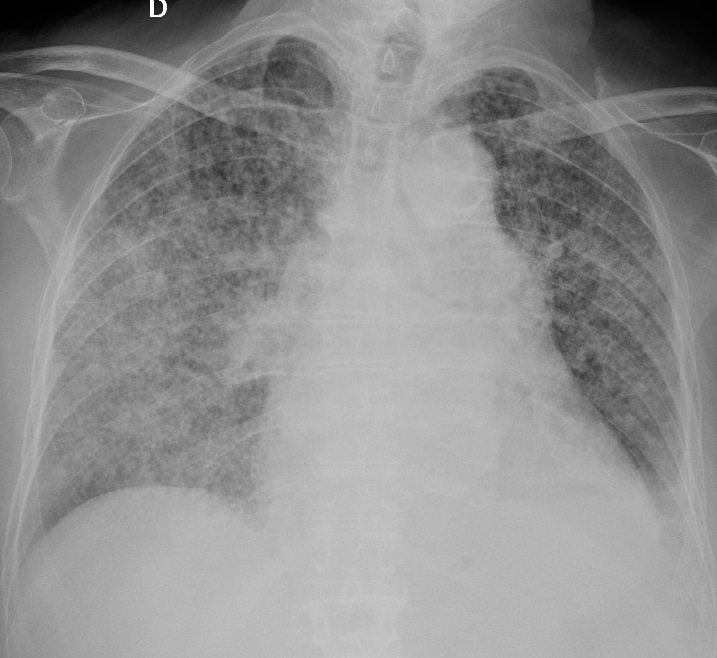
Image Source: Wikimedia Commons (2018). Chest radiograph of miliary tuberculosis. 2, Licensed under a creative commons licence. Available for free at: https://upload.wikimedia.org/wikipedia/commons/7/70/Chest_radiograph_of_miliary_tuberculosis_2.jpg (Accessed: 22 February 2022).
Management
Adults aged under 65 years old with latent TB are treated with either:
- 3 months of isoniazid (with pyridoxine) and rifampicin or
- 6 months of isoniazid (with pyridoxine).
The risk of hepatotoxicity from these medications has been shown to significantly increase in patients aged over 65 years, and therefore, the decision to treat latent TB infection in elderly patients requires careful consideration of risks and benefits.
Patients with active TB without central nervous system (CNS) involvement should be offered:
- isoniazid (with pyridoxine), rifampicin, pyrazinamide and ethambutol for 2 months then
- isoniazid (with pyridoxine) and rifampicin for a further 4 months.
For patients with CNS involvement, isoniazid (with pyridoxine) and rifampicin are continued for 10 months (rather than four) after the initial two months of quadruple therapy.
Patients with active TB admitted to hospital should be cared for in a single room until they have completed two weeks of the standard treatment regimen. If the patient is suspected or confirmed to have multi-drug resistant TB, whereby the organism is resistant to isoniazid and rifampicin (+/- other anti-tuberculous treatments), the patient should be managed in a negative pressure room.
Adverse effects of TB medications
Patients starting on a TB treatment regime must have their liver and renal function assessed before commencing treatment. Visual acuity should be tested by Snellen chart before treatment with ethambutol.
| Medication | Side effects |
|---|---|
| Rifampicin | Hepatotoxicity, orange discolouration of secretions, potent inducer of the cytochrome P450 system, thrombocytopaenia |
| Isoniazid | Hepatitis, peripheral neuropathy (give with pyridoxine to reduce risk), cytochrome P450 inhibitor |
| Pyrazinamide | Hepatitis, arthralgia |
| Ethambutol | Optic neuritis |
Table 1: adverse effects of medications used to treat tuberculosis. Adapted from: Antitubercular Medications – StatPearls – NCBI Bookshelf [Internet]. [cited 2022 Mar 11]. Available from: https://www.ncbi.nlm.nih.gov/books/NBK557666/
References
- Seung KJ, Keshavjee S, Rich ML. Multidrug-Resistant Tuberculosis and Extensively Drug-Resistant Tuberculosis. Cold Spring Harb Perspect Med [Internet]. 2015 Sep 1 [cited 2022 Feb 22];5(9). Available from: /pmc/articles/PMC4561400/
- Smith BM, Schwartzman K, Bartlett G, Menzies D. Adverse events associated with treatment of latent tuberculosis in the general population. C Can Med Assoc J [Internet]. 2011 Feb 22 [cited 2022 Feb 22];183(3):E173. Available from: /pmc/articles/PMC3042475/
- Bhalla AS, Goyal A, Guleria R, Gupta AK. Chest tuberculosis: Radiological review and imaging recommendations. Indian J Radiol Imaging [Internet]. 2015 Aug 1 [cited 2022 Feb 22];25(3):213. Available from: /pmc/articles/PMC4531444/
- Recommendations | Tuberculosis | Guidance | NICE [Internet]. [cited 2022 Feb 22]. Available from: https://www.nice.org.uk/guidance/ng33/chapter/Recommendations#active-tb
- Recommendations | Tuberculosis | Guidance | NICE [Internet]. [cited 2022 Feb 22]. Available from: https://www.nice.org.uk/guidance/ng33/chapter/Recommendations#latent-tb
- Miliary Tuberculosis – StatPearls – NCBI Bookshelf [Internet]. [cited 2022 Feb 22]. Available from: https://www.ncbi.nlm.nih.gov/books/NBK562300/
- Kiazyk S, Ball T. Tuberculosis (TB): Latent tuberculosis infection: An overview. Canada Commun Dis Rep [Internet]. 2017 Mar 2 [cited 2022 Feb 22];43(3–4):62. Available from: /pmc/articles/PMC5764738/
- Active Tuberculosis – StatPearls – NCBI Bookshelf [Internet]. [cited 2022 Feb 22]. Available from: https://www.ncbi.nlm.nih.gov/books/NBK513246/
- Clinical Manifestations – Tuberculosis in Adults and Children – NCBI Bookshelf [Internet]. [cited 2022 Feb 22]. Available from: https://www.ncbi.nlm.nih.gov/books/NBK344404/
- Global Health – Newsroom – Tuberculosis [Internet]. [cited 2022 Feb 22]. Available from: https://www.cdc.gov/globalhealth/newsroom/topics/tb/index.html
- Tuberculosis [Internet]. [cited 2022 Feb 22]. Available from: https://www.who.int/news-room/fact-sheets/detail/tuberculosis
Complete Guide to Clinical Genetics ST3 Application and Recruitment (2027)
Written by Medibuddy. Last updated: October 2026. Clinical Genetics is

Complete Guide to Clinical Radiology ST3 Application and Recruitment (2027)
Recruitment paused: NHS England is not running Clinical Radiology ST3+ recru

Complete Guide to Paediatric Surgery ST3 Application and Recruitment in United Kingdom (2026)
Written by Medibuddy. Last updated: October 2026. If you’re planning


Take your subscriptions with you
Our mobile app allows you to access your interview and exam question banks wherever you are.

