


 Close
Close
 11th April 2024
Background
Gynaecomastia is a benign proliferation of the glandular breast tissue, as opposed to pseudo-gynaecomastia, that is due to fat deposition. It occurs in 35% of men and is most common in men between 50 – 69, although it is also common in adolescence and infancy.
It is caused by an imbalance between circulating oestrogen and androgen. Androgens have an apoptotic and anti-proliferative effect on glandular breast tissues, whereas oestrogen promotes proliferation. Any increase in free circulating oestrogen or decrease in testosterone can therefore lead to gynaecomastia. The four main mechanisms through which this can occur are shown in Fig. 1.
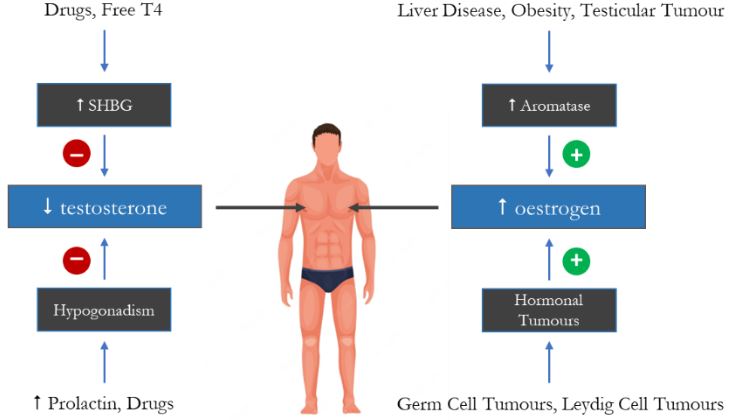
Image source: Authors’ Own Image
The cause is often multi-factorial and will vary depending on patient age. For instance, older males experience a decrease in testosterone production and an increase in adipose tissue, which increases the aromatisation of androgens into estrone (E1) and oestradiol (E2). Drugs are a common cause and act through suppression of androgen production, promotion of oestrogens or an increase in prolactin, resulting in hypogonadism.
The main causes are as follows:
| Drug Related | Anti-Androgenic Drugs | 5α Reductase (bicalutamide, finasteride, dutasteride) |
| Ketoconazole | ||
| Spironolactone | ||
| Antibiotics | Isoniazid | |
| Metronidazole | ||
| Cardiovascular Drugs | ACE-inhibitors | |
| Amiodarone | ||
| Calcium channel blockers | ||
| Statins | ||
| Chemotherapy Drugs | Alkylating agents | |
| Methotrexate | ||
| Vinca alkaloids | ||
| Gastrointestinal Drugs | Cimetidine | |
| Omeprazole | ||
| Psychoactive Drugs | Atypical antipsychotics (olanzapine, risperidone) | |
| Diazepam | ||
| Haloperidol | ||
| Tricyclic antidepressants | ||
| Drugs of Abuse | Alcohol | |
| Marijuana | ||
| Other | Domperidone, metoclopramide | |
| HAART | ||
| Phenytoin | ||
| Gonadal Failure | Hypogonadism | |
| Hyperprolactinaemia | ||
| Hormone Secreting Tumours | Adrenocortical malignancy | |
| Testicular malignancy | ||
| Other | Cirrhosis | |
| Chronic kidney disease | ||
| Hyperthyroidism | ||
| Obesity | ||
Table 2. Causes of gynaecomastia
Investigations
Initial blood tests should include morning testosterone, LFTs, TFTs and U&Es. If testosterone is low, then it should be repeated alongside FSH, prolactin, oestradiol and SHBG. If the history or examination is suggestive of testicular malignancy, then β-hCG, AFP and LDH should be performed alongside testicular ultrasound.
Management
All men with pathological gynaecomastia should be referred for specialist advice. Adolescents should not be treated unless symptoms have been present for at least 2 years, as in most cases, gynaecomastia is transient in this age group. Men whose gynaecomastia is likely secondary to drugs should be offered alternative treatment.
Medical management has a high success rate but is ineffective once breast fibrosis is established. Danazol is a synthetic steroid with anti-gonadotrophic and anti-estrogenic effects that is licensed to treat gynaecomastia. However, it is also associated with weight gain, which can exacerbate symptoms. Common off-licence medications include tamoxifen (a selective oestrogen receptor modulator) and aromatase inhibitors (e.g. letrozole, anastrozole). Tamoxifen should be avoided in patients with a history of venous thromboembolism.
Surgical intervention should be considered for men with fibrotic gynaecomastia.
Complete Guide to Clinical Genetics ST3 Application and Recruitment (2027)
Written by Medibuddy. Last updated: October 2026. Clinical Genetics is

Complete Guide to Clinical Radiology ST3 Application and Recruitment (2027)
Recruitment paused: NHS England is not running Clinical Radiology ST3+ recru

Complete Guide to Paediatric Surgery ST3 Application and Recruitment in United Kingdom (2026)
Written by Medibuddy. Last updated: October 2026. If you’re planning


Take your subscriptions with you
Our mobile app allows you to access your interview and exam question banks wherever you are.

