


 Close
Close
 13th January 2024
Obstructive Sleep Apnoea/Hypopnea Syndrome (OSAHS)
Overview and Clinical Significance
OSAHS is a common disorder, with NICE estimating that ~5% of UK adults have undiagnosed OSAHS. It is a syndrome with a spectrum of severity. Patients with the syndrome have obstructed or partially obstructed airways during sleep, stopping ventilation, leading to arousals and disrupting sleep.
This impairment of sleep has been linked to an increased risk of developing cardiovascular disease, pulmonary hypertension, hypertension, weight gain and diabetes. Patients with excessive daytime sleepiness are at an increased risk of road accidents. They can develop mood disorders and may even exhibit some cognitive dysfunction.
Pathophysiology and Risk Factors:
Patients who have OSAHS tend to have upper airways that are more collapsible or narrower than the healthy population. As they sleep, their upper airway collapse and can partially or fully obstruct the airway; this tends to happen in REM sleep. The patient is unable to ventilate effectively, which leads to hypoxaemia and hypercarbia and triggers arousals during sleep. This impairs sleep quality, and patients have unrefreshing sleep.
Risk factors associated with developing OSAHS are:
- Population-based:
- Men > Women
- Increasing age (estimated 15-20% of patients with OSAHS are >70 years old)
- Smoking
- Co-Morbidities based
- Obesity
- T2DM
- Hypertension
- Chronic lung disease (e.g. COPD, Pulmonary Fibrosis)
- Acromegaly
- Hypothyroidism
- Down’s Syndrome
- Prader Willi
- Anatomy:
- Large neck
- Large soft tissues of the mouth and upper airways (tongue, adenoids and tonsils)
- Maxillo-mandibular abnormalities
- Nasal Congestion (polyposis, deviated septum, sinusitis etc)
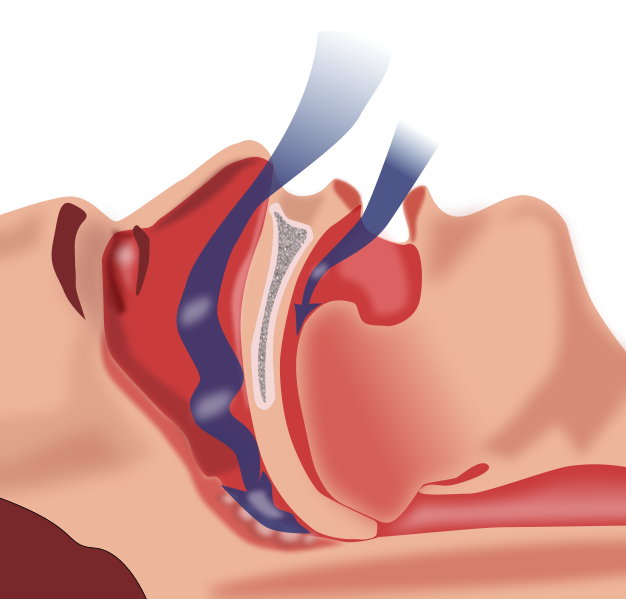
Image Source: Wikimedia Commons (2010). Obstruction ventilation apnee sommeil, Licensed under a creative commons licence. Available for free at: https://commons.wikimedia.org/wiki/File:Obstruction_ventilation_apn%C3%A9e_sommeil.svg (Accessed: 5 August 2022).
Diagnosis
While clinical assessment and history can be strongly suspicious of OSAHS, definitive diagnosis requires polysomnography or home sleep studies. Diagnosis for OSAHS requires either/or:
- Obstructive AHI or REI of ≥15 episodes/hour
- AHI or REI of ≥5 episodes/hour AND EITHER:
- Symptoms: excessive daytime sleepiness, insomnia
- Complications: hypertension, ischaemic heart disease, stroke, mood disorder, cognitive dysfunction
OSAHS is then classified as:
- Mild: mild/absent sleepiness and AHI/REI of 5-15 episode/hour
- Moderate: sleepiness during activities that require some attention and AHI/REI 15-30 episodes/hour
- Severe: sleepiness during active activities (e.g. eating or driving) and AHI/REI of >30episodes/hour
Management
Management of OSAHS is primarily aimed at improving quality of life for patients and reducing symptom burden. In addition, the aim is to stop the development of complications. This can be measured by symptomatic improvement (especially excessive daytime sleepiness) via reduction of the AHI/REI, control of blood pressure and control of hyperglycaemia.
First Line:
Overnight CPAP is the first-line intervention for symptomatic adults (especially in patients with severe OSAHS).
- CPAP helps splint open the upper airway and prevent collapse, thus preventing airway obstruction and apnoea.
- CPAP therapy has a survival benefit and improves sleep quality (reducing daytime sleepiness), mood, and cognition. There is some evidence that it can improve glycaemic control and help control hypertension.
- Improving excessive daytime sleepiness reduces the risk of road traffic accidents (See DVLA requirements)
Adherence to CPAP:
CPAP is often not well tolerated, and adherence is thus low. The mask is often found to be uncomfortable, the pressures not well tolerated or too noisy, and patients can get a dry mouth/nasopharynx. Given that adherence is critical to controlling symptoms, it is critical to help patients with adapting to and accepting CPAP therapy.
- Addition of humidification
- Proper fit and interface:
- The mask should be adjusted to fit the patient, and additional straps may be necessary
- The mask should be nasal or oro-nasal or full face (dependant on patient preference/ presence of oral air leak)
- Reduce nasal resistance
- Nasal surgery (see below under Surgery)
- Intranasal steroid sprays (e.g. with concurrent rhinitis or turbinate hypertrophy)
- Patient education, support, and behavioural therapy
- Behavioural interventions (e.g. Cognitive Behavioural Therapy). There is good evidence that this can significantly improve adherence to therapy
- Supportive therapy (e.g. additional follow-up, phone call check-ins, adherence monitoring equipment, etc.). There is moderate evidence that this can improve adherence
- Patient education around CPAP and/or OSAHS. There is mixed to low evidence that this, in isolation, can help with adherence.
Adjuncts:
Lifestyle advice
- Obese patients are advised to lose weight. Loss of 10% body weight was found to reduce AHI by 26% in one study.
- Advice to avoid alcohol and sedating medications (e.g. benzodiazepines/opiates).
Surgery
- Surgery may be a first-line option in patients with OSAHS caused by distinct anatomy (e.g. bulky palatine tonsils)
- Surgery can improve upper airway flow via reducing upper airway resistance (e.g. nasal polypectomy, nasal septal surgery) or increasing the calibre of the pharyngeal airway (tonsillectomy, adenoidectomy, uvulopalatopharyngoplasty).
- Surgery to help improve nasal airflow may be required to help with CPAP adherence.
- Bariatric surgery may be an option in patients with a BMI >40 or <40 with comorbidities.
Second Line:
Oral Appliances
- For patients with mild to moderate disease who fail to adhere to or tolerate CPAP, oral appliances (e.g. mandibular splints or tongue retainers) can be used to help keep the upper airway open.
DVLA Requirements
Given the dangers of driving while excessively sleepy, there are DVLA requirements for patients who have OSAHS. The rules depend on the severity of OSAHS and the presence of excessive daytime sleepiness. In addition, the guidance for follow-up differs for Group 1 drivers (car and motorcycle) versus Group 2 drivers (bus, taxi or lorry drivers).
The penalties are strict for patients not following the guidance, with fines of up to £1000.00 for not telling the DVLA about medical conditions that affect their driving. They can also be liable to prosecution if involved in an accident.
On diagnosis:
- Mild, Moderate or Severe OSAHS, without symptoms of excessive daytime sleepiness:
- Can drive as usual
- No need to notify the DVLA
- Mild OSAHS with symptoms of excessive daytime sleepiness
- Must NOT drive until symptoms satisfactorily controlled
- If symptoms cannot be controlled within 3 months of initiation of treatment, the DVLA must be informed
- Moderate/ Severe OSAHS with symptoms of excessive daytime sleepiness
- Must NOT drive until sleep clinic has confirmed that OSAHS is under control, sleepiness is no longer excessive, and that patient is compliant with CPAP treatment.
- DVLA must be informed. DVLA require medical confirmation of control of symptoms before allowing driving/restoring driving licences.
- Excessive sleepiness with suspected OSAHS
- Must NOT drive until OSAHS diagnosed and sleep clinic has confirmed excessive sleepiness is controlled by treatment (as per above guidance dependent on severity)
Monitoring:
- Group 1 Drivers: Condition reviewed at least every 3 years
- Group 2 Drivers: Condition review at least annually
Responsibility lies with the driver to contact the sleep services to arrange this review (can be by telephone or in-person, depending on the sleep service).
Complete Guide to Clinical Genetics ST3 Application and Recruitment (2027)
Written by Medibuddy. Last updated: October 2026. Clinical Genetics is

Complete Guide to Clinical Radiology ST3 Application and Recruitment (2027)
Recruitment paused: NHS England is not running Clinical Radiology ST3+ recru

Complete Guide to Paediatric Surgery ST3 Application and Recruitment in United Kingdom (2026)
Written by Medibuddy. Last updated: October 2026. If you’re planning


Take your subscriptions with you
Our mobile app allows you to access your interview and exam question banks wherever you are.

