


 Close
Close
 29th January 2024
Behçet’s disease
Background
Epidemiology
Behçet’s syndrome is most common along the ancient silk trading routes from the Far East to the Mediterranean and has the highest prevalence in Turkey and surrounding regions. It is very rare in the UK but may occur in people of any nationality and race. Men and women are affected equally. It may occur at any age but is diagnosed most commonly in adults between the age of 20-30.
Aetiology
Genetic links with HLA B-51 (which plays a role in immunity) have been associated with the disease. Environmental triggers such as herpes virus, bacterial infections, and smoking have been identified to contribute to the condition.
Pathogenesis
The pathogenesis of Behçet’s disease is still largely unknown. However, interleukin-driven T-cell responses, along with other inflammatory pathways and mediators, correlate with disease activity.
Clinical features
Recurrent mouth ulcers are the hallmark of Behcet’s syndrome. They can be large, small or multiple. These are often in the inner lips but can also occur on the tongue, the roof of the mouth and occasionally in the throat. Ulcers often resolve within 10-14 days, although replacement with new ulcers can be frequent. Genital ulcers occur less frequently and affect 60-70% of people. Skin redness and pustules can resemble acne. Other skin manifestations include erythema nodosum and pathergy (an exaggerated skin reason occurring after trauma). Other symptoms include blurred vision, painful eyes (caused by anterior/posterior uveitis and retinal vasculitis), fatigue, headaches, myalgia, arthralgia and abdominal pain.
Complications of disease include decreased vision and blindness, as well as meningitis. Vasculitis predisposes to venous blood clots and arterial aneurysms.
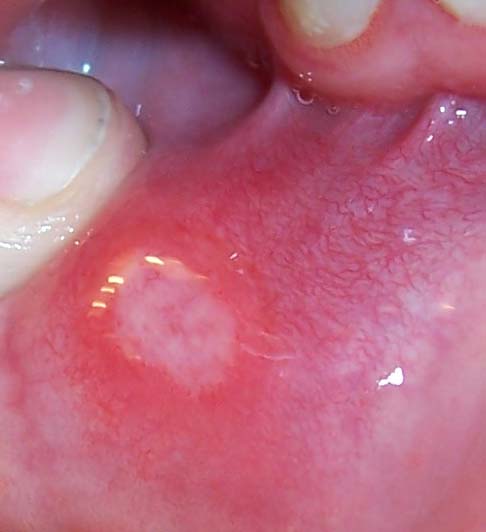
Image Source: Wikipedia (2009). Aphthous_stomatiti, Licensed under a creative commons licence. Available for free at: https://en.wikipedia.org/wiki/Aphthous_stomatitis#/media/File:Aphtha2.jpg (Accessed:18 September 2023).
Diagnosis
Diagnosis of the condition is primarily based on clinical suspicion of ocular lesions, genital and oral ulcerations, skin lesions, neurological manifestations, vascular manifestations and a positive pathergy test. A pathergy test is usually performed by applying a sterile needle with multiple pricks to the forearm. A positive test is interpreted by the presence of a large skin bump, pustule or ulceration after 48 hours. Blood tests such as inflammatory markers and HLA B51 expression are of limited value.
Treatment
The mainstay of treatment targets organ involvement and the severity of involvement. Male sex and younger age at onset also require more aggressive management.
Topical treatments such as local steroid preparation, chlorhexidine mouth wash and colchicine can be used for ulcerations and skin disease. Systemic corticosteroids may be required for disease exacerbations or chronic diseases. In individuals with organ damage such as eye or central nervous system involvement, high-dose steroids and immunosuppressive agents such as azathioprine, cyclosporine, cyclophosphamide, and TNF-alpha inhibitors are usually necessary.
References
- About vasculitis, Vasculitis UK. Available at: https://www.vasculitis.org.uk/about-vasculitis [Accessed 28th January 2022].
- Behcet’s Disease, Johns Hopkins Vasculitis Center. Available at: https://www.hopkinsvasculitis.org/types-vasculitis/behcets-disease/ [ Accessed 19th January 2022].
- Behcet’s Disease, Vasculitis Foundation. Available at: https://www.vasculitisfoundation.org/education/behcets-disease/ [Accessed 2nd February 2022].
- Davatchi, F., 2012. Diagnosis/classification criteria for Behcet’s disease. Pathology research international, 2012.
- de Chambrun, M.P., Wechsler, B., Geri, G., Cacoub, P. and Saadoun, D., 2012. New insights into the pathogenesis of Behcet’s disease. Autoimmunity reviews, 11(10), pp.687-698.
- Vasculitides, Amboss. Available at: https://www.amboss.com/us/knowledge/Vasculitides/ [Accessed 17th January 2022].
Complete Guide to Clinical Genetics ST3 Application and Recruitment (2027)
Written by Medibuddy. Last updated: October 2026. Clinical Genetics is

Complete Guide to Clinical Radiology ST3 Application and Recruitment (2027)
Recruitment paused: NHS England is not running Clinical Radiology ST3+ recru

Complete Guide to Paediatric Surgery ST3 Application and Recruitment in United Kingdom (2026)
Written by Medibuddy. Last updated: October 2026. If you’re planning


Take your subscriptions with you
Our mobile app allows you to access your interview and exam question banks wherever you are.

