


 Close
Close
 29th January 2024
IgA Vasculitis/Henoch-Schönlein Purpura (HSP)
Background
Epidemiology
Children are most often affected, but Henoch-Schönlein Purpura (HSP) can affect adults of all ages. Half the affected children are under the age of 5. Kidney involvement is more likely to be severe in older children and adults. It affects both sexes equally.
Aetiology
In two-thirds of cases, the disease follows an upper respiratory tract infection, with onset an average of 10 days after the start of symptoms. However, no single microorganism or environmental exposure has been confirmed to cause HSP.
Streptococcus strains and Parainfluenza virus are the most commonly associated pathogens, and in children, Human Parvovirus B19 is a frequent viral trigger.
Pathophysiology
IgA antibodies act to protect the lining of the airway, throat and gut, hence why HSP is triggered by infections in those organs. IgA binds to and cross-reacts with the endothelial cells following the activation of complement factors. This damages the endothelium. Inflammation of the small blood vessels causes bleeding into the skin and, therefore, produces the typical purpuric rash, primarily seen on the lower limbs.
Clinical features
Symptoms are typically more severe in adults compared to children. They develop over days to weeks with a widespread rash commonly noted over the backs of the legs, buttocks, trunk and back. This purpuric papular rash can coalesce into patches and cause ulceration in severe cases. Other patients may present with arthralgia, abdominal pain and rectal bleeding. Abdominal symptoms may be severe and be misdiagnosed as appendicitis. Complications of gastrointestinal involvement include intussusception, perforation and bowel infarction. Kidney involvement, such as macroscopic or microscopic haematuria along with proteinuria, will be present along with associated hypertension. This can progress to nephrotic or nephritic syndrome and renal failure.
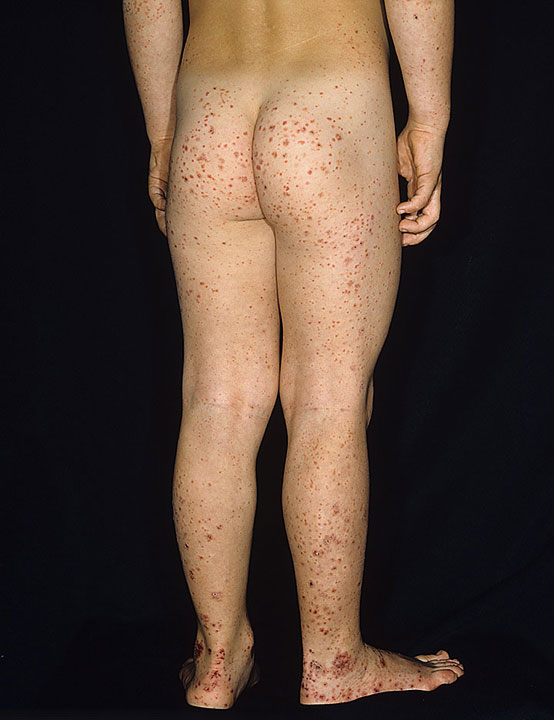
Image Source: Wikipedia. (2021). Henoch–Schönlein purpura, Licensed under a creative commons licence. Available for free at:https://en.wikipedia.org/wiki/Henoch%E2%80%93Sch%C3%B6nlein_purpura (Accessed: 16 February 2022).
Diagnosis
The clinical tetrad of purpura, arthritis, kidney inflammation and abdominal pain is highly suggestive of diagnosis. Blood tests may demonstrate a raised IgA level in around one-third of patients. Biopsy of the skin, bowel or kidneys will show IgA deposition in the vessel walls on direct immunofluorescence in 81% of cases. CT scan of the abdomen may demonstrate bowel inflammation or abdominal complications of disease.
Treatment
In most cases, HSP resolves spontaneously; however, the disease can often relapse. In children, the disease usually resolves within a few weeks. Symptom management with NSAIDs can be used for joint pains without kidney involvement. Dapsone may be effective in some cases. Corticosteroids can be used to reduce inflammation, especially in adults. Long-term kidney protection, such as blood pressure control, may be required.
References
- About vasculitis, Vasculitis UK. Available at: https://www.vasculitis.org.uk/about-vasculitis [Accessed 28th January 2022].
- Henoch-Schönlein Purpura, Johns Hopkins Vasculitis Center, Available at: https://www.hopkinsvasculitis.org/types-vasculitis/henochschnlein-purpura/ [Accessed 16th January 2022].
- Hetland, L.E., Sørensen SUSRUD, K., Lindahl, K.H. and Bygum, A., 2017. Henoch-Schönlein Purpura: A Literature Review. Acta dermato-venereologica, 97(10).
- Vasculitides, Amboss. Available at: https://www.amboss.com/us/knowledge/Vasculitides/ [Accessed 17th January 2022].
Complete Guide to Clinical Genetics ST3 Application and Recruitment (2027)
Written by Medibuddy. Last updated: October 2026. Clinical Genetics is

Complete Guide to Clinical Radiology ST3 Application and Recruitment (2027)
Recruitment paused: NHS England is not running Clinical Radiology ST3+ recru

Complete Guide to Paediatric Surgery ST3 Application and Recruitment in United Kingdom (2026)
Written by Medibuddy. Last updated: October 2026. If you’re planning


Take your subscriptions with you
Our mobile app allows you to access your interview and exam question banks wherever you are.

