


 Close
Close
 31st July 2023
Background to Virology
In order to aid in understanding viral infections in medicine, it is important to be aware of some of the basic sciences which underlie virology.
Taxonomic classification
Taxonomy is one system by which viruses are classified. Viruses are grouped into families, and then each family is broken down into genuses. For example, rabies is caused by the rabies viruses belonging to the Lyssavirus genus in the Rhabdoviridae family.
Some families of viruses have multiple members, which can cause human infection. An example is the Coronaviridae family. Before the advent of COVID-19, little attention was paid to this family in medicine. However, COVID-19 is actually one of 7 distinct coronaviruses of clinical significance. These are SARS-CoV-1, SARS-CoV-2, MERS-CoV, NL63, HKU1, OC43 and 229E – with the latter 4 typically causing no more concern than the common cold.
Molecular classification
Viruses can also be classified based on their genomic structure and the resultant method of viral replication. This is known as the Baltimore Classification System (see image below).
For the MRCP exam, being able to determine where a virus may fit within the 7 categories of the Baltimore system is unlikely to be very important. However, it can help us understand how different viruses replicate and hence cause disease, which is crucial to designing antiviral drugs and vaccines. Hence it is worthwhile being aware of. Basic sciences are on the MRCP curriculum.
Some important viruses, as per their molecular classification, include:
- Group I – herpes simplex virus (HSV)
- Group IV – coronaviruses, dengue virus, and poliovirus
- Group V – Ebola virus
- Group VI – human immunodeficiency virus (HIV)
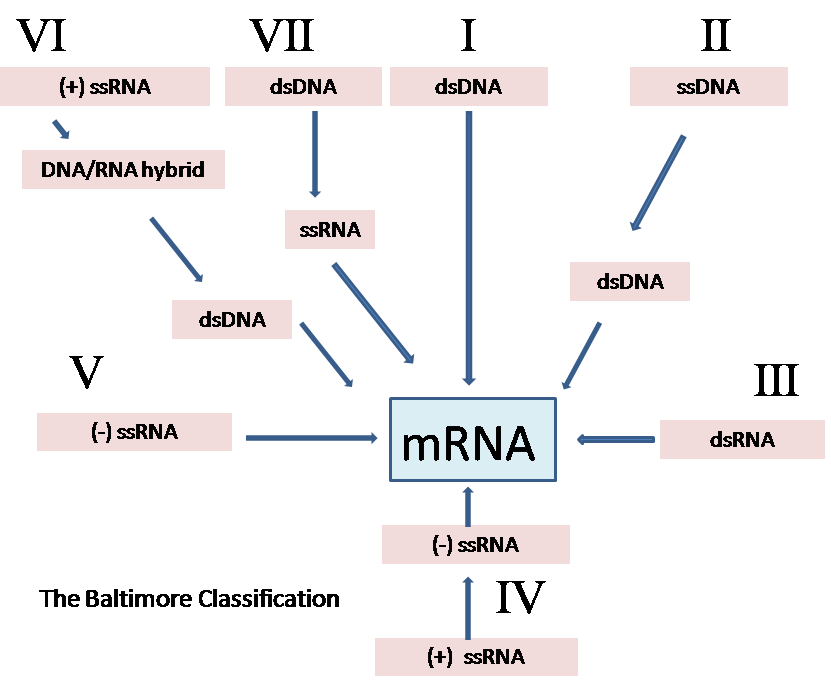
The Baltimore Classification System
Image Source: Wikimedia Commons (2009). Baltimore Classification, Licensed under a creative commons licence. Available for free at: https://commons.wikimedia.org/wiki/File:Baltimore_Classification.png (Accessed: 17 September 2022).
The 7 groups are depicted here, categorised by how they produce the mRNA used to replicate. ds = double stranded, ss = single stranded, (+) = positive sense, (-) = negative sense.
Immunology
The human body has a variety of methods to defend itself against viral infection. These include anatomical and chemical barriers, such as mucus and stomach acid, and chemical mediators of the immune system. The latter can be broken down into intrinsic methods (i.e. interferons, apoptosis, autophagy), the innate immune responses (i.e. complement, cytokines, natural killer cells) and the adaptive immune response (i.e. T cells and B cells). The subject is vast and beyond the remit of this section to fully address.
Interferons (IFNs) are arguably the most important of these defences to know about. IFNs are a crucial part of our intrinsic defence system – they are produced by virus-infected cells and uninfected sentinel cells (e.g. dendritic cells, macrophages and natural killer cells) in response to triggers from viruses.
IFN-α and -β are produced rapidly in the early stages of viral infection, and their binding to receptors triggers the synthesis of multiple cell proteins. Their expression has dramatic physiological consequences, resulting in symptoms such as fever, rigors, malise and nausea, which are well recognised as viral phenomena.
In the reference section, a course providing an overview of viral immunology can be found as further reading.
Complete Guide to Clinical Genetics ST3 Application and Recruitment (2027)
Written by Medibuddy. Last updated: October 2026. Clinical Genetics is

Complete Guide to Clinical Radiology ST3 Application and Recruitment (2027)
Recruitment paused: NHS England is not running Clinical Radiology ST3+ recru

Complete Guide to Paediatric Surgery ST3 Application and Recruitment in United Kingdom (2026)
Written by Medibuddy. Last updated: October 2026. If you’re planning


Take your subscriptions with you
Our mobile app allows you to access your interview and exam question banks wherever you are.

