


 Close
Close
 13th February 2025
Glaucoma
Overview of glaucoma
Glaucoma is a disease whereby the optic nerve becomes damaged. Classically, this was thought to be due to raised intraocular pressure (IOP), largely due to dysfunctional outflow of aqueous humour from the anterior chamber of the eye. However, there is likely also an element of optic nerve ischaemia independent of the level of IOP. Acute closed-angle glaucoma is an ophthalmological emergency which can cause permanent visual loss if not treated promptly.
Pathophysiology of glaucoma
IOP is determined by the balance of production and removal of aqueous humour. This is secreted by the ciliary processes into the posterior chamber and passes through the pupil into the anterior chamber. It leaves the eye from the periphery of this space, the anterior chamber angle, by flowing through the trabecular meshwork, ultimately draining into the episcleral veins (Figure 7).
Obstruction to the outflow of aqueous humour from the anterior chamber causes IOP to rise. This leads to optic nerve axon loss, although the exact mechanism for this is unclear.
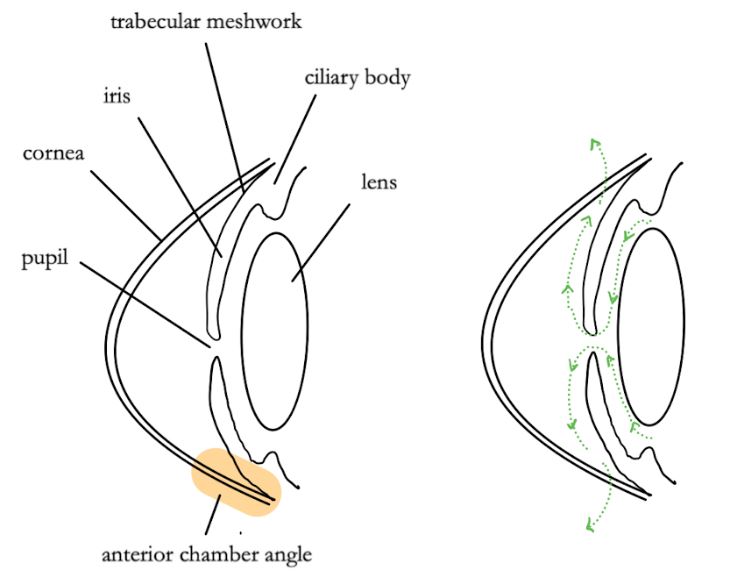
Classification of glaucoma
Primary glaucoma is classified by the cause of the outflow obstruction:
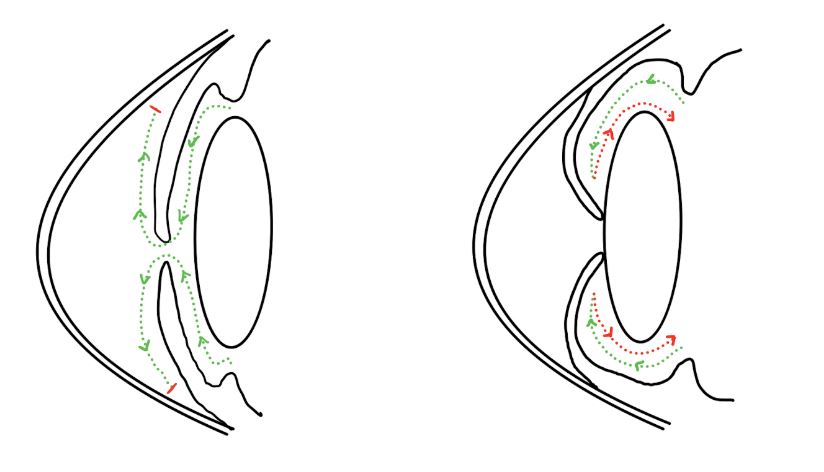
- Open-angle glaucoma: the anterior chamber angle remains open, but outflow is impaired nonetheless, perhaps secondary to structural changes in the trabecular meshwork (Figure 8).
- Closed-angle glaucoma: the peripheral iris is pushed against the trabecular meshwork, blocking outflow. In acute cases, this is often secondary to pupillary block, where the iris comes into contact with the lens, causing a buildup of aqueous humour, which in turn causes the iris to bow outwards, closing the anterior chamber angle (Figure 9).
Secondary glaucoma has various causes including drugs, trauma and inflammation.
Fundoscopy findings in glaucoma
Fundoscopy typically shows cupping of the optic disc (a raised cup to disc ratio).

Primary open-angle glaucoma
Clinical findings in open-angle glaucoma
The prevalence of primary open-angle glaucoma increases with age, though is equally common in males and females. Family history is a risk factor, as is afro-caribbean heritage. It is often asymptomatic until relatively advanced disease at which point there may be painless visual loss.
Typical examination findings include a normal appearance of the sclera and cornea (in contrast to acute closed-angle glaucoma). Peripheral visual field loss may be present in advanced disease.
Management of open-angle glaucoma
Management of open-angle glaucoma aims to reduce intraocular pressure. February 2023 NICE guidelines suggest the following:
- First line:
- Laser trabeculoplasty, during which a laser is used to improve drainage of aqueous humour through the trabecular meshwork
- If trabeculoplasty is not available or the patient prefers medical therapy, a generic prostaglandin analogue (PGA) should be prescribed, such as bimatoprost or latanoprost
- Second line:
- An alternative PGA
- Topical beta blockers, such as timolol
- Other topical medications including miotics, sympathomimetics, or carbonic anhydrase inhibitors
Note that topical non-selective beta blockers have been shown to increase asthma morbidity and should therefore be avoided in asthmatic patients.
Acute primary closed-angle glaucoma
Acute primary closed-angle glaucoma is rarer than open-angle glaucoma. The condition is three times more common in females than males, and hypermetropia (being long sighted) is also a risk factor. Acute closed-angle glaucoma is important as a potentially sight-threatening emergency, although it is much more common for patients to have a chronic process which may well be asymptomatic.
Clinical findings in closed-angle glaucoma
Acute closed-angle glaucoma presents with severe discomfort, which may be in the form of a headache rather than eye pain. A typical history includes onset of pain after sitting in a darkened room as dilatation of the pupil can precipitate angle closure. There may also be photophobia, eye watering and loss of vision. The patient may be systemically unwell with nausea, vomiting or abdominal pain (via the oculo-trigemino-vago-abdominal reflex).
The patient may previously have had symptoms of intermittent closed-angle glaucoma, such as self-resolving episodes of eye ache, blurred vision and seeing halos around lights.
Typical examination findings include a red eye, cloudy cornea, a fixed dilated pupil and reduced acuity (Figure 11).
Management of closed-angle glaucoma
This includes immediate ophthalmology referral and admission.
Initial management is medical, with the aim of relieving symptoms and lowering IOP. This includes IV acetazolamide and topical beta-blockers (e.g. timolol).
Definitive management is laser iridotomy to create a hole in the iris through which aqueous humour can flow, equalising pressure in the anterior and posterior compartments, which pushes back the iris and opens up the anterior chamber angle. The contralateral eye is often treated too, prophylactically, as it will likely share anatomical features predisposing to the condition.
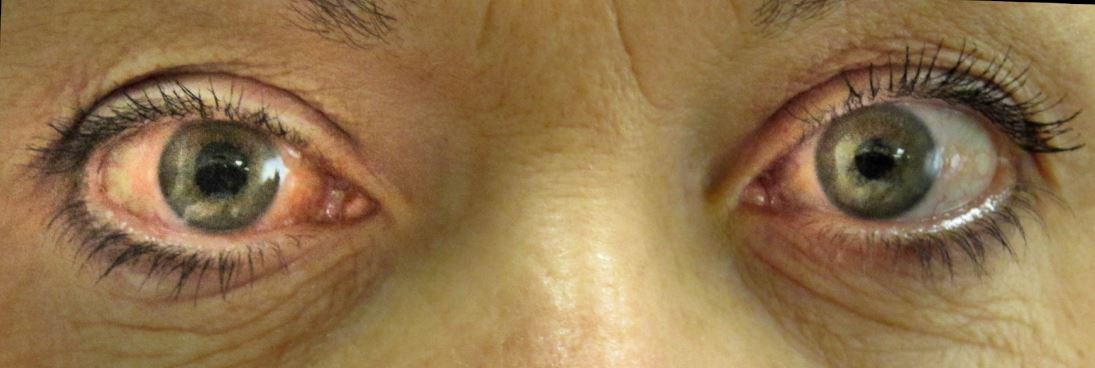
Image Source: Wikimedia Commons (2020). Acute angle closure glaucoma., Licensed under a creative commons licence. Available for free at: https://en.m.wikipedia.org/wiki/File:Acute_angle_closure_glaucoma.JP, via Wikimedia Commons (Accessed: 18 January 2024).
References
- James B, Bron AJ, Parulekar MV. Lecture notes. Ophthalmology. 12th ed. Chichester, West Sussex, UK: Wiley Blackwell; 2017
- Amerasinghe N. Open-angle glaucoma [Internet]. BMJ Best Practice. 2018 [cited 2022 Jan 29]. Available from: https://bestpractice.bmj.com/topics/en-gb/373
- Khondkaryan A, Francis BA. Angle-closure glaucoma [Internet]. BMJ Best Practice. 2019 [cited 2021 Nov 13]. Available from: https://bestpractice.bmj.com/topics/en-gb/372
- Morales DR, Dreischulte T, Lipworth BJ, Donnan PT, Jackson C, Guthrie B. Respiratory effect of beta-blocker eye drops in asthma: population-based study and meta-analysis of clinical trials. Br J Clin Pharmacol. 2016 Sep;82(3):814-22. doi: 10.1111/bcp.13006. Epub 2016 Jun 17. PMID: 27161880; PMCID: PMC5338116
- National Institute for Health and Care Excellence. Scenario: Primary open angle glaucoma and ocular hypertension [Internet]. NICE. 2023 [cited 2023 Jun 24]. Available from: https://www.nice.org.uk/guidance/ng81/chapter/Recommendations#treatment
Complete Guide to Clinical Genetics ST3 Application and Recruitment (2027)
Written by Medibuddy. Last updated: October 2026. Clinical Genetics is

Complete Guide to Clinical Radiology ST3 Application and Recruitment (2027)
Recruitment paused: NHS England is not running Clinical Radiology ST3+ recru

Complete Guide to Paediatric Surgery ST3 Application and Recruitment in United Kingdom (2026)
Written by Medibuddy. Last updated: October 2026. If you’re planning


Take your subscriptions with you
Our mobile app allows you to access your interview and exam question banks wherever you are.

