


 Close
Close
 30th May 2026
ST-Elevation Myocardial Infarction (STEMI)
Background
ST-elevation myocardial infarction (STEMI) is a type of acute myocardial infarction caused by complete atherothrombotic occlusion of a coronary artery, leading to myocardial cell death due to oxygen supply-demand mismatch.
Diagnostic Criteria
- Persistent ST-segment elevation in at least two contiguous ECG leads:
- ≥2.5 mm (men <40 years)
- ≥2 mm (men >40 years)
- ≥1.5 mm (women, all ages)
Epidemiology
STEMI incidence has declined over the past two decades, but saw a 16% increase in 2021-22 due to post-COVID-19 effects. In the UK, STEMI accounts for ~3% prevalence and 1.2 million hospitalisations annually.
Risk Factors
- Lifestyle: Smoking, obesity, physical inactivity, poor diet, cocaine use.
- Chronic conditions: Hypertension, diabetes, dyslipidemia, atherosclerosis.
- Demographics: Age >60, family history, prior stent thrombosis, sleep apnea, depression.
Aetiology & Pathophysiology
- Coronary Artery Disease (CAD): Plaque rupture or fissuring leads to thrombus formation and complete occlusion.
- Plaque Formation: LDL accumulation, foam cell formation, smooth muscle migration, and potential rupture.
- Myocardial Ischaemia: Occlusion halts contractile function, leading to necrosis and infarct zone expansion.
Fourth Universal Definition of MI
- Type 1: Atherothrombotic MI (e.g., STEMI, NSTEMI).
- Type 2: Oxygen supply-demand imbalance.
- Type 3: Sudden cardiac death with symptoms before biomarker confirmation.
Diagnosis
Investigations
- Immediate Actions: ECG within 10 minutes, assess hemodynamic status, and consider reperfusion therapy (primary PCI or fibrinolysis).
- Symptoms: Central chest pain, radiating to the arm, neck, or jaw, with nausea or syncope.
- Cardiac Biomarkers: Elevated troponins confirm diagnosis but should not delay reperfusion therapy.
- ECG Findings: ST-elevation criteria based on gender and age, and consider posterior STEMI or left main coronary artery obstruction.
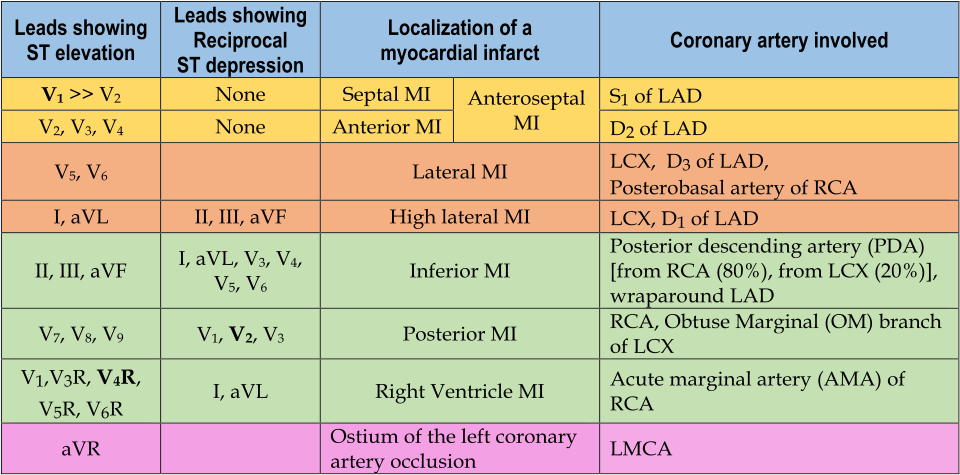
Localisation of ST-elevation MI, from: Image Source: Wikimedia Commons (2020), ECG AVNRT, Licenced under a creative commons licence. Available for free at: https://commons.wikimedia.org/wiki/File:Localisation_of_the_occlusion_in_STEMI.svg (Accessed: 25 April 2026).
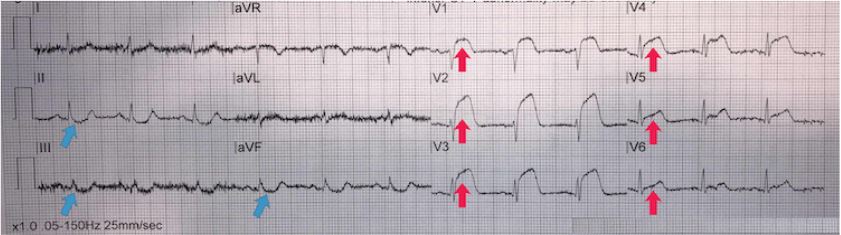
Anterior STEMI. From the personal collection of Dr Aung Myat (used with permission)
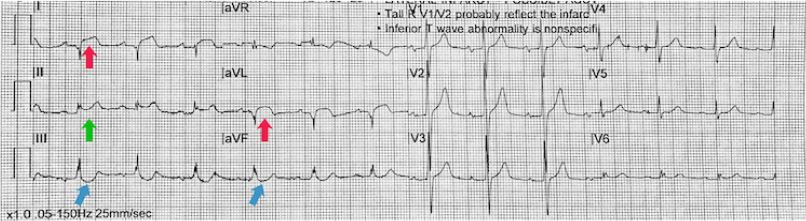
High lateral STEMI. From the personal collection of Dr Aung Myat (used with permission)
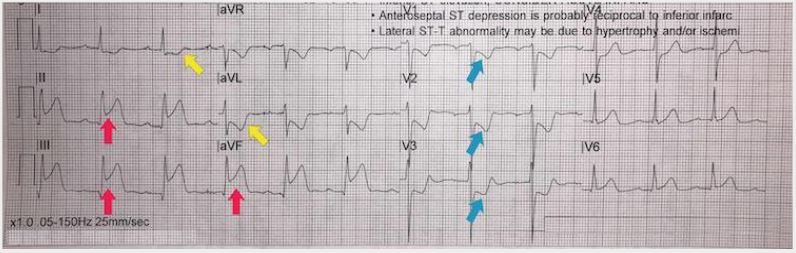
Inferoposterior STEMI example II. From the personal collection of Dr Aung Myat (used with permission)
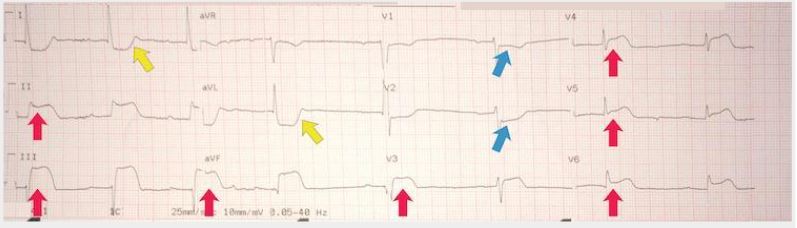
Inferoposterolateral STEMI example III. From the personal collection of Dr Aung Myat (used with permission)
Management
Emerging Treatments:
- Factor Xa Inhibitors: Rivaroxaban reduces cardiovascular events but increases bleeding risk.
- Colchicine: Low-dose colchicine for long-term secondary prevention in ACS patients.
Clinical Diagnosis and Immediate Action
- Diagnose STEMI based on signs of myocardial ischaemia + persistent ST elevation in two or more contiguous leads on ECG.
- Do not wait for cardiac troponin results before initiating treatment.
- Administer a single loading dose of aspirin (unless hypersensitive).
- Begin reperfusion therapy (primary PCI or fibrinolysis) promptly.
- Primary PCI is preferred if feasible within 120 minutes of symptom onset.
- Fibrinolysis if PCI is not timely, using alteplase or tenecteplase.
- Begin dual antiplatelet therapy (aspirin + P2Y12 inhibitor).
- Provide pain relief (opioids are preferred agents) and antiemetics.
- Use oxygen only if oxygen saturation is <90%.
- Consider nitrates for persistent pain or hypertension, but avoid if hypotension is present.
Coronary Reperfusion Therapy
- Primary PCI is the preferred strategy if symptom onset is within 12 hours and PCI can be performed within 120 minutes.
- If PCI cannot be delivered within 120 minutes, fibrinolysis is recommended.
- If fibrinolysis is given, assess success via ECG after 60-90 minutes.
- If fibrinolysis fails, perform immediate coronary angiography and PCI.
- In elderly patients, although bleeding risk is higher, if candidates for fibrinolysis, the benefits of early reperfusion generally outweigh the risks
Contraindications to fibrinolysis
- Absolute:
- Prior intracranial haemorrhage/stroke
- Recent ischemic stroke (<6 months)
- CNS damage/neoplasm/AV malformation
- Recent major trauma/surgery/head injury (<1 month)
- GI bleeding (<1 month)
- Known bleeding disorders
- Aortic dissection
- Non-compressible punctures (<24h)
- Relative
- TIA (<6 months)
- Oral anticoagulant use
- Pregnancy or <1 week postpartum
- Refractory hypertension (SBP >180 mmHg, DBP >110 mmHg)
- Advanced liver disease
- Infective endocarditis
- Active peptic ulcer
- Prolonged or traumatic resuscitation
Anticoagulation and Antithrombotic Therapy
- Avoid anticoagulants if the patient is eligible for primary PCI (PCI team will start anticoagulation).
- Following PCI, DAPT should be commenced in all patients (aspirin and P2Y12 inhibitor combination, e.g. clopidogrel, ticagrelor), and typically continued for at least 12 months.
- If fibrinolysis is used, start anticoagulation (enoxaparin or unfractionated heparin).
Special Considerations
- Out-of-hospital cardiac arrest: If there is ST elevation on post-ROSC ECG, proceed with PCI.
- Cardiogenic shock: Immediate senior support and PCI are recommended.
- Late presentation (>12 hours after symptom onset): Consider coronary angiography or PCI if there is ongoing ischaemia, haemodynamic instability, or arrhythmias.
Timing Targets
- Aim for rapid delivery of reperfusion therapy (PCI or fibrinolysis).
- Optimal outcomes are achieved when reperfusion is done as early as possible.
| Interval | Target |
| First medical contact to ECG and STEMI diagnosis | <10 minutes |
| STEMI diagnosis to primary PCI | <120 minutes
If this time target cannot be met, consider fibrinolysis |
| STEMI diagnosis to primary PCI if the patient’s first medical contact is at a hospital | <60 minutes if the patient presents to or is in a PCI-capable hospital
<90 minutes if the patient presents to or is in a non-PCI-capable hospital and needs transferring |
| STEMI diagnosis to administration of a bolus/infusion of a fibrinolytic drug (if primary PCI cannot be accessed within 120 minutes) | <10 minutes |
| Start of fibrinolysis to ECG assessment of its success or failure | 60-90 minutes |
| If fibrinolysis is successful, time interval from starting fibrinolysis to early coronary angiography | 2-24 hours |
Long-Term Management of STEMI
Medications
- Aspirin: Continue lifelong, with a P2Y12 inhibitor for up to 12 months as part of dual antiplatelet therapy.
- ACE inhibitor: For patients with reduced ejection fraction or heart failure.
- Beta-blocker: To reduce the risk of reinfarction and improve survival.
- Statin: To manage cholesterol and reduce cardiovascular risk.
Cardiac Rehabilitation and Risk Factor Modification
- Enrol in cardiac rehabilitation to improve recovery and reduce the risk of future events.
- Address modifiable risk factors for cardiovascular disease, including:
- Smoking cessation
- Blood pressure control
- Diabetes management
- Dietary changes and exercise
- Weight management
These measures are crucial for improving long-term outcomes, preventing reinfarction, and reducing the risk of complications.
Prevention and Follow-up
- Primary Prevention: Encourage lifestyle changes and medications (statins) for high-risk individuals.
- Secondary Prevention: Lifestyle modifications, cardiac rehabilitation, medications (dual antiplatelet therapy, beta-blockers, statins, ACE inhibitors).
- Follow-up: Survivors should be evaluated within 2-3 weeks post-discharge. Continue optimal medical therapy and assess ejection fraction.
Complications
- Short-term: Sinus bradycardia, heart block, recurrent chest pain, acute mitral regurgitation, ventricular septal defects, and pericarditis.
- Long-term: Congestive heart failure, recurrent ischemia, depression, ventricular arrhythmias.
Prognosis
The prognosis is better with early reperfusion, adherence to therapy, and risk factor modification. In-hospital mortality is around 9%, and elevated troponin levels indicate a worse prognosis. Major bleeding events increase 1-year mortality risk. Evidence-based treatments improve patient outcomes.
Complete Guide to Clinical Genetics ST3 Application and Recruitment (2027)
Written by Medibuddy. Last updated: October 2026. Clinical Genetics is

Complete Guide to Clinical Radiology ST3 Application and Recruitment (2027)
Recruitment paused: NHS England is not running Clinical Radiology ST3+ recru

Complete Guide to Paediatric Surgery ST3 Application and Recruitment in United Kingdom (2026)
Written by Medibuddy. Last updated: October 2026. If you’re planning


Take your subscriptions with you
Our mobile app allows you to access your interview and exam question banks wherever you are.

