


 Close
Close
 4th June 2025
Polycythaemia
Polycythaemia refers to an increase in the red cell mass in the blood (erythrocytosis), this can be due to either a primary myeloproliferative disorder (polycythaemia vera – PV) or secondary to chronic hypoxia (e.g. due to underlying lung disease +/- sleep apnoea). Less commonly, polycythaemia may be present due to an erythropoietin-secreting tumour, exogenous steroid use or a congenital disorder. The increase in red cell mass produces clinical signs and symptoms related to hyperviscosity of the blood; we will focus on the skin manifestations of polycythaemia in this sub-chapter.
Epidemiology
Current data indicates that PV is most common in white people aged 60 and above, with the median age of diagnosis at 65 years. PV has been reported more frequently in people of Ashkenazi Jewish descent, and it is very rarely diagnosed in children (fewer than 100 documented cases). However, there is little research data available on PV outside of the USA and Europe.
Skin manifestations of polycythaemia
The skin manifestations of polycythaemia are due to the increased red cell volume of the blood (and hence increased circulating blood volume) and hyperviscosity of the blood.
- Plethoric complexion
- As polycythaemia progresses, the venules and capillaries in the skin must distend to accommodate the increase in blood volume
- Leads to a ruddy and plethoric complexion
- The face, palms, earlobes and mucous membranes of the eyes are frequently affected.
- Aquagenic pruritus
- Itchy skin triggered by water contact – is another skin manifestation of polycythaemia.
- Cause unknown but multiple underlying mechanisms have been suggested – such as the release of inflammatory mediators from mast cell degranulation or platelet aggregation.
- Erythromelalgia
- Condition that produces intermittent attacks of redness and a burning pain of the feet and hands.
- It can be a primary condition in itself, or secondary to haematological disorders such as polycythaemia.
- When associated with polycythaemia, it is thought that increased platelet activation causes the formation of thrombi in arterioles within the distal extremities; this results in tissue hypoxia and pain.
- Livedo reticularis describes
- A net-like (or reticular) skin discolouration, with purplish rings surrounding a paler centre.
- Results from impaired blood flow to the skin; in polycythaemia, this is due to the viscous blood flowing sluggishly through the blood vessels in the skin.
Diagnosis
Dermatological findings in polycythaemia:
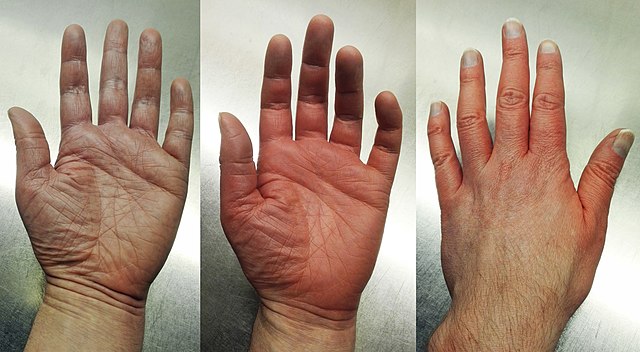

Medical management
The management of polycythaemia depends on the underlying cause; there is no cure for PV and so management focuses on symptomatic relief and the prevention of complications. For PV patients under 60 years and at low-risk of thrombosis, phlebotomy and low-dose aspirin are first-line treatments. For PV patients over 60 years and/or at high-risk of thrombosis, cytoreductive therapy (such as with hydroxycarbamide) and low-dose aspirin are first-line. As a result, the reduction in circulating red cell volume should improve some of the skin manifestations of polycythaemia.
For aquagenic pruritus several different treatments have been suggested, such as antihistamines, aspirin, SSRIs and JAK2 inhibitors in refractory cases.
For erythromelalgia secondary to polycythaemia, aspirin is the first-line treatment.
Complications
PV can progress to post-PV myelofibrosis, a form of bone marrow malignancy where the bone marrow becomes scarred. Current evidence suggests that none of the treatment options for PV will reduce the likelihood of progression to myelofibrosis. PV may also transform into an acute leukaemia, the prognoses for these patients are poor.
Complete Guide to Clinical Genetics ST3 Application and Recruitment (2027)
Written by Medibuddy. Last updated: October 2026. Clinical Genetics is

Complete Guide to Clinical Radiology ST3 Application and Recruitment (2027)
Recruitment paused: NHS England is not running Clinical Radiology ST3+ recru

Complete Guide to Paediatric Surgery ST3 Application and Recruitment in United Kingdom (2026)
Written by Medibuddy. Last updated: October 2026. If you’re planning


Take your subscriptions with you
Our mobile app allows you to access your interview and exam question banks wherever you are.

