


 Close
Close
 5th May 2025
Acute Bradyarrhythmias
In the peri-arrest setting, bradyarrhythmias are managed as per Advanced Life Support guidelines. Initial assessment should always begin with a systematic ‘A to E’ approach followed by ensuring an oxygen supply (if appropriate) and IV access are established. Initial investigations include oxygen saturations, blood pressure and 12-lead ECG monitoring. Evaluation and treatment of any reversible causes (electrolyte derangement, drugs & toxins) is crucial at this stage. Atropine may be used initially to block parasympathetic tone, followed by a positive chronotropic and inotropic agent such as isoprenaline or adrenaline. Non-invasive temporary pacing may be implemented for bradycardias that cause haemodynamic compromise and are unresponsive to atropine – illustrated in Figure 2 below. Pulseless electrical activity is defined as ‘organised cardiac electrical activity in the absence of any palpable pulses. In PEA, there is myocardial contraction sufficient to cause some detectable electrical potential but not sufficient to produce any cardiac output. Management of PEA arrest is as per ALS guidelines (CPR and alternate cycles of adrenaline every 2-minutes). Unless PEA arrest is due to a reversible cause, survival is often unlikely. Asystole is defined as ‘absence of electrical activity on the ECG trace’. When diagnosing asystole, care must be taken to not miss ventricular standstill, which may be reversible and is discussed below.
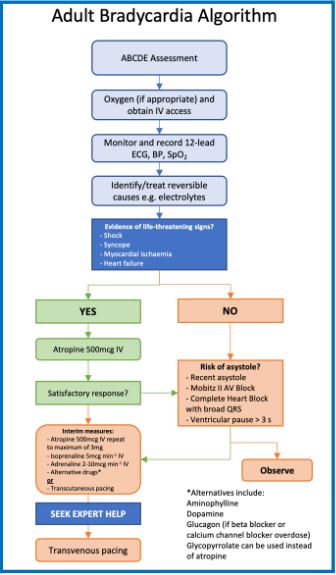
Image Source: Wikimedia Commons (2021). Bradycardia Algorithm, Licensed under a creative commons licence. Available for free at: https://www.resus.org.uk/sites/default/files/2021-04/Bradycardia%20Algorithm%202021.pdf (Accessed 1 May 2025).
Ventricular standstill (VS) is a rare arrhythmia wherein there is no ventricular activity. ECG classically shows p waves with no QRS – it is also hence referred to as ‘p-wave asystole’. Due to there being no flow of blood through the ventricles, there is very high risk of sudden cardiac death. In the acute setting, VS requires temporary pacing wire insertion to prevent further ischaemic damage to the myocardium. Definitive treatment of VS is with permanent pacemaker insertion.
Complete Guide to Clinical Genetics ST3 Application and Recruitment (2027)
Written by Medibuddy. Last updated: October 2026. Clinical Genetics is

Complete Guide to Clinical Radiology ST3 Application and Recruitment (2027)
Recruitment paused: NHS England is not running Clinical Radiology ST3+ recru

Complete Guide to Paediatric Surgery ST3 Application and Recruitment in United Kingdom (2026)
Written by Medibuddy. Last updated: October 2026. If you’re planning


Take your subscriptions with you
Our mobile app allows you to access your interview and exam question banks wherever you are.

