


 Close
Close
 4th May 2025
Accessory Pathways
Background
Wolff-Parkinson-White (WPW) Syndrome is caused by an accessory conduction pathway between the atria and the ventricles leading to an atrioventricular reentry tachycardia (AVRT). This accessory pathway is also called the bundle of Kent which allows electrical impulses generated by the Sino-atrial node to bypass the AV node. This accessory pathway allows electrical impulses to be conducted quicker than the AV node, resulting in a shorter PR interval which brings about the characteristic Delta wave seen in ECGS. WPW has an incidence of 0.1-0.3 per 1000.
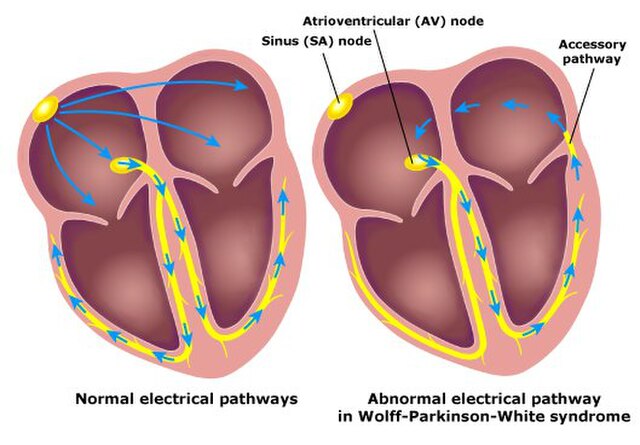
Image Source: Wikimedia Commons (2011). Wolf, Parkinson and White. Licenced under a creative commons licence. Available for free at: https://commons.wikimedia.org/w/index.php?search=wolf+parkinson+white&title=Special:MediaSearch&go=Go&type=image (Accessed: 1 May 2025).
Associations with WPW syndrome
- Hypertrophic Cardiomyopathy (HCM)
- Mitral valve prolapse
- Ebstein’s Anomaly
Clinical manifestations
Most patients who present with an arrhythmia will present with one or more of the following symptoms:
- Palpitations
- Chest pain
- Light-headedness or dizziness
- Syncope or presyncope
- Sudden cardiac death
ECG features in WPW
- Short PR interval <120ms
- Slurred upstroke of a wide QRS complex – ‘delta wave’
- Prolonged QRS >110ms
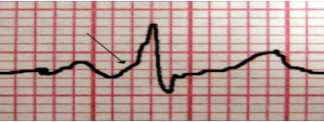
Image Source: Wikimedia Commons (2020). Delta Wave, Licensed under a creative commons licence. Available for free at: https://upload.wikimedia.org/wikipedia/commons/thumb/e/e9/DeltaWave09.JPG/640px- DeltaWave09.JPG (Accessed: 1 May 2025).
Arrhythmias associated with WPW
Atrial Fibrillation is seen in about 10-30% of patients with WPW syndrome. The presence of an accessory pathway in WPW allows the rapid conduction of atria signals to the ventricles as it bypasses the AV node. This results in rapid ventricular rates that may result in VT or VF.
Medical management
The general principle in managing patients with WPW is to prevent electrical impulses from travelling through the accessory pathway. Hence any AV nodal blocking drugs such as Adenosine, Beta blockers and Calcium channel blockers are contraindicated as blocking the AV node will allow uncontrolled electrical impulses down the accessory pathway potentially leading to VT/VF and cardiac arrest.
Drugs used to treat WPW include
- Flecainide (In the absence of structural heart disease)
- Amiodarone
- Procainamide
Surgical management
Definitive treatment options include Catheter ablation or Surgical ablation. Efficacy of catheter- based ablation is around 85%to 95% but this is mainly dependent on the location of the accessory pathway.
Complete Guide to Clinical Genetics ST3 Application and Recruitment (2027)
Written by Medibuddy. Last updated: October 2026. Clinical Genetics is

Complete Guide to Clinical Radiology ST3 Application and Recruitment (2027)
Recruitment paused: NHS England is not running Clinical Radiology ST3+ recru

Complete Guide to Paediatric Surgery ST3 Application and Recruitment in United Kingdom (2026)
Written by Medibuddy. Last updated: October 2026. If you’re planning


Take your subscriptions with you
Our mobile app allows you to access your interview and exam question banks wherever you are.

