


 Close
Close
 4th May 2025
Atrioventricular Nodal Reentry Tachycardia (AVNRT)
AVNRT typically occurs in younger people. It is usually paroxysmal and may occur spontaneously. It may have a trigger such as alcohol intoxication, nicotine, stress, concurrent illness, caffeine or stimulants such as amphetamines.
Brief pathophysiology of ‘Slow-Fast AVNRT’
AVNRT results from having dual AV nodal pathways within the AV node itself. There is a fast pathway which conducts rapidly but has a long refractory period, and there is a slow pathway which conducts slowly but a short refractory period. During normal sinus rhythm, electrical impulses travel down both pathways simultaneously and cancel each other out.
However, a premature atrial contraction disrupts this as while the fast pathway is still in a refractory period, electrical impulses would then have to solely travel down the slow pathway as it is no longer in refractory period. By the time the premature impulses reach the distal end of the slow pathway, the fast pathway is no longer in a refractory period which allows impulses to travel retrogradely up the fast pathway.
Hence, a ‘re-entrant’ circuit is created as impulses are now continuously cycling around both pathways activating the bundle of His anterogradely and the atria retrogradely.
Clinical manifestations
Symptoms arise from the tachycardia generated and they include:
- Palpitations
- Chest pain
- Light-headedness or dizziness
- Syncope or presyncope
- Breathlessness
- Anxiety
ECG features
- P waves hidden within QRS complexes
- Late P waves resulting in Pseudo R wave/second R wave
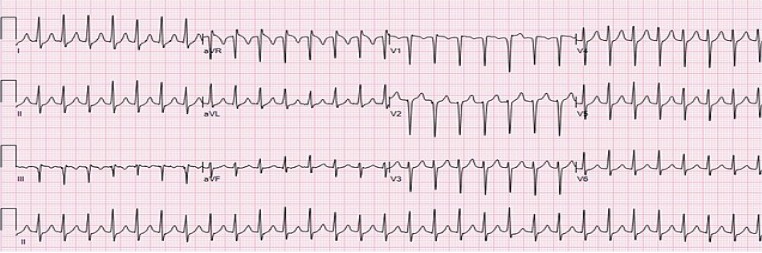
Image Source: Wikimedia Commons (2020), ECG AVNRT, Licenced under a creative commons licence. Available for free at: https://commons.wikimedia.org/wiki/File:ECG_AVNRT_181_bpm.jpg (Accessed: 1 May 2025).
Medical management
The principle in managing AVNRT is inhibiting AV nodal activity as this is the driver for the tachycardia. This can be achieved via vagal manoeuvres and medication. Vagal manoeuvres work by increasing vagal parasympathetic tone. DCCV is rarely required unless the patient is haemodynamically unstable or refractory to medical cardioversion.
1st line therapy: Vagal manoeuvres:
- Blowing into an empty 10ml syringe
- Carotid sinus massage (contraindicated in carotid disease due to the risk of stroke)
- Modified Valsalva Manoeuvre: head down, legs up
2nd line therapy: Adenosine
- This is given IV 6mg, then 12mg and then followed by 18mg
- Contraindicated in asthma due to bronchoconstriction
- Safe to give in pregnancy as does not significantly cross the placenta
- Dipyridamole enhances the effect of adenosine, whereas Theophylline is a potent adenosine receptor antagonist
3rd line therapy: Beta blockers or Calcium channel blockers
- IV Metoprolol or Verapamil
- If 3rd line treatment ineffective, DCCV should be attempted with appropriate sedation and anaesthetic support
Complete Guide to Clinical Genetics ST3 Application and Recruitment (2027)
Written by Medibuddy. Last updated: October 2026. Clinical Genetics is

Complete Guide to Clinical Radiology ST3 Application and Recruitment (2027)
Recruitment paused: NHS England is not running Clinical Radiology ST3+ recru

Complete Guide to Paediatric Surgery ST3 Application and Recruitment in United Kingdom (2026)
Written by Medibuddy. Last updated: October 2026. If you’re planning


Take your subscriptions with you
Our mobile app allows you to access your interview and exam question banks wherever you are.

