


 Close
Close
 6th July 2026
Diagnosis
Suspicion for DVT is based on history and clinical presentation. Signs and symptoms include pain and tenderness over the affected area. NICE guidelines suggest the following pathway in the initial diagnosis and management of DVT:
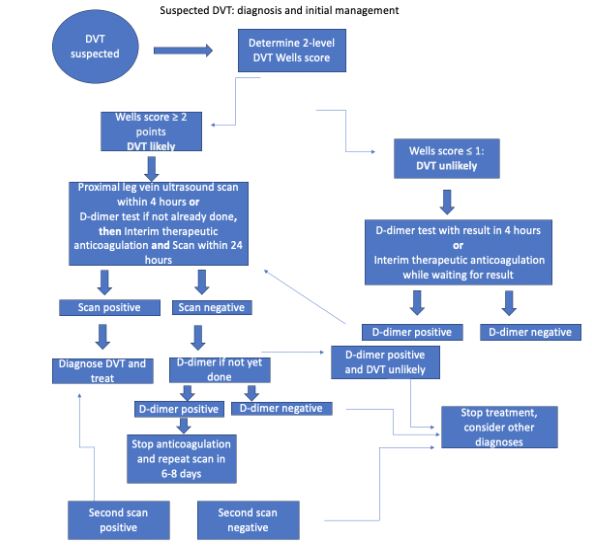
Figure 1: Suspected DVT diagnosis and initial management, adapted from NICE guidelines: Venous thromboembolic diseases: diagnosis, management and thrombophilia testing
Image Source: Wikimedia Commons (2023). Visual Summary, Licensed under a creative commons licence. Available for free at: https://www.nice.org.uk/guidance/ng158/resources/visual-summary-pdf-11193380893 (Accessed 8 May 2025).
The components of the Wells score have been summarised into the table below:
| Clinical feature | Points |
|---|---|
| Active cancer (patient either receiving treatment within the last 6 months, or is palliative) | 1 |
| Paralysis, paresis, or (recent) plaster immobilisation of the lower limbs | 1 |
| 1 | |
| Localised tenderness along the distribution of the deep venous system | 1 |
| Swelling of the entire leg | 1 |
| Swelling of the calf at least 3 cm larger than on the asymptomatic side (to be measured 10 cm below the tibial tuberosity) | 1 |
| Pitting oedema of only the symptomatic side | 1 |
| Collateral superficial veins (non-varicose) | 1 |
| History of previous DVT | 1 |
| Alternative diagnosis at least as likely as DVT | -2 |
| DVT likely | 2 points or more |
| DVT unlikely | 1 point or less |
Table 5- 2 Level DVT Wells Score (adapted from: https://www.nejm.org/doi/full/10.1056/NEJMoa023153)
Complete Guide to Clinical Genetics ST3 Application and Recruitment (2027)
Written by Medibuddy. Last updated: October 2026. Clinical Genetics is

Complete Guide to Clinical Radiology ST3 Application and Recruitment (2027)
Recruitment paused: NHS England is not running Clinical Radiology ST3+ recru

Complete Guide to Paediatric Surgery ST3 Application and Recruitment in United Kingdom (2026)
Written by Medibuddy. Last updated: October 2026. If you’re planning


Take your subscriptions with you
Our mobile app allows you to access your interview and exam question banks wherever you are.

