


 Close
Close
 6th July 2026
VTE in pregnancy and malignancy
Investigation and management of VTE in pregnancy
Pregnancy, in and of itself, is a risk factor for thromboembolism. In preparation for delivery, the body goes into a procoagulant state, to combat the risk of any haemorrhage during or after delivery.
If DVT is suspected, compression duplex ultrasound of the leg should be done. If this is negative AND there is low clinical suspicion, anticoagulation can be stopped.
In all women presenting with signs and symptoms of PE, ECG and CXR should be performed, as well as baseline bloods. If there is concurrent presentation of DVT, duplex ultrasound should be performed. Otherwise, V/Q scan or CTPA should be done. If the CXR is abnormal, CTPA is preferential to a V/Q scan. Both CTPA and V/Q scans will expose the patient and foetus to ionising radiation with V/Q scans causing a slight increase in the risk of cancer developing in childhood but producing a lower dose of radiation to breast tissue (which is more sensitive to radiation during pregnancy). The absolute risk for both is minimal, however patients should be counselled on the risks and consented:
V/Q scans produce a lower dose of radiation to breast tissue (breast tissue is more sensitive to radiation during pregnancy) but carries a slightly increased risk of childhood cancer
CTPA scans will give a smaller dose of radiation to the foetus
The first line management for VTE is low molecular weight heparin (LMWH), and should be started if DVT/PE is clinically suspected, even if imaging has not yet been performed (unless there is a strong contraindication to treatment). Continue to treat with therapeutic doses of subcutaneous LMWH throughout the rest of the pregnancy, and for 6 weeks postnatally – a minimum total of 3 months. In the haemodynamically unstable patient, rapid assessment by the on-call team (including the consultant obstetrician) is crucial. Patients with a massive PE who are haemodynamically unstable should be treated with IV unfractionated heparin.
The same mechanical treatments are available for use in pregnancy under certain circumstances, and would require specialist input.
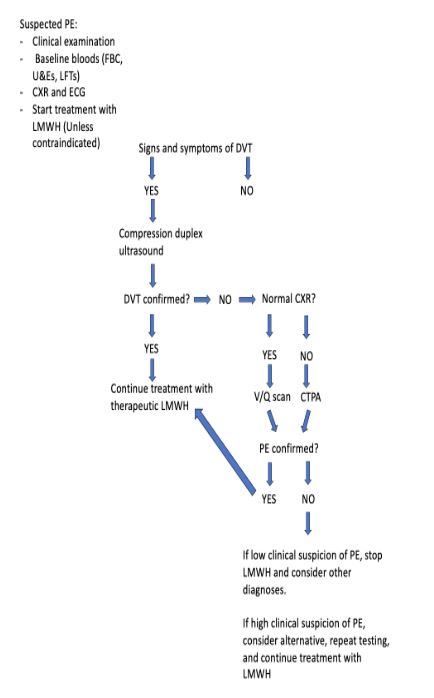
Figure 4 – Algorithm for the investigation and initial management of suspected PE in pregnancy and puerperium. (Adapted from the RCOG guidelines for Thromboembolic Disease in Pregnancy and Puerperium: Acute Management: https://www.rcog.org.uk/media/wj2lpco5/gtg-37b-1.pdf
VTE in Malignancy
Malignancy, like pregnancy, is a risk factor for VTE. Chemotherapy increases the risk sevenfold, compared to patients without cancer. It would be wise to have a low threshold for suspicion of VTE. Investigations should follow the guideline as per above. Management is a complex decision that should be discussed with the MDT. If DVT/PE is confirmed, consider treating with a DOAC. If inappropriate, consider treatment with LMWH +/- a vitamin K antagonist (LMWH is usually discontinued once INR is >2, and warfarin then continued as a monotherapy).
Complications
The commonest complications of a DVT include a PE and post-thrombotic syndrome. In post-thrombotic syndrome, a chronic condition, the thrombus obstructs blood flow, resulting in venous hypertension and valvular incompetence. This can lead to chronic venous insufficiency. As a result, patients may have leg pain, oedema, a feeling of “heaviness,” and skin hyperpigmentation.
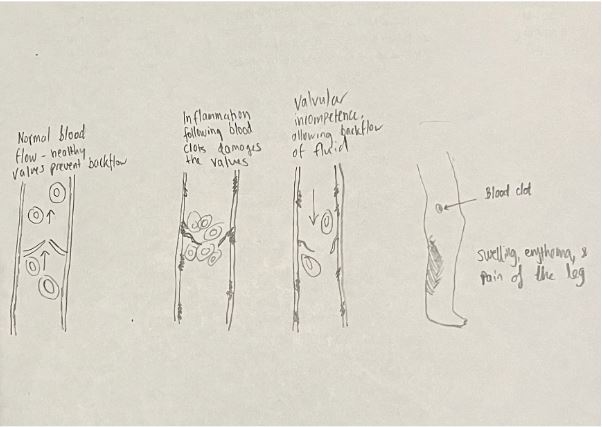
Figure 5 – Pathophysiology of post-thrombotic syndrome
Complications of a PE can be life threatening, and include recurrent thromboembolisms, right heart failure, and cardiogenic shock. When a thrombus occludes a pulmonary artery, it may cause a part of the lung to infarct. This is rare as the lung’s bronchial circulation is not disrupted and is generally adequate. However, if there is an infarct, the pressure in the pulmonary arterial bed may rise, causing cardiac output to drop. Eventually, the patient may go into shock.
Complications related to treatment
- Bleeding
- Heparin induced thrombocytopaenia
Important considerations for VTE treatment (PE and DVT)
PE with haemodynamic instability
- Unfractionated heparin infusion or thrombolysis
Renal impairment, active malignancy, or antiphospholipid syndrome
Medications may be unlicenced so seek specialist advice
Renal impairment: calculate creatinine clearance and prescribe as per NICE or local trust policy
Active cancer: consider initial treatment with DOAC
Antiphospholipid syndrome: LMWH and a vitamin K antagonist (e.g., warfarin) for either 5 days or until INR > 2 on two consecutive readings, then vitamin K antagonist alone
Body weight
- If patient is <50 kg or >120kg, consider monitoring of therapeutic levels of anticoagulation – seek specialist advice
Investigations to guide treatment
- Full blood count, renal function, liver function, coagulation screen (PT, APTT, INR)
- Do not delay urgent treatment whilst awaiting results, but may need doses adjusting subsequently
Medical management for patients without renal impairment, active malignancy, antiphospholipid syndrome, who are haemodynamically stable
- Apixaban and rivaroxaban advised by NICE
- If contraindicated, refer to trust guidelines and seek specialist advice
Length of treatment
- At least 3 months of treatment should be considered for the majority of patients
- Patients with underlying comorbidities such as active malignancy may require longer duration of treatment (up to 6 months). Treatment should be reviewed after 3 months
Monitoring
- Requires monitoring by a community or hospital team, depending on local services and policy
- Self-monitoring of INR and dose adjustment should not be routinely offered
Treatment failure
- If treatment fails (i.e., patient develops a further VTE on treatment), check compliance with treatment, screen for other causes of hypercoagulability, consider dose adjustments, or consider changing to an alternative anticoagulant
Complete Guide to Clinical Genetics ST3 Application and Recruitment (2027)
Written by Medibuddy. Last updated: October 2026. Clinical Genetics is

Complete Guide to Clinical Radiology ST3 Application and Recruitment (2027)
Recruitment paused: NHS England is not running Clinical Radiology ST3+ recru

Complete Guide to Paediatric Surgery ST3 Application and Recruitment in United Kingdom (2026)
Written by Medibuddy. Last updated: October 2026. If you’re planning


Take your subscriptions with you
Our mobile app allows you to access your interview and exam question banks wherever you are.

