


 Close
Close
 5th June 2025
Tuberous Sclerosis
Tuberous Sclerosis is a genetic multi-system disorder. It is characterised by the formation of hamartomas (benign tumours) in the brain, skin, kidney, lung, and heart. It is typically caused by the autosomal dominant inheritance of pathogenic variants in tuberous sclerosis 1 or 2 genes.
Presentation
- Differs in severity between patients
- It usually presents in childhood (before the age of 5) with skin change and epilepsy
- Disease can remain latent until adulthood
- Skin changes:
- Ash leaf macules on trunk (depigmentation during infancy and can be present from birth)
- Confetti lesions which are a cluster of hypomelanotic lesions all over the skin
- Facial angiofibromas which are red nodules over cheeks and nose
- Shagreen patch over the back and sacrum which are thickened skin areas
- Poliosis which is a localised patch off white hair
- Forehead plaques which are raised, red, and pigmented lesions
- Ungual fibromas found underneath the nails as firm fresh-coloured growth
- Skin tags in the axillae, groin and around head can be found
Other clinical features include:
- Cardiac rhabdomyomas in infancy
- Brain lesions including cortical tubers, subependymal nodules and subependymal giant cell astrocytoma
- Seizure disorders and infantile spasms
- Cardiac arrhythmias
- Cognitive and behavioural issues
- Renal angiomyolipoma
- Pulmonary Lymphangioleiomyomatosis
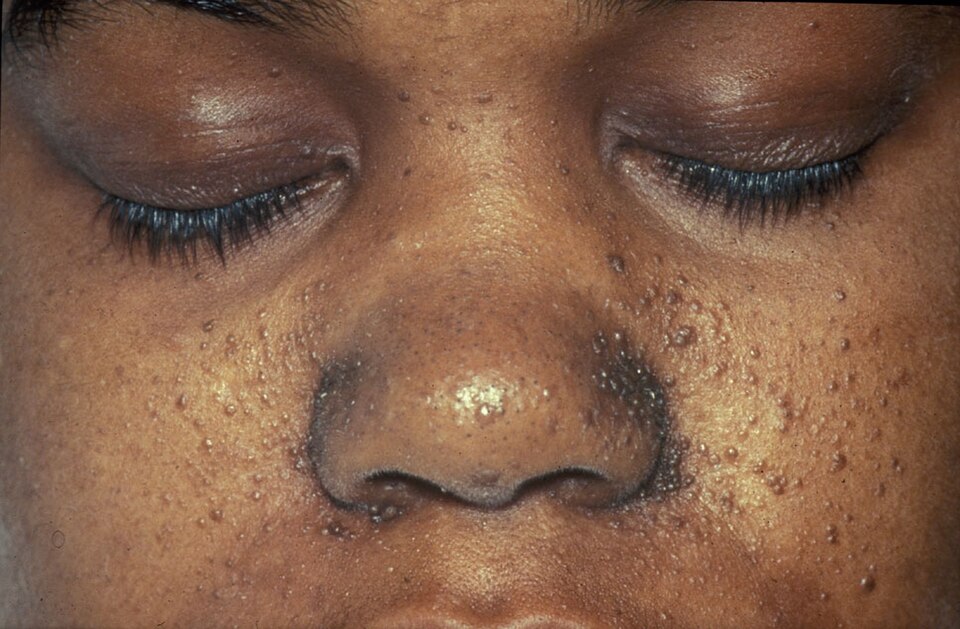
Image Source: Wikimedia Commons (2010). Patient with facial Angiofibromas caused by Tuberous Sclerosis, Licensed under a creative commons licence. Available for free at: https://commons.wikimedia.org/wiki/File:Patient_with_facial_angiofibromas_caused_by_tuberous_sclerosis.jpg (Accessed 20 May 2025).
Investigation
Investigation will depend on presenting features but include:
- Fundoscopy to check for retinal lesions.
- Wood’s lamp to check for hypopigmented patches.
- MRI of the brain to look for cortical tubers, subependymal nodules and subependymal giant cell astrocytoma.
- Electroencephalography when there is epilepsy
- MRI for renal lesions with annual evaluation of renal function
- ECG for cardiac arrhythmias
- Echocardiography for cardiac rhabdomyoma
- Spirometry, CXR and high- resolution CT for pulmonary lymphangioleiomyomatosis
Treatment
As tuberous sclerosis is a multisystem disorder a multidisciplinary approach with a team of specialist doctors is needed. The extra-dermal manifestations can be managed with medications or surgery. For skin lesions such as angiofibromas, laser treatment or electrosurgery can be used. Surgical excision is also an option for disfiguring skin lesions
Complete Guide to Clinical Genetics ST3 Application and Recruitment (2027)
Written by Medibuddy. Last updated: October 2026. Clinical Genetics is

Complete Guide to Clinical Radiology ST3 Application and Recruitment (2027)
Recruitment paused: NHS England is not running Clinical Radiology ST3+ recru

Complete Guide to Paediatric Surgery ST3 Application and Recruitment in United Kingdom (2026)
Written by Medibuddy. Last updated: October 2026. If you’re planning


Take your subscriptions with you
Our mobile app allows you to access your interview and exam question banks wherever you are.

