


 Close
Close
 6th June 2025
Nail Changes Associated with Skin Disorders
Psoriasis
Psoriasis can affect both fingernails and toenails, with half of those with psoriasis having some form of nail involvement. The incidence increases in those with psoriatic arthritis, and it is reported that this could be as high as 4 out of 5 people seeing changes to their nails. Fingernails are more often involved than toenails. For many people, nail psoriasis is often mild and causes few problems.
The changes of the nails with psoriasis include:
- Pitting of the nails – the surface of the nail develops small pits, looking rather like the surface of a thimble. The number of pits can vary from one to dozens.
- Onycholysis – the nail becomes detached from the underlying nail bed and a gap develops under the nail. When it starts there is a white or yellowish patch at the tip of the nail, and this then extends down to the cuticle. The gap between the nail and the nail bed can become colonised by particular bacteria, such as pseudomonas, which can then produce a dark green pigment. The nail can become infected and discoloured and can easily be mistaken for melanoma under the nail.
- Subungual hyperkeratosis – a chalky substance accumulates under the nail. The nail becomes raised and can become tender, especially when the surface of the nail is pressed. Subungual hyperkeratosis of the toenails can be particularly uncomfortable because when wearing shoes the nail may be put under constant pressure.
- Discolouration – this may be seen as unusual nail colouration, such as yellow/brown.
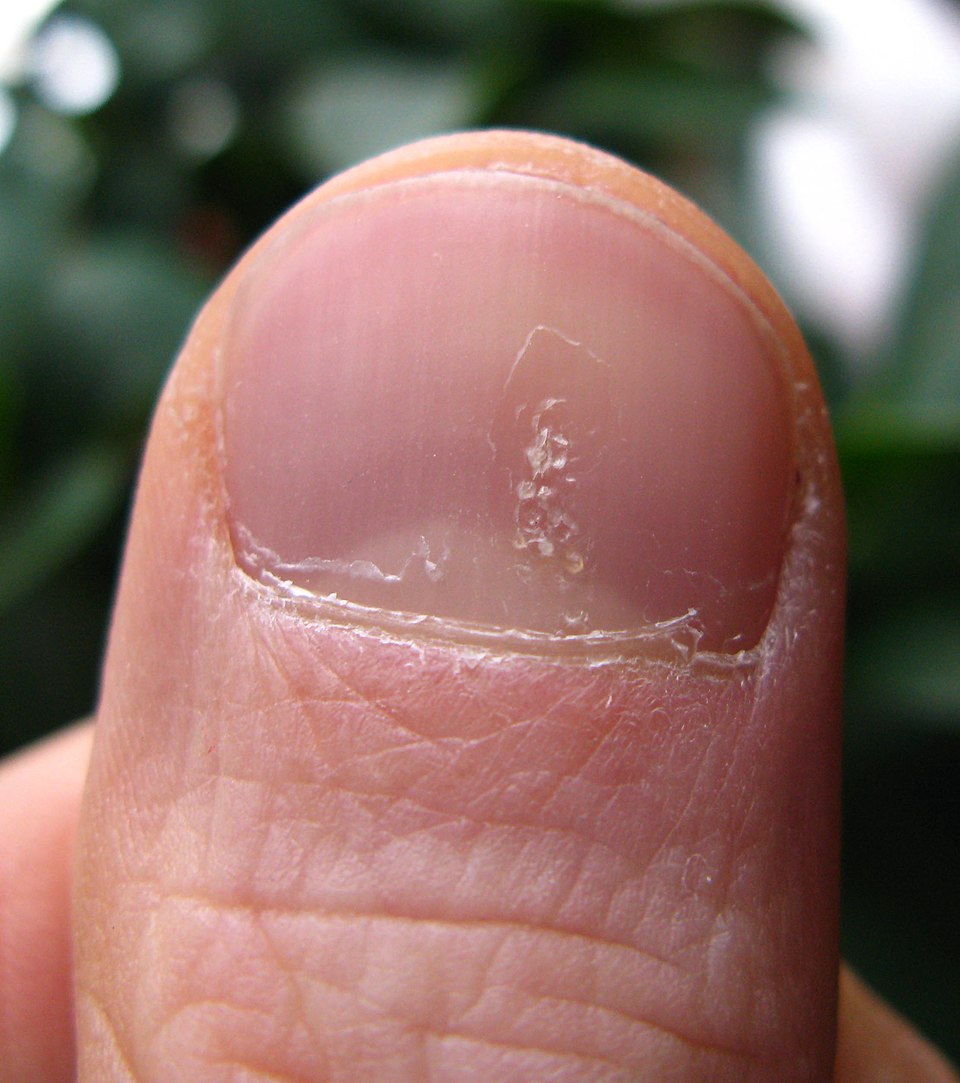
Image Source: Wikimedia Commons (2011). Luszczyca Paznokcia, Licensed under a a creative commons licence. Available for free at: https://commons.wikimedia.org/wiki/File:Luszczyca_paznokcia.jpg (Accessed 22 May 2025).
Eczema
Eczema is another skin condition associated with nail changes. It is not as common as psoriasis nail changes. Pompholyx eczema can affect the nail folds and skin around the nails (cuticles), resulting in swelling. Nail eczema can cause pitting in the nails and requires treatment to avoid worsening of the condition. A 2019 study looked at the nails of 235 patients aged 2 to 19 with eczema. Of the group, 10% of people had nail abnormalities. The most common nail changes found were grooved nails (25%), nail pitting (16.7%), and koilonychia (16.7%).
Complete Guide to Clinical Genetics ST3 Application and Recruitment (2027)
Written by Medibuddy. Last updated: October 2026. Clinical Genetics is

Complete Guide to Clinical Radiology ST3 Application and Recruitment (2027)
Recruitment paused: NHS England is not running Clinical Radiology ST3+ recru

Complete Guide to Paediatric Surgery ST3 Application and Recruitment in United Kingdom (2026)
Written by Medibuddy. Last updated: October 2026. If you’re planning


Take your subscriptions with you
Our mobile app allows you to access your interview and exam question banks wherever you are.

