


 Close
Close
 6th May 2025
Management
The key aim of treatment is to improve the patient’s prognosis and reduce mortality. Secondary aims include alleviating symptoms and reducing morbidity by slowing or reversing the cardiac dysfunction.
Lifestyle changes
Lifestyle modifications are crucial in the management of heart failure. This includes dietary counselling (restricting salt intake and encouraging a healthy balanced diet), moderate alcohol consumption, smoking cessation and encouraging an active lifestyle (150 minutes of moderate intensity activity a week or 75 minutes of vigorous intensity activity a week).
Pharmacological therapy
Heart failure with preserved ejection fraction (HFpEF)
No pharmacological therapies have been shown to benefit HFpEF. Treatment is focused on managing comorbidities such as atrial fibrillation, hypertension, diabetes and ischemic heart disease and encouraging lifestyle modifications, including smoking cessation, moderate alcohol use, healthy dietary habits and maintaining an active lifestyle. Patients should also be offered a personalised exercise-based cardiac rehabilitation programme.
Heart failure with reduced ejection fraction (HFrEF)
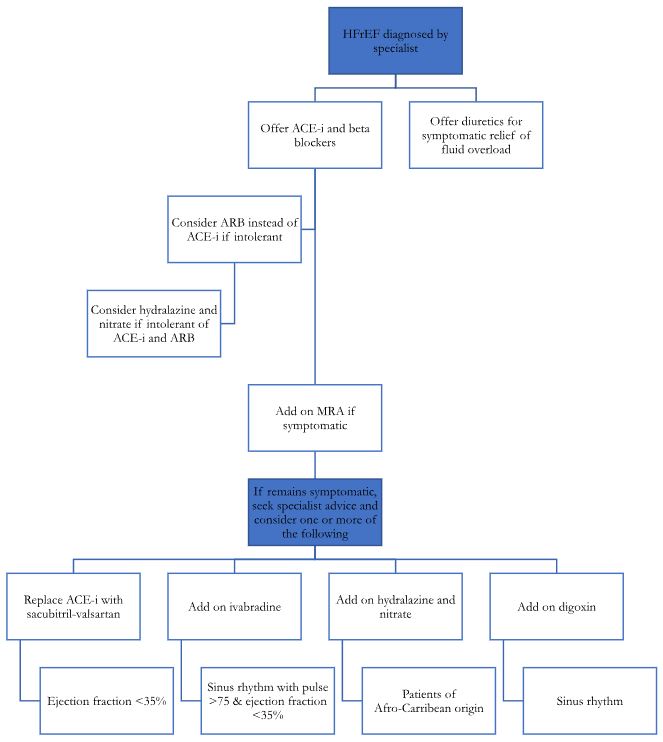
Heart failure patients should be commenced on an ACE-inhibitor and a beta-blocker, which have both been shown to reduce mortality in heart failure. If the patient remains symptomatic following these medications, a mineralocorticoid receptor antagonist (MRA) can be added to the regime. If patients are unable to tolerate ACE-inhibitors or an ARB, they can be offered hydralazine and nitrates.
If symptoms persist despite the medications above, the patient should be referred for specialist advice and can be commenced on one of the medications specified in Figure 1.
Sodium-glucose co-transporter-2 (SGLT-2) inhibitors
In 2019, a landmark trial on the use of dapagliflozin in patients with heart failure (DAPA-HF) showed that SGLT-2 inhibitors reduced cardiovascular morbidity and mortality in patients with heart failure independent of their diabetes status. This has been reflected in the NICE guidance for type 2 diabetes control where SGLT-2 inhibitors are preferentially selected in patients who are comorbid with diabetes and heart failure. Please note: the NICE guidance for heart failure in 2018 does not comment on the routine initiation of SGLT-2 inhibitors.
| Medication | Side effects | Monitoring requirements |
|---|---|---|
| Loop diuretics | Common:
Uncommon:
|
Renal function, serum electrolytes & blood pressure |
| ACE-inhibitors | Common:
If patients are unable to tolerate dry cough, consider switching to an angiotensin II receptor blocker (ARB). |
Renal function, serum electrolytes & blood pressure |
| Beta-blockers | Common:
|
No routine blood test monitoring. Monitor blood pressure and pulse rate whilst adjusting dosage. |
| Mineralocorticoid antagonist | Common:
Gynaecomastia is more common with spironolactone, and less common with eplerenone. This should be considered when starting MRA in male patients as gynaecomastia can affect treatment concordance. |
Renal function, serum electrolytes & blood pressure |
| Digoxin | Common:
Uncommon:
Digoxin binds to the potassium binding site of the Na-K ATPase pump; hence, hypokalaemia can precipitate digoxin toxicity as there is reduced competition for the binding site. |
ECG, renal function, serum electrolytes |
Table 6: Common side effects of heart failure medications and drug monitoring.
Non-pharmacological therapy
Patients can also be considered for cardiac resynchronisation therapy (CRT) or an implantable cardioverter defibrillator (ICD). CRT is indicated in patients who remain symptomatic on optimum medical therapy, with low LVEF of <35% and a QRS duration of >120ms. Biventricular pacing through CRT decreases the risk of heart failure events, improves cardiac function and can reverse left ventricular remodelling.
ICD is indicated in patients with a low LVEF <35%, previous ventricular tachycardia and symptoms no worse than NYHA Class III. ICD has been shown to increase survival in heart failure by 23% (SCD-HeFT).
These two devices can also be combined into a CRT-D (cardiac resynchronisation therapy – defibrillator) and has been shown to reduce the progression of heart failure in patients with NYHA I/II.
Complete Guide to Clinical Genetics ST3 Application and Recruitment (2027)
Written by Medibuddy. Last updated: October 2026. Clinical Genetics is

Complete Guide to Clinical Radiology ST3 Application and Recruitment (2027)
Recruitment paused: NHS England is not running Clinical Radiology ST3+ recru

Complete Guide to Paediatric Surgery ST3 Application and Recruitment in United Kingdom (2026)
Written by Medibuddy. Last updated: October 2026. If you’re planning


Take your subscriptions with you
Our mobile app allows you to access your interview and exam question banks wherever you are.

