


 Close
Close
 19th June 2026
Hypertension
Background
Hypertension is a persistent elevation of blood pressure, defined as systolic blood pressure (SBP) ≥140/90 mmHg and/or diastolic blood pressure >90 mmHg. It is associated with an increased risk of cardiovascular disease (CVD; encompassing coronary heart disease, heart failure, stroke, myocardial infarction, atrial fibrillation and peripheral artery disease), stroke and renal failure.
Epidemiology
Hypertension is a significant contributor to the global burden of disease; it is the leading single contributor to all-cause mortality and disability worldwide. It affects more than 1 billion people and contributes to cardiovascular death more than any other risk factor globally. Certain ethnic groups are disproportionately affected, such as Black individuals, who are in turn more likely to experience complications. The World Health Organisation estimates that hypertension is responsible for nearly 7.5 million deaths worldwide. In the UK, the National Health Survey 2019 reported that hypertension affects approximately 1 in 4 adults and is a leading cause of morbidity and mortality.
The following are recognised risk factors for hypertension:
- Age
- Family history
- Obesity
- Physical inactivity
- High salt intake
- Alcohol consumption
- Smoking
- Stress
- Diabetes
- High cholesterol
- Sleep apnoea
Aetiology and pathophysiology
The mechanism underlying hypertension is multifactorial, displaying a complex interplay between genetic, environmental and lifestyle factors. Hypertension can be categorised into primary and secondary causes.
Primary hypertension (or essential hypertension) accounts for 90-95% of cases of hypertension and has no identifiable cause.
Secondary hypertension refers to hypertension with a known cause. These are summarised in Table 1.
Table 1. Secondary causes of hypertension
| Condition | |
|---|---|
| Cardiac | Aortic coarctation |
| Atherosclerotic renovascular disease | |
| Congenital heart defects | |
| Heart failure | |
| Endocrine causes | Cushing’s syndrome |
| Hyperthyroidism | |
| Hypothyroidism | |
| Primary aldosteronism | |
| Pheochromocytoma | |
| Renal | Chronic kidney disease |
| Glomerulonephritis | |
| Polycystic kidney disease | |
| Renal artery stenosis | |
| Other | Medications, such as NSAIDs, oral contraceptives, corticosteroids, ciclosporin and atypical antipsychotics |
| Obstructive sleep apnoea | |
| Pregnancy |
Clinical manifestations
The large majority of patients with hypertension are asymptomatic. Headaches are a common feature, classically occipital. Other associated features give useful clues to the underlying secondary cause of hypertension, for example, weight gain, muscle weakness and thinning skin in Cushing’s syndrome.
Malignant hypertension may be associated with:
- Hypertensive retinopathy
- Visual disturbance
- Cardiac symptoms, e.g. chest pain
- Confusion (cerebral oedema)
- Oliguria or polyuria
Diagnosis and staging
The evaluation of patients with hypertension involves a combination of clinical examination, laboratory tests, and imaging to assess for evidence of target-organ damage (for example, left ventricular hypertrophy and hypertensive retinopathy) and presence of comorbidities.
NICE guidelines recommend that initial investigations should include
- Measurement of blood pressure in both arms
- Physical examination to identify secondary causes of hypertension
- Assessment of cardiovascular risk. Formal assessment may involve using risk calculators such as the Framingham Risk Calculator 1991 or the Q-RISK2
Table 2. Directions by NICE for diagnosing hypertension
| Blood pressure measurement | Direction |
|---|---|
| Clinic blood pressure |
|
| Ambulatory blood pressure monitoring (ABPM) – used to confirm the diagnosis of hypertension |
|
| Home blood pressure monitoring (HBPM): offer if ABPM is unsuitable or the patient is unable to tolerate it |
|
In those diagnosed or whilst awaiting confirmation of diagnosis:
- Albumin-creatinine ratio (ACR) and urinalysis: to assess for renal impairment, as indicated by elevated ACR and proteinuria/haematuria
- Fundoscopy: to assess for hypertensive retinopathy
- 12-lead ECG: to assess for abnormalities in heart rhythm, structure or function
- Bloods: HbA1c, U&Es, total cholesterol and HDL cholesterol
Hypertension is confirmed if:
- Clinic blood pressure is ≥ 140/90 mmHg.
- ABPM or HBPM provide average values of ≥ 135/85 mmHg.
Table 3. Diagnostic criteria of hypertension by NICE
| Hypertension category | Clinic reading (mmHg) | ABPM/HBPM (mmHg) |
|---|---|---|
| Stage 1 | ≥140/90 | ≥135/85 |
| Stage 2 | ≥160/100 | ≥150/95 |
| Stage 3 (severe hypertension) | SBP ≥ 180 or DBP ≥ 120 Carry out same-day referral |
|
| Accelerated (malignant) hypertension | ≥180/120 with signs of retinal damage, haemorrhage or papilloedema. Usually associated with new or progressive target-organ damage. | |
| Isolated systolic hypertension | SBP ≥ 160 |
NICE, National Institute for Health and Care Excellence; ABPM, Ambulatory Blood Pressure Monitoring; HBPM, Home Blood Pressure Monitoring; SBP, systolic blood pressure; DBP, diastolic blood pressure
Table 4. Investigations for hypertension
| Investigation | Notes |
|---|---|
| Blood pressure measurement | All patients 24-hour ABPM or HBPM in suspected white coat hypertension or masked hypertension |
| Fasting blood glucose and lipid profile | Assessment of cardiovascular risk profile |
| Serum U&Es | Assessment of renal function |
| Endocrine investigations (e.g. renin/aldosterone ratio, TFTs) | Suspected secondary hypertension |
| Urinalysis | Assessment of proteinuria and haematuria |
| ECG | Assessment of abnormalities in heart rhythm, structure or function |
| Echocardiogram | |
| Renal artery imaging | Suspected renal artery stenosis |
ABPM, Ambulatory Blood Pressure Monitoring; HBPM, Home Blood Pressure Monitoring; U&Es, urea and electrolytes; TFTs, thyroid function tests
Cardiovascular disease risk assessment
Assessment of cardiovascular disease (CVD) risk is an important component in the management of hypertension. The NICE guidelines recommend using the QRISK3 risk assessment tool to calculate the 10-year risk of developing CVD in people with hypertension who are not already known to be at high risk.
The QRISK3 tool takes into account various factors, including age, sex, ethnicity, smoking status, systolic blood pressure, total cholesterol to HDL ratio, body mass index, family history of coronary heart disease, and other medical conditions such as diabetes, atrial fibrillation, and chronic kidney disease.
For individuals with a 10-year CVD risk of 10% or greater, NICE recommends offering statin therapy for primary prevention, in addition to lifestyle modifications and appropriate antihypertensive treatment. This emphasises the importance of considering overall cardiovascular risk, rather than treating hypertension in isolation.
Management
Management of hypertension involves a combination of lifestyle interventions and pharmacological therapy, which aim to reduce blood pressure and prevent complications.
Lifestyle interventions are the first-line treatment for suspected or diagnosed hypertension. This includes:
- Dietary changes: reducing sodium intake, increasing potassium intake, and following a Mediterranean diet
- Regular physical activity
- Weight loss for overweight/obese individuals
- Reducing caffeine
- Limiting alcohol consumption
- Smoking cessation
The choice of pharmacological therapy depends on factors such as age, ethnicity, comorbidities and contraindications. Figure 1 below outlines the patient groups who should be offered antihypertensive treatment. Figure 2 shows the stepped-care treatment protocol recommended by NICE, with medications added or changed based on a patient’s response to treatment.
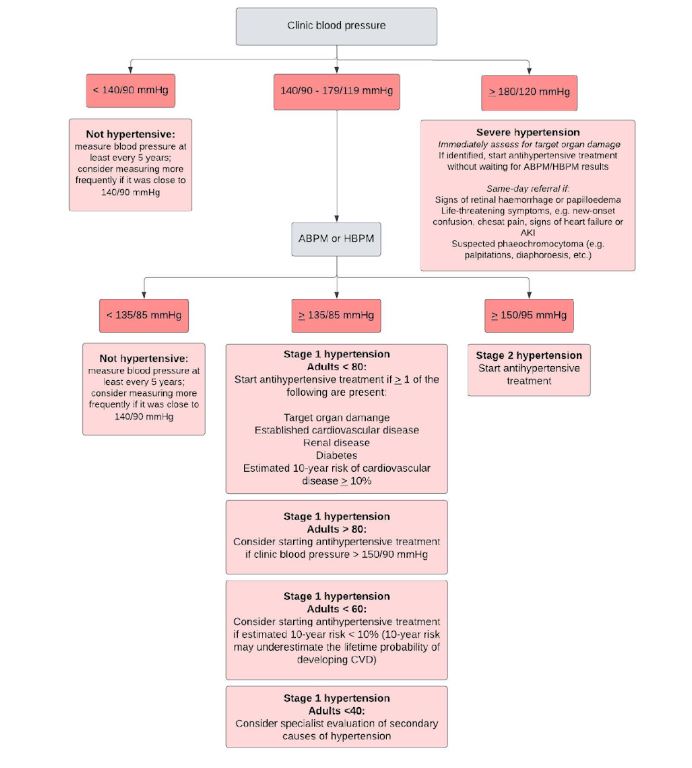
Summary of NICE guidelines on the initiation of antihypertensive drug treatment. Adapted from NICE guidelines (2019)
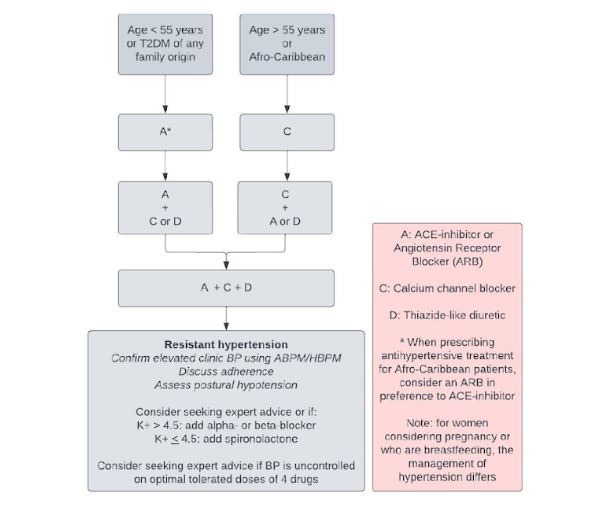
Stepped-care treatment protocol for the initiation of antihypertensives by NICE and the BIHS. Adapted from NICE guidelines (2019)
Table 5. NICE recommendations for blood pressure targets in patients with hypertension
| Patient group | Target blood pressure using ABPM/HBPM (mmHg) | Target blood pressure in clinic (mmHg) |
|---|---|---|
| Adults < 80 | < 135/85 | < 140/90 |
| Adults ≥ 80 | < 145/85 | < 150/90 |
Complete Guide to Clinical Genetics ST3 Application and Recruitment (2027)
Written by Medibuddy. Last updated: October 2026. Clinical Genetics is

Complete Guide to Clinical Radiology ST3 Application and Recruitment (2027)
Recruitment paused: NHS England is not running Clinical Radiology ST3+ recru

Complete Guide to Paediatric Surgery ST3 Application and Recruitment in United Kingdom (2026)
Written by Medibuddy. Last updated: October 2026. If you’re planning


Take your subscriptions with you
Our mobile app allows you to access your interview and exam question banks wherever you are.

