


 Close
Close
 13th February 2025
Overview of diplopia
Diplopia, or double vision, is the separation of images horizontally, vertically or obliquely.
Diplopia can be monocular whereby the abnormality persists when the unaffected eye is closed. This is typically associated with local ocular causes such as refractive error or media abnormalities.
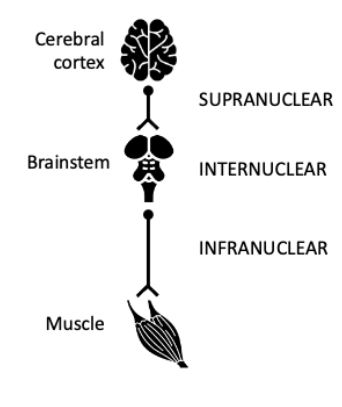
Binocular diplopia is the result of dysfunction of the extraocular muscles which leads to ocular misalignment, preventing fusion of the two images produced by each eye. The aetiology of binocular diplopia can be classified according to the segment of the efferent oculomotor pathway that is involved.
The following will be discussed:
| Location | Example | |||
|---|---|---|---|---|
 |
Supranuclear | Progressive supranuclear palsy | ||
| Nuclear and internuclear | Internuclear ophthalmoplegia | |||
| Infranuclear | Cranial nerves | Third nerve palsy
Fourth nerve palsy Sixth nerve palsy |
||
| Muscles and neuromuscular junction | Myasthenia gravis
Thyroid eye disease Miller Fisher syndrome |
|||
Table 5 Causes of binocular diplopia
Figure adapted from icons through The Noun Project, CC BY 3.0
Cerebral cortex – VectorsLab https://thenounproject.com/icon/brain-4224212/
Brainstem – Tezar tantular https://thenounproject.com/icon/brainstem-3656737/
Muscle – Amethyst Studio https://thenounproject.com/icon/muscle-4666756/
Complete Guide to Clinical Genetics ST3 Application and Recruitment (2027)
Written by Medibuddy. Last updated: October 2026. Clinical Genetics is

Complete Guide to Clinical Radiology ST3 Application and Recruitment (2027)
Recruitment paused: NHS England is not running Clinical Radiology ST3+ recru

Complete Guide to Paediatric Surgery ST3 Application and Recruitment in United Kingdom (2026)
Written by Medibuddy. Last updated: October 2026. If you’re planning


Take your subscriptions with you
Our mobile app allows you to access your interview and exam question banks wherever you are.

