


 Close
Close
 17th February 2025
Diagnosis of COPD
Typical investigation findings include the following:
- Blood tests: FBC and CRP to identify anaemia and secondary polycythaemia, and rule out infection
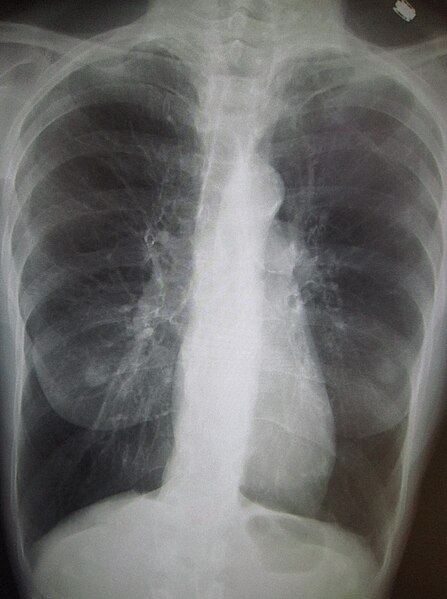
- Chest X-ray: flattened diaphragm, hyperexpanded lungs, bullae
- Lung function tests, especially post-bronchodilator spirometry, which should show an obstructive picture (FEV1/FVC <70%) to be in keeping with a diagnosis of COPD
- BMI: low BMI or weight loss is common in severe COPD and associated with a worse prognosis. It can also be associated with a co-existing lung cancer
Image Source: Wikimedia Commons (2010). COPD, Licensed under a creative commons licence. Available for free at: https://commons.wikimedia.org/wiki/File:COPD.JPG (Accessed: 19 January 2024).
FEV₁ is used to determine the severity of COPD:
| >80% of predicted | Stage 1: mild COPD – should have symptoms, e.g. cough or breathlessness, to make diagnosis |
| 50-80% of predicted | Stage 2: moderate COPD |
| 30-50% of predicted | Stage 3: severe COPD |
| <30% of predicted | Stage 4: very severe COPD |
Table 3 Staging of COPD using FEV₁
Complete Guide to Clinical Genetics ST3 Application and Recruitment (2027)
Written by Medibuddy. Last updated: October 2026. Clinical Genetics is
Clinical Genetics ST3

Complete Guide to Clinical Radiology ST3 Application and Recruitment (2027)
Recruitment paused: NHS England is not running Clinical Radiology ST3+ recru
Clinical Radiology ST3

Complete Guide to Paediatric Surgery ST3 Application and Recruitment in United Kingdom (2026)
Written by Medibuddy. Last updated: October 2026. If you’re planning
Paediatric Surgery ST3


Take your subscriptions with you
Our mobile app allows you to access your interview and exam question banks wherever you are.

