


 Close
Close
 11th August 2024
Muscular dystrophies
Myotonic dystrophy
This is the most common muscular dystrophy. It is an autosomal dominant disorder that generally develops in the 2nd-4th decades and is characterised by respiratory and skeletal muscle weakness (distal limb and facial/neck most commonly), cataracts, frontal balding, cardiac conduction problems and myotonia (delayed relaxation of muscles following contraction).
Duchenne (DMD) and Becker muscular dystrophy (BMD)
DMD and BMD are both caused by mutations of the dystrophin gene on the X chromosome. Males, therefore, are most affected, though female carriers can display mild symptoms.
DMD is the more severe and more common form (prevalence 3/100,000) and typically presents in the first years of life. Features include proximal muscle weakness (with walking problems including toe walking or waddling gait), cardiomyopathy or conduction issues, and scoliosis/bony fractures. The prognosis is poor, with most wheelchair bound by the early teens and death usually from respiratory compromise or cardiomyopathy, in the teens or twenties.
BMD, the rarer form (0.3/100,000), presents with milder symptoms in the teens or twenties. Many survive into their thirties.
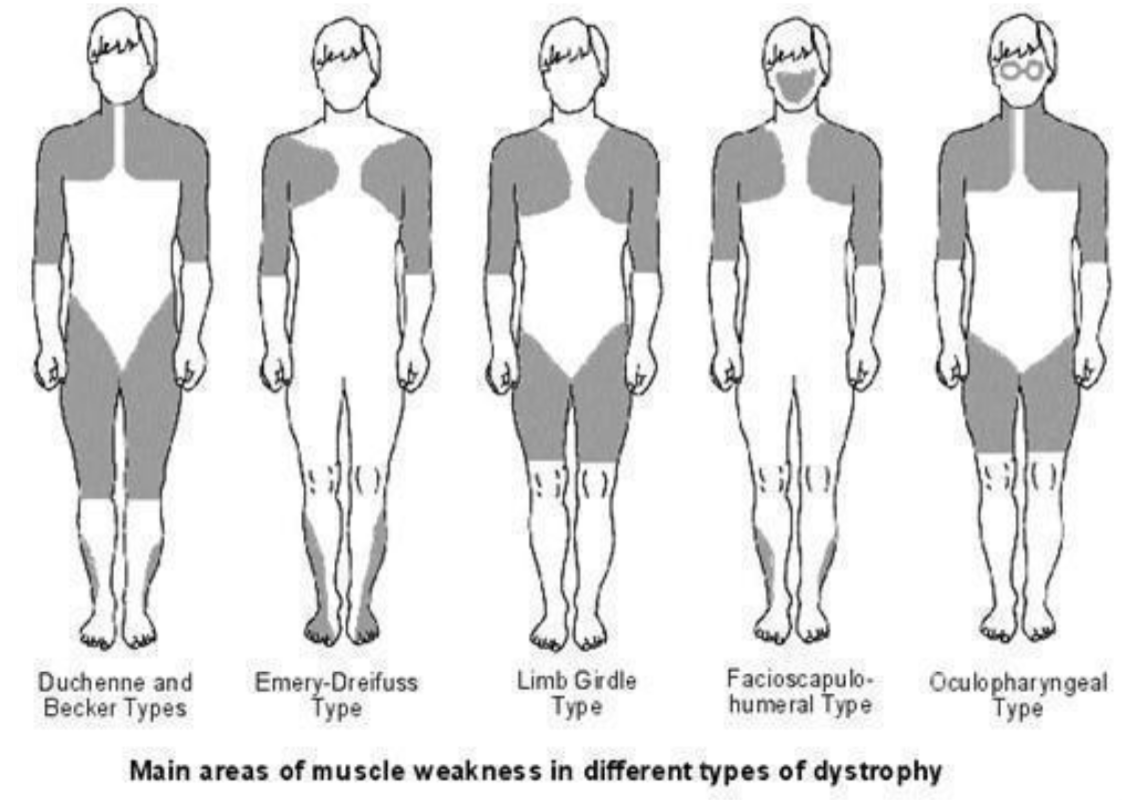
Image Source: Egton Medical Information Systems Limited. All rights reserved (2023). Bones joints muscles/muscular-dystrophies, Licensed under a creative commons licence. Available for free at: https://patient.info/bones-joints-muscles/muscular-dystrophies (Accessed: 17 January 2024)
Facioscapulohumeral muscular dystrophy (FSHD)
FSHD is an autosomal dominant condition with prevalence of 1-2/100,000. Patients generally present in their teens with weakness of facial muscles, scapula (upwards displacement), upper arm (with deltoid sparing), and lower leg. Weakness is generally asymmetric. Genetic testing confirms the diagnosis identifying mutations leading to inappropriate DUX4 gene expression.
Emery-Dreifuss muscular dystrophy
This has autosomal dominant or X-linked inheritance. Clinical features include scapula, humerus and peroneal weakness, and cardiac conduction defects often requiring pacing. Patients may also develop contractures of the cervical extensors, biceps and long finger extensors.
Complete Guide to Clinical Genetics ST3 Application and Recruitment (2027)
Written by Medibuddy. Last updated: October 2026. Clinical Genetics is

Complete Guide to Clinical Radiology ST3 Application and Recruitment (2027)
Recruitment paused: NHS England is not running Clinical Radiology ST3+ recru

Complete Guide to Paediatric Surgery ST3 Application and Recruitment in United Kingdom (2026)
Written by Medibuddy. Last updated: October 2026. If you’re planning


Take your subscriptions with you
Our mobile app allows you to access your interview and exam question banks wherever you are.

