


 Close
Close
 30th December 2024
Immunotherapy toxicities
Introduction to immune-mediated toxicities
Immunotherapeutics encompass a broad range of drugs that interact with the body’s immune system. Within oncology, the term ‘immunotherapy’ generally refers to immune checkpoint inhibitors (ICI). These drugs sensitise the body’s immune system to recognise and destroy malignant cells. ICIs have greatly improved survival in many cancer types, and their use within oncology is rapidly increasing.
However, the resultant activation of the immune system can have unintended consequences if the immune system then attacks and inflames other organ systems. This is known as immune-mediated toxicity, and can affect any organ system, can range from mild to life threatening, and can occur up to one year after cessation of an ICI.
It is, therefore, imperative to recognise ICIs when taking an oncological treatment history and to consider immune-mediated toxicity in any patient who may have received treatment with an ICI within the last year.
Immune checkpoints and ICIs
Immune checkpoints
T cells are involved in the recognition and destruction of non-self cells, including malignant cells. T cells express certain transmembrane proteins that, when bound, modulate T-cell response. These proteins include programmed cell death protein 1 (PD-1) and cytotoxic T-lymphocyte associated protein 4 (CTLA-4). Very broadly, binding of these proteins inhibits T cells from destroying cells. These receptors are known as immune checkpoints and in normal immune function prevent the immune system from destroying healthy self cells. It may be helpful to imagine immune checkpoints as ‘brakes’ on the immune system.
Cancer cells may exploit immune checkpoints by ‘turning on the brakes’
Tumour cells are able to proliferate without limit in part by evading the normal T cell-mediated immune response to non-self cells. This may be by exploiting immune checkpoints or ‘putting the brakes on’. For example, malignant cells may display proteins such as programmed cell death ligand-1 (PD-L1) that binds PD-1 and activates the T cell immune checkpoint (or turns on ‘the brakes’ on the immune system), preventing tumour cell destruction.
ICIs ‘take the brakes off’ at immune checkpoints
ICIs are drugs that we can administer to harness the immune system to destroy malignant cells. They are monoclonal antibodies that interact with immune checkpoints. Their targets may be T-cell receptors (such as PD-1 and CTLA-4) or tumour cell proteins (such as PDL-1). They bind these proteins and inhibit their function in immune checkpoints, thus ‘releasing the brakes’ on these T cells. This promotes T cell-mediated destruction of non-self and malignant cells.
However, releasing these immune checkpoint ‘brakes’ also increases the risk of immune-mediated destruction of healthy tissues. This can result in immune-mediated toxicity in any tissue.
Examples of ICIs
There are many ICIs in clinical practice useful to recognise commonly used ICIs. Summarised below are some common ICIs and their targets.
| Immune checkpoint target | Location of target | Example of ICI |
|---|---|---|
| PD-1 | Immune cells |
|
| PD-L1 | Tumour cells |
|
| CTLA-4 | Immune cells |
|
Presentation and management of immune-mediated toxicities
Presentation of immune-mediated toxicities
Immune-mediated toxicity can affect any organ system and can range in severity from mild to life threatening. Presenting features are, therefore, broad. It may be easiest to consider presentation by organ system – see the subsections below for more detail.
Of note, the risk of immune-mediated toxicity increases in cases where patients are treated with dual ICI therapy.
Immune-mediated toxicity triggered by ICIs is not a direct consequence of ICIs interacting with organ systems. It instead results from an ICI sensitising the body’s immune system and the sensitised immune system, in turn, interacting with an organ to cause side effects. Therefore, symptoms may be delayed and removal of the ICI does not necessarily translate to cessation of symptoms. It is essential to remember that toxicity can occur any time during treatment and can even occur up to one year after cessation of an ICI.
Broad principles of management of immune-mediated toxicities
When assessing immune-mediated toxicity, the oncologist first grades the severity of the reaction by taking a full history and examination. The broad management depends on the severity of symptoms. Generally speaking, management can be summarised as follows:
- Mild reactions (minimally symptomatic)
- Treatment with the ICI may be allowed to continue
- Add treatments for symptomatic relief
- Moderate reactions (limiting activities of daily living)
- Withhold ICI
- Corticosteroids, usually oral prednisolone 0.5-1 mg/kg
- Severe or life-threatening reactions or non-responding moderate reactions
- Withhold or permanently discontinue ICI
- Inpatient treatment with IV methylprednisolone 1-2 mg/kg
- If deteriorating despite this may require other immunosuppressants such as infliximab, mycophenolate mofetil (MMF) or tacrolimus
- Specialty referral
- Consider intensive care admission if organ support required
- In any grade of reaction, monitor closely for deterioration or non-response to treatment; escalate treatment as necessary
- Once symptoms have improved, wean steroids gradually, with the exception of hypophysitis which will require long term oral steroid replacement
- If prescribing high-dose steroids, consider gastroprotection, bone protection and PCP (pneumocystis pneumonia) prophylaxis
The European Society for Medical Oncology (ESMO) has released comprehensive guidelines to aid in the detection, investigation and management of immune mediated toxicities. The presentation, pertinent investigations and management are summarised by organ system in figures 16-21 below.
Skin toxicities
Skin toxicity presents with a rash, most commonly maculopapular. It may be itchy or painful.
Rarely, severe reactions such as Steven Johnson Syndrome (SJS), toxic epidermal necrolysis (TEN) or bullous dermatitis may occur. These can be life threatening.
| Presentation | Management |
|---|---|
| Mild: <30% body surface area |
|
| Moderate: >30% body surface area, may limit ADLs |
|
Severe:
|
Endocrine toxicities
Endocrinopathies resulting from immune-mediated toxicity can be varied. It is essential to detect and treat hypophysitis early, as otherwise the resultant hypoadrenalism can result in an Addisonian crisis. Thyroid disturbance is common and may occur in 5-10% of patients.
Baseline TSH, T3 are and free T4, pituitary axis bloods (9 am cortisol, ACTH, TSH [thyroid stimulating hormone], T4, LH [luteinising hormone], FSH [follicle-stimulating hormone], oestradiol/testosterone, IGF [insulin-like growth factor]-1, prolactin) and glucose are checked prior to commencing an ICI. TFTs are then monitored regularly throughout treatment and, in some instances, monitored even after cessation of ICI (delayed hypothyroidism/hypophysitis may occur).
| Presentation | Management |
|---|---|
Hypothyroidism
|
If TSH >10 or symptomatic hypothyroidism, start levothyroxine, even with normal T4 |
Thyroiditis
|
|
Hypophysitis
|
|
Diabetes
|
|
Gastrointestinal toxicities (colitis)
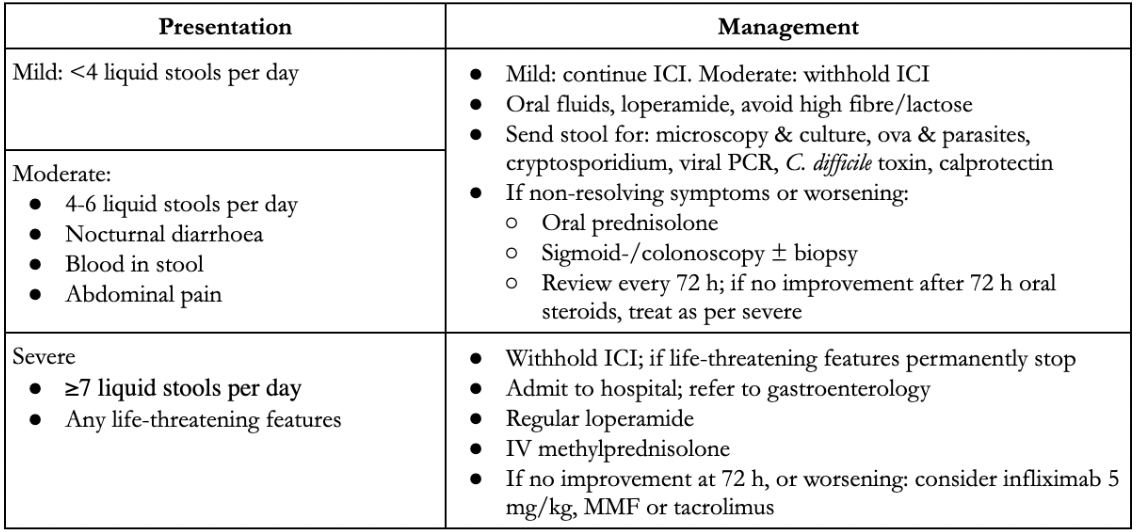
Gastrointestinal toxicity is common, with up to 30% of patients experiencing diarrhoea. Severe, high-grade colitis may occur in as many as 1% of patients. This can be life threatening, resulting in perforation or death. It is, therefore, essential to ask about diarrhoea with each cycle and monitor symptoms closely if they occur. Always rule out infection in patients presenting with diarrhoea.
Hepatic toxicities (hepatitis)
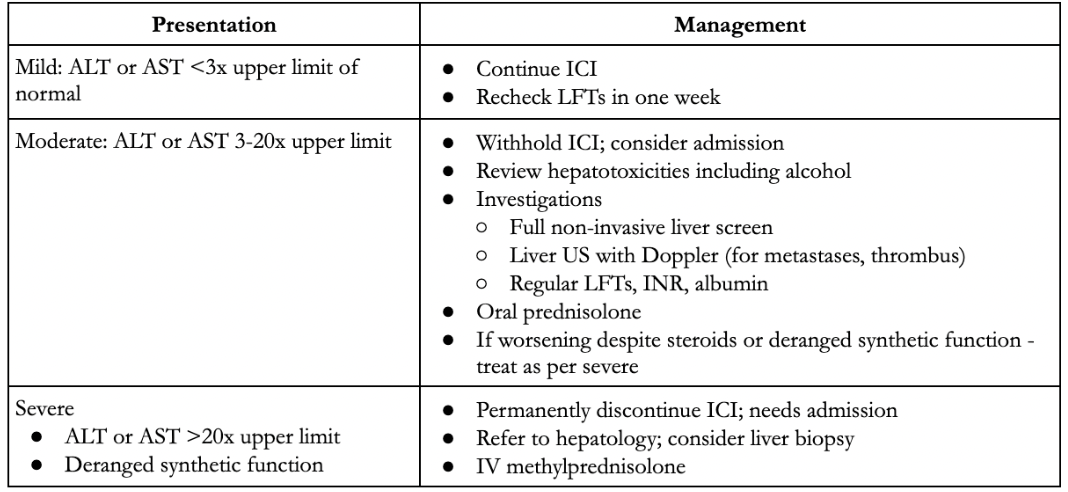
Hepatic toxicity or hepatitis is common; 5-10% of patients may present with ICI-induced hepatitis, rising to 30% in patients receiving combined therapy. LFTs are, therefore, measured with each treatment cycle. Severity is determined by the degree of transaminase derangement and presence of derangement in INR or albumin.
Respiratory toxicities (pneumonitis)
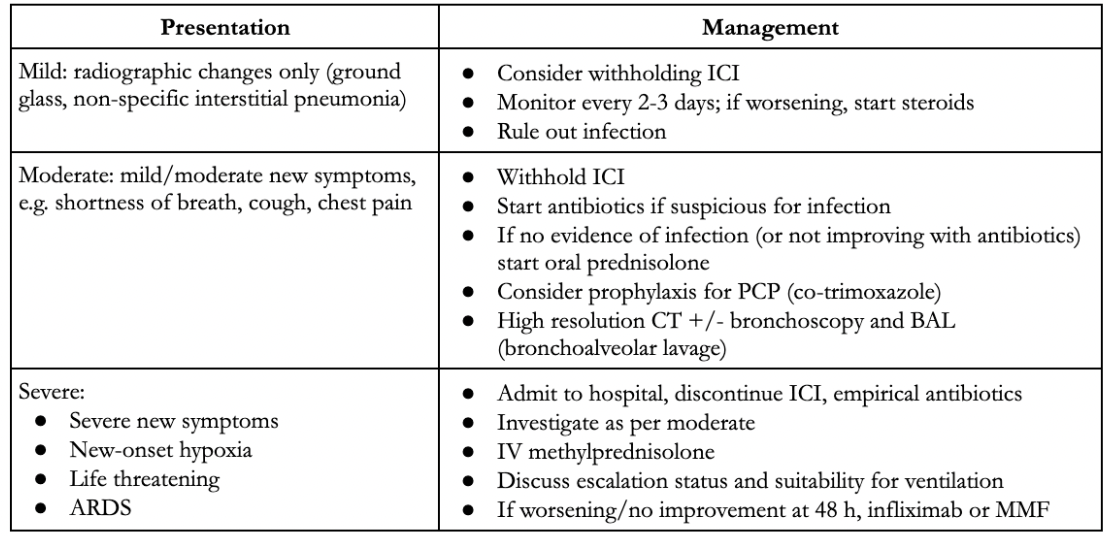
Respiratory toxicity, or pneumonitis, is common and can be life threatening. ICIs may be withheld even in mild immune-mediated pneumonitis.
Rare immune-mediated toxicities
It is important to be aware that immune-mediated toxicity can occur in any organ system and to consider immune-mediated toxicity in any patient with almost any symptom! Generally, management is still based on severity. Most instances of these rare toxicities require referral to the specialist team for ongoing management and advice.
| Neurological |
|
|
| Rheumatological |
|
|
| Renal |
|
|
| Cardiac |
|
|
| Ocular |
|
|
| Haematological |
|
|
References
- Cassidy J, Bissett D, Spence RAJ, Payne M, Morris-Stiff GJ. Oxford Handbook of Oncology. 4th ed. Oxford: Oxford University Press; 2015
- Haanen JBAG, Carbonnel F, Robert C, Kerr KM, Peters S, Larkin J, et al. Management of toxicities from immunotherapy: ESMO Clinical Practice Guidelines for diagnosis, treatment and follow-up. Annals of Oncology. 2017 Jul 1;28(suppl_4):iv119–42
- Thompson JA, Schneider BJ, Brahmer J, Andrews S, Armand P, Bhatia S, et al. Management of Immunotherapy-Related Toxicities, Version 1.2019. Journal of the National Comprehensive Cancer Network: JNCCN [Internet]. 2019 Mar 1 [cited 2022 Oct 1];17(3):255–89. Available from: https://pubmed.ncbi.nlm.nih.gov/30865922/
Complete Guide to Clinical Genetics ST3 Application and Recruitment (2027)
Written by Medibuddy. Last updated: October 2026. Clinical Genetics is

Complete Guide to Clinical Radiology ST3 Application and Recruitment (2027)
Recruitment paused: NHS England is not running Clinical Radiology ST3+ recru

Complete Guide to Paediatric Surgery ST3 Application and Recruitment in United Kingdom (2026)
Written by Medibuddy. Last updated: October 2026. If you’re planning


Take your subscriptions with you
Our mobile app allows you to access your interview and exam question banks wherever you are.

