


 Close
Close
 17th May 2025
Prescribing in pregnancy
Teratogenicity
Many therapeutic medications and toxins can harm the unborn foetus, causing teratogenicity and higher incidence of foetal malformations compared to the general population (1-2 in 100 live births). The time during pregnancy when foetal organs are most affected by each drug coincides with their corresponding period of rapid development. For drugs that pass to the foetus via the placenta or affects its blood flow, their effect would not be apparent until 10 to 12 weeks after conception when the placenta starts to become functional. Most internal organs are formed during the first 12 weeks of pregnancy, thus women who would like to conceive or are pregnant should avoid teratogenic drugs in the beginning of their pregnancy. Brain development occurs throughout pregnancy up to delivery; insult at any point of time before birth could have the potential to alter the child’s postnatal learning and behaviour.
Women taking teratogenic medications should be educated to undertake several precautions to avoid getting pregnant by having reliable contraception preferably in 2 forms. Moreover, taking regular pregnancy tests, especially 1 month before starting treatment or repeat prescription, and 1 month after stopping treatment. If positive, it is advisable to switch onto an alternative non-teratogenic medication to manage her condition and receive closer prenatal monitoring.
Antibiotics
Many classes of antibiotics have effects on the foetus due to their mechanism of action. Penicillin is generally a safe class of medications for pregnant women, except for Co-amoxiclav in the context of pre-labour premature rupture of the membranes as it increases the risk of necrotising enterocolitis in postnatal period.
| Antibiotic | Associated harm |
| Aminoglycosides (e.g., Gentamicin, Streptomycin; especially if IV) | Ototoxic and nephrotoxic |
| Nitrofurantoin (in third trimester, during labour and delivery) | Haemolytic anaemia of the neonate due to immature erythrocyte enzyme systems |
| Quinolones (e.g. Ciprofloxacin, Levofloxacin) | Increased risk of stillbirth, cardiac cono-truncal defects, tetralogy of Fallot |
| Sulphonamides (e.g. Trimethoprim; only if taken before first 12 weeks of pregnancy) | Neural tube defect (NTD), cleft lip or palate, cardiac malformation |
| Tetracyclines (e.g. Doxycycline; especially in second and third trimester) | Stains on teeth, potential problem on bones where drug accumulates, maternal liver failure (if given intravenously in third trimester), higher chance of miscarriage |
Table 6. Teratogenic antibiotic classes and their adverse effects
If taking sulphonamides within the first 12 weeks of conception, women must take high dose folic acid (5mg OD) to counteract its anti-folate action. It disrupts spine and skull development by preventing proper closure of the neural tube. Exposing the spinal cord to amniotic fluid causes permanent neurological damage, and a varied degree of severity leads to a range of conditions called neural tube defect (NTD). Folic acid should also be taken by women who have:
- Family history of or previous pregnancy with child born with NTD
- Body mass index (BMI) >30kg/m2
- Diabetes mellitus
- Conditions associated with haemolytic anaemia (e.g. Sickle cell disease, Thalassaemia)
- Conditions that can lead to malabsorption (e.g. Coeliac disease)
- Regular AED
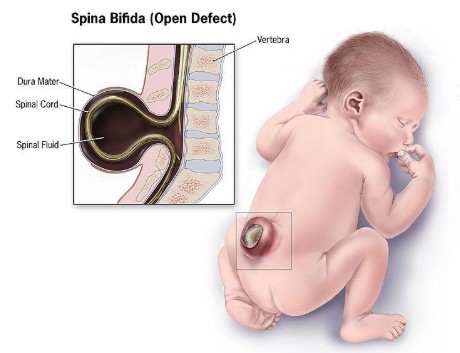
Figure 1: Open spina Bifida
Image Source: Wikimedia Commons (2012). Spina Bifida, Licensed under a creative commons licence. Available for free at: https://commons.wikimedia.org/wiki/File:Spina-bifida.jpg (Accessed 12 May 2025).
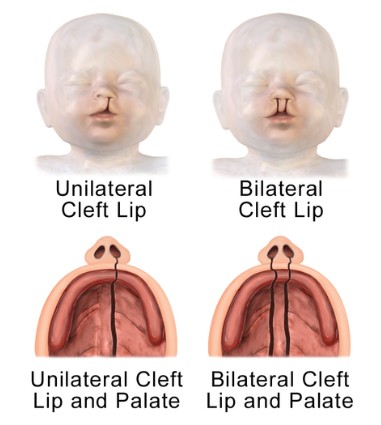
Figure: Cleft Lip and Palate
Image Source: Wikimedia Commons (2016). Unilateral and Bi-lateral Cleft Lip and Palate, Licensed under a creative commons license. Available for free at: https://commons.wikimedia.org/wiki/File:Unilateral_and_Bilateral_Cleft_Lip_and_Palate.png (Accessed 12 May 2025).
Antiepileptic drugs (AED)
Carbamazepine is a highly teratogenic medication, leading to:
- Intrauterine growth restriction (IUGR)
- Craniofacial abnormalities
- Wide-spaced eyes
- Small, broad and flatter nose
- Epicanthal folds
- Long and smooth philtrum
- NTD
- Neonatal abstinence syndrome (NAS; removal of exposure to drugs foetus was exposed to in the womb causes a group of symptoms with similar presentation to drug withdrawal in adults)
- Tachycardia, hypertension, tachypnoea
- Tremor
- Sweating
- Diarrhoea and vomiting
- Hyperirritability
- Seizure
- Hypertonia
- Theoretical risk of anticoagulative effect in new-borns (all babies whose mother took carbamazepine in pregnancy should receive vitamin K injection at birth)
Phenytoin use during pregnancy leads to foetal hydantoin syndrome characterised by:
- IUGR
- Craniofacial abnormalities
- Microcephaly
- Broad nose
- Cleft lip or palate
- Hypoplastic nails and fingers
- Intellectual disability
Sodium valproate reduces amount of folic acid required for foetal growth, and leads to foetal valproate syndrome (FVS) in around 10% of new-borns who were exposed during first trimester:
- NTD
- Cardiac defects
- Cleft lip and palate
- Hypospadias
- Finger abnormalities
- More likely to have problems with coordination, movement, learning and behaviour including Autistic Spectrum Disorder (ASD), Attention Deficit Hyperactivity Disorder (ADHD) and Conduct disorder
Women who have a previous child with FVS are more likely to have a second child with the same condition, possibly indicating a genetic susceptibility towards the medication. The likelihood of miscarriage has a positive dose-response relationship with drug dosage.
Cardiac medications
Both angiotensin-converting enzyme (ACE) inhibitors and angiotensin receptor blockers (ARB) are not advised to be taken in second and third trimesters due to its potential to increase the risk of:
- Miscarriage
- IUGR
- Patent ductus arteriosus (PDA)
- Oligohydramnios which may then lead to microcephaly, lung and renal hypoplasia, flattened facial features, misshapen skull & long bones, and joint contracture
Beta blockers used in late pregnancy can potentially lead to lower birth weight and neonatal hypoglycaemia, thus neonates have additional monitoring scans around 32 to 36-week gestation and a few days after delivery.
Statins remove cholesterol essential for foetal growth, thus should be discontinued for 3 months before attempting to conceive.
Warfarin, especially if taken in the first trimester, is another potent teratogen that leads to severe congenital malformations that collectively named foetal warfarin syndrome:
- Nasal hypoplasia
- Chondrodysplasia punctata (interferes with cartilage formation)
- Heart defects
- Increase risk of haemorrhage
- Cerebral
- Placental (leading to IUGR, preterm delivery, placental abruption and stillbirth if severe)
- Neurological malformations
- Microcephaly
- Abnormal spinal bones
- Cerebral defects and mental retardation
- Optic atrophy and blindness
- Altered development and hypoplasia of limb bones
The probability of birth defects is highest in women who take higher doses of warfarin (more than 5 mg/day). Warfarin could be reinstated during the third trimester, but it should be stopped 4 weeks prior to planned vaginal delivery to reduce the effect of medication on the new-born.
Immunomodulators
Thalidomide and Linalidomide were widely used to treat nausea and vomiting in pregnant women before its teratogenic effects were discovered. Males taking this class of drugs are advised to use contraception during sexual contact with a female as they can enter semen to affect the developing foetus. They can cause severe developmental abnormalities, the most significant of which are:
- Limb abnormalities
- Micromelia (small limbs or “flipper limbs”)
- Phocomelia (teratogenic limb defect characterised by absence of proximal portion of limb e.g., hand or foot are directly attached to shoulder or hip)
- Symmetrical amelia (complete absence of limbs)
- Craniofacial abnormalities
- Anotia (absence of external ear)
- Central facial naevus
- Cleft palate
- Cardiovascular, urogenital & GI abnormalities
- Neurodevelopmental problems
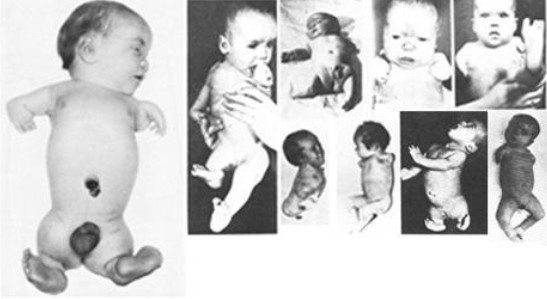
Figure 3: Malformations associated with thalidomide
Image Source: Wikimedia Commons (2007). Thalidomide effects, Licensed under a creative commons licence. Available for free at: https://commons.wikimedia.org/wiki/File:Thalidomide_effects.jpg (Accessed 12 May 2025).
Methotrexate reduces the amount of essential substrate for DNA synthesis and can lead to multiple negative outcomes: increased chance of miscarriage and serious birth defects, and IUGR. It should be discontinued 6 months, in both males and females, before attempting to conceive as it remains in the body for a period of time.
Hydroxychloroquine increases the likelihood of miscarriage two times more than the general population.
There is no clear evidence that monoclonal antibodies and small molecules for cancer treatment such as Adalimumab, Etanercept, Infliximab affect pregnancy. However, if used in later pregnancy they can potentially affect the child’s immune system for several months after birth. Live vaccines should be avoided in the neonatal period, such as rotavirus and BCG vaccine until after they have reached six months old.
Psychiatric medications
Many antidepressants and antipsychotics have adverse effects on the foetus. Most tricyclic antidepressants (TCA; excluding amitriptyline), selective serotonin receptor inhibitors (SSRI), antipsychotics cause NAS, and behavioural and learning difficulties. Women taking SSRI are 3 times more likely to have a child with ASD. SSRI and antipsychotics can also sometimes lead to persistent pulmonary hypertension of the new-born (PPHN; 1 in 300 babies) and slightly higher risk of postpartum haemorrhage (PPH).
Lithium is associated with multiple congenital abnormalities such as cardiovascular defects, congenital goitre, foetal macrosomia, and floppy infant syndrome. There are also studies showing increased risk of prematurity and perinatal mortality.
Thyroid medications
Carbimazole and methimazole use in early pregnancy appears to occasionally cause congenital malformations including:
- Choanal atresia
- Cardiovascular problems
- Gastroschisis
- Nail and finger abnormalities
- Aplasia cutis (scalp defect)
- Neonatal hypothyroidism (if used after week 10 of pregnancy)
- Learning and behavioural problems
Exposure to radiation emitted by Iodine-131 in the first trimester can theoretically cause birth defects or miscarriage, and it can accumulate and damage foetus’ developing thyroid gland from 10-12 weeks of pregnancy. Therefore, women receiving radioiodine should avoid conception for 6 months after treatment, and pregnant women should avoid prolonged close contact with other people (i.e., sleeping or sitting together for several hours per day) who have received this treatment within the previous 3 weeks.
Analgesia
NSAIDs should be avoided from second trimester due to their potential to increase rates of:
- Miscarriage
- Oligohydramnios
- Premature closure of ductus arteriosus
- PPHN
Low dose Aspirin (75mg OD) is an exception that is often used to prevent preeclampsia from 12 weeks onwards until end of pregnancy, but higher dose (up to 4g OD) taken regularly for more than 5 days after 30 weeks gestation is not advised.
Opioids exert similar effects on the foetus to those experienced by adults such as respiratory depression and withdrawal. It also has widespread effects on general development such as foetal dysgenesis, growth retardation and high rates of premature birth.
Miscellaneous
Oral and, to a lesser extent, topical forms of retinoids (i.e., vitamin A) carry a high risk of miscarriage (3 in 10 women), ectopic pregnancy, and birth defects (1 in 5 women taking isotretinoin during the first 12 weeks of pregnancy):
- Thymic hypoplasia, aplasia and ectopia
- Craniofacial defects
- Ear and eye abnormality
- Cleft palate
- Micrognathia
- Depressed nasal bridge
- Hypertelorism
- Heart defects
- Tetralogy of Fallot
- Septal defects
- Transposition of the great vessels
- Aortic arch hypoplasia
- Learning difficulties secondary to central nervous system defects
- Microcephaly
- Hydrocephaly
- Cerebral cortex abnormalities
There is no ‘safe’ period of exposure during pregnancy, as little as 1 week of use has been observed to cause birth defects. As it is slowly excreted, women must wait at least 1 month after stopping treatment before getting pregnant.
Sex hormones (e.g., progestogens & oestrogens) cause virilisation of female foetus and feminisation of male foetus.
Sulfonylureas may cause up to 10 days of severe hypoglycaemia in neonates born to mothers who were receiving them at the time of delivery.
DPP-4 inhibitors or gliptins, GLP-1 analogues and Pioglitazone have been shown to be toxic to the unborn baby in animal studies, thus they should be avoided.
Toxins
Alcohol is the most common cause of teratogenic damage in children (0.2–1.5 per 1,000 live births) and highest preventable cause of intellectual disability. Heavy drinking (defined as more than 5 units of alcohol per day) in pregnant mothers is a major risk factor for developmental disability, as high alcohol level leads to failure of neuronal and glial cell development in the first trimester, when the toxin exerts the most harmful effects. The constellation of symptoms and signs exhibited by children affected is called foetal alcohol spectrum disorder (FASD):
- Pregnancy
- Miscarriage (5 times more likely)
- Stillbirth (3 times more likely)
- Premature delivery
- IUGR and postnatal restricted growth
- Neonatal abstinence syndrome
- Dysmorphic features
- Microcephaly
- Down-slanting short palpebral fissures
- Hypertelorism and microphthalmia
- Epicanthal folds
- Cyclopia
- Cleft lip or palate
- Thin upper lip and vermillion border
- Smooth hypoplastic philtrum
- Midfacial hypoplasia
- Receding chin and micrognathia
- Systemic defects
- Heart defects: ventricular septal defect (VSD), heart-lung fistulae
- Skeletal anomalies: limb dislocations, joint contractures, pectus excavatum/pectus carinatum
- Aplastic or dysplastic kidneys leading to hypertension
- Endocrine disorders related to pituitary dysfunction (e.g., diabetes insipidus)
- Central nervous system defects: holoprosencephaly, seizures, epilepsy
- Learning and behavioural problems
Because of the high risk of alcohol in causing detrimental developmental features, the Department of Health in the United Kingdom recommends women to avoid alcohol during pregnancy and ideally when trying to conceive.
Nicotine in cigarette smoking increases release of catecholamines that causes vasoconstriction of uteroplacental blood vessels. Together with increased carbon monoxide level in the blood and carboxyhaemoglobin formation, tissue hypoxia affects many parts of the foetal body. Reduced oxygen delivery increases risk of miscarriage, ectopic pregnancy, premature delivery, low birth weight and IUGR. Women who smoke are twice as likely to have a stillbirth, partly due to problems with placental blood flow such as placental abruption. Nonetheless, pregnant women who give up smoking in the first few weeks of pregnancy are no more likely to have a low-birth-weight baby than those who do not. Specific defects in children born to mothers who smoke include:
- Craniosynostosis
- Gastroschisis
- Defects of urinary tract and cardiac system
- Congenital diaphragmatic hernia
- Talipes
Children affected are also more likely to encounter adverse events:
- Sudden infant death syndrome (SIDS; i.e., ‘cot death’)
- Childhood illness: gastrointestinal problems, obesity, ear and respiratory infections
- Learning or behavioural problems
Cannabis has a similar effect to cigarettes as they are often mixed with tobacco for smoking. It has been linked to stillbirth, premature delivery, and low birth weight. There is stronger evidence for its effect on causing VSD and gastroschisis.
Cocaine and ecstasy/3,4-methylenedioxymethamphetamine (MDMA) can cross the placenta and collect within the amniotic fluid that the foetus swallows. It causes vasoconstriction in placental vessels that has consequences to both mother and foetus. Abnormal placental blood flow increases risk of preterm labour, spontaneous abortion, and hypertensive crisis in pregnancy (e.g., pre-eclampsia, eclampsia and HELLP syndrome) which are all risk factors for placental abruption. The foetus is more likely to have IUGR, low birth weight, and learning or behavioural problems. They can also show signs of NAS reminiscent of withdrawal symptoms.
Breastfeeding
Breastfeeding is recommended by the World Health Organisation (WHO) as the default method of feeding new-borns until they reach 2 years old. Many antibodies and nutrients are transferred to the neonates in the process, but the same occurs for toxins.
List of medications contraindicated in breastfeeding mothers as they can have adverse effects on the baby when passed on through breast milk:
- Amiodarone (theoretical risk of neonatal hypothyroidism from triggering iodine release in infant)
- Antibiotics
- Clindamycin (risk of infant colitis but incidence is rare)
- Co-trimoxazole (risk of haemolysis in glucose-6-phosphate dehydrogenase deficient infants)
- Metronidazole (give breast milk an unpleasant taste that causes babies to refuse it)
- Nitrofurantoin (risk of haemolysis in glucose-6-phosphate dehydrogenase deficient infants)
- Quinolone
- Tetracycline (staining of infant’s teeth and disrupts normal bone growth)
- Aspirin (risk of metabolic acidosis and Reye’s syndrome in infant)
- Cytotoxic drugs
- Iodine
- Methotrexate (should not breastfeed 24 hours after weekly dose)
- Opioids, in particular Codeine and Tramadol (risk of ultra-rapid conversion of codeine and tramadol to their active metabolites can result in unsafe levels, leading to lethargy and respiratory depression in infant)
- Psychiatric medications
- Clozapine
- Olanzapine
- Lithium
- Retinoids
- Hypoglycaemics (found in breast milk in animal studies)
- Sulfonylurea (theoretical risk of infant hypoglycaemia)
- DPP-4 inhibitors or gliptins
- Pioglitazone
- GLP-1 analogues
Complete Guide to Clinical Genetics ST3 Application and Recruitment (2027)
Written by Medibuddy. Last updated: October 2026. Clinical Genetics is

Complete Guide to Clinical Radiology ST3 Application and Recruitment (2027)
Recruitment paused: NHS England is not running Clinical Radiology ST3+ recru

Complete Guide to Paediatric Surgery ST3 Application and Recruitment in United Kingdom (2026)
Written by Medibuddy. Last updated: October 2026. If you’re planning


Take your subscriptions with you
Our mobile app allows you to access your interview and exam question banks wherever you are.

