


 Close
Close
 10th July 2026
Prescribing in patients with renal and liver impairment
Prescribing in patients with renal impairment
Renal impairment can alter both the pharmacokinetics and pharmacodynamics of drugs in the body. Pharmacokinetics is often described as what the body does to the drugs, referring to the:
Absorption > how the drug moves from the administration site to the site of action.
Distribution > the journey of the drug through the bloodstream to various tissues of the body.
Metabolism > the process that breaks down the drug.
Excretion > the removal of the drug from the body.
Pharmacodynamics can also be affected by renal impairment; it is often defined as the relationship between the concentration of drug at the site of action and the biochemical and physiological effect, or what the drug does to the body. Antiplatelet drugs, for example, have an exaggerated response in uraemic patients, resulting in an increased risk of statin-induced myopathy.
Pharmacokinetic alterations in renal impairment
Absorption
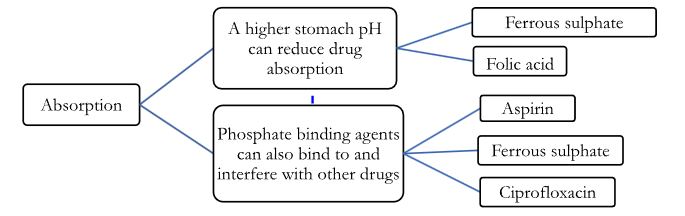
Hydrolysis of excess urea in renal impairment causes increased ammonia production in the stomach, which buffers hydrochloric acid and raises pH. A higher stomach pH can reduce drug absorption of ferrous sulphate and aspirin.
If phosphate-binding agents are administered for renal impairment, such as aluminium hydroxide, these can also bind to and interfere with other drugs such as aspirin, ferrous sulphate, and ciprofloxacin.
Distribution
The Volume of distribution (Vd) is a proportionality constant:
Volume of Distribution (L) = Amount of drug in the body (mg)
Based on the above equation, a drug with a high Vd tends to leave the plasma, entering the extravascular compartments of the body, meaning that a higher dose of a drug is essential to attain a given plasma concentration. (High Vd -> More distribution to other tissue)
Conversely, a drug with a low Vd tends to remain in the plasma, meaning a lower dose of a drug is necessary to attain a given plasma concentration. (Low Vd -> Less distribution to other tissue)
Fluid retention in renal impairment can lead to the expansion of both the extracellular and intravascular fluid compartments, resulting in an increased Vd for numerous drugs. For drugs which are usually distributed in these compartments, e.g. atenolol, the plasma drug concentrations are consequently reduced.
Alternatively, some drugs which act by binding to tissues have a reduced ability to do so, e.g. decreased binding of digoxin to skeletal muscle results in a reduced Vd, which can increase the plasma concentration of the drug from a set dose.
Acidic compounds build up in renal impairment, causing competition with drugs for binding sites on proteins, e.g. albumin. Serum albumin levels are also reduced in nephrotic syndrome, meaning that the ratio of free to bound drug is increased, and the levels of free drug are therefore higher. Reduced protein binding affects warfarin, diazepam, and phenytoin.
Metabolism
The majority of drugs are excreted from the kidneys either unchanged or as more water-soluble compounds after being metabolised in the liver. Insulin is filtered at the glomerulus and almost completely reabsorbed and degraded by cells lining the proximal convoluted tubules, there is therefore reduced insulin metabolism in renal impairment.
Excretion
Several factors affect the rate of renal excretion of drugs:
- Glomerular filtration
- Active tubular secretion
- Active tubular absorption
- Passive diffusion
A reduction in GFR (glomerular filtration rate) can lead to the accumulation of active metabolites and unaltered drugs, such as digoxin, gentamicin, and morphine.
Assessing renal function
GFR is the most widely used proxy for renal function when prescribing medications. Serum creatinine levels are used as a surrogate for renal function, though this is affected by creatinine production as well as GFR. The GFR can therefore be overestimated in those with low body mass and the elderly population.
The most used formula for estimated GFR (eGFR) is the Modification of Diet in Renal Disease (MDRD), which uses age, gender, and serum creatinine levels. However, there are several limitations:
- eGFR is unreliable at extremes of bodyweight, leading to underdosing of large patients and overdosing of small patients.
- eGFR is not authorised to be used in children or pregnant women.
- reductions in eGFR due to a rise in serum creatinine can lag behind the actual deterioration of GFR in acute kidney injury.
Therapeutic drug monitoring
Therapeutic drug monitoring describes the process of tailoring drug regimens for individual patients by monitoring the drug concentrations or drug effects. This is vital, particularly for drugs with a narrow therapeutic window, and where pharmacokinetics are disturbed (i.e. in renal impairment). When a patient with renal impairment is prescribed a drug primarily with renal excretion, the dosing can be adjusted by:
- Dose reduction
- Extending the dose intervals
- A combination of both above.
Dose adjustment should normally only be carried out if the creatinine clearance is <60mL/min. For drugs with serious adverse effects or a narrow therapeutic index, plasma drug concentrations should be monitored as a guide. The following drug alterations are according to the BNF.
Antimicrobials
Most antimicrobials are excreted renally. The majority have a wide therapeutic index, and apart from gentamicin and vancomycin, dose reduction is only required when the eGFR is <20 mL/min.
In accumulation, aminoglycosides can cause severe nephrotoxicity and ototoxicity, therefore dose adjustments are crucial in renal impairment.
With gentamicin intramuscular or intravenous use in adults, an adequate loading dose is required initially, depending on the indication and creatinine clearance. The trough level, which is the level immediately before the next dose, should be <2 mg/litre. The peak level, taken one hour after the dose administration, should be 5-10 mg/litre. In renal impairment, trough levels must be measured after every dose. Creatinine clearance can be calculated using the Cockcroft and Gault formula:
Estimated Creatining Clearance = (140 – Age ) x Weight x Constant
- Age in years
- Weight in kilograms (use ideal body weight where fat is likely to be the major contributor to body mass)
- Serum creatinine in micromol/litre
- Constant = 1.23 for men; 1.04 for women
Vancomycin loading dose should be based on actual body weight. Maintenance doses should be prescribed after creatinine clearance is calculated and, based on this, the initial dose level, administration rate, and timing of trough level are determined; these are found in local guidelines. In renal impairment, trough levels and renal function should be monitored daily.
Penicillins (e.g. amoxicillin, benzylpenicillin, co-amoxiclav), cefotaxime, ceftazidime, ciprofloxacin, clarithromycin, meropenem, metronidazole and trimethoprim can be cleared by haemodialysis. B-Lactam accumulation significantly increases the risk of seizures when high doses are used in patients with renal impairment.
Amoxicillin: The doses should be reduced if eGFR is 30 mL/minute/1.73 m² or less.
Benzylpenicillin: Use normal dose every 8–12 hours if estimated glomerular filtration rate 10–50 mL/minute/1.73 m²; use normal dose every 12 hours if estimated glomerular filtration rate less than 10 mL/minute/1.73 m².
Co-amoxiclav: if eGFR < 30 mL/minute/1.73 m², reduce dose and extend dose interval.
Cefotaxime: If eGFR less than 5 mL/minute/1.73 m², reduce dose.
Ceftazidime: Reduce dose if creatinine clearance 50 mL/minute or less
Ciprofloxacin: if eGFR < 60 mL/minute/ 1.73m² reduce dose and extend dose interval
Clarithromycin: Avoid if severe hepatic impairment also present.
For modified-release preparations, avoid if creatinine clearance < 30 mL/minute, reduce dose if creatinine clearance 30–60 mL/minute.
For immediate-release preparations, reduce dose if creatinine clearance < 30 mL/minute, max. duration 14 days.
Meropenem: if creatinine clearance 50 mL/minute, reduce dose and extend dose interval
Trimethoprim: if eGFR < 30 mL/minute/1.73 m², reduce dose.
Macrolides, metronidazole, cloxacillin and clindamycin do not require renal dose adjustments.
Antivirals
Many antivirals depend on renal clearance, including acyclovir, famciclovir, valganciclovir and ganciclovir. Side effects of accumulation include confusion, dizziness, hallucinations, and convulsions, which are reversible and dose-related. Acyclovir, Famciclovir, Valganciclovir and Ganciclovir need dose adjustments, usually at eGFR < 50 mL/minute/1.73 m².
Analgesics
Opiates
Morphine is problematic in renal impairment, as opioid effects are prolonged, and active metabolites are prone to accumulation. Pethidine is contraindicated as there is increased risk of seizures from the accumulation of norpethidine. The first line strong opioid should be oxycodone, however this also has partial renal excretion, as well as prolongation of its half-life, so requires dose reduction.
Fentanyl and alfentanil may be a safer alternatives as they are metabolised to inactive and nontoxic metabolites and are not significantly renally excreted. Patients should be monitored closely for signs of toxicity. For medium to long-term analgesia use, prolonged-release oxycodone may be used in mild to moderate CKD; however, may cause problems in stages G4-5 CKD. It may be more suitable to administer transdermal fentanyl or buprenorphine, as they are not renally excreted.
Non-steroidal anti-inflammatory drugs (NSAIDS)
NSAIDS should be avoided in renal impairment, as they can cause a rapid deterioration in renal function. As they are effective in nociceptive pain associated with inflammation, where there is a strong indication for them, they can be trialled as a last resort and with close monitoring in patients with mild or moderate CKD. Topical formulations should be used with caution and over a small surface area.
Gabapentin and pregabalin
Anticonvulsants are useful for neuropathic pain. Caution should be exercised when administering these in renal impairment, as they are renally excreted and require dose if creatinine clearance is < 80 mL / minute for gabapentin and ≤ 60 mL / minute for pregabalin. Patients should be closely monitored for neurologic side effects.
Amitriptyline
Tricyclic antidepressants, which are also useful for neuropathic pain, are not renally cleared and, therefore, can be used at usual doses.
Anticoagulants
Recommendations for DOACs in adults with renal impairment
- End-stage renal impairment CrCl <15 mL / min
- Dabigatran, Apixaban, Edoxaban and Rivaroxaban are all either contraindicated or not recommended.
- Severe renal impairment (CrCl 15 to 29 mL per minute)
- Dabigatran is contraindicated.
- Depending on clinical requirements, dose reductions are required for apixaban, edoxaban and rivaroxaban.
- Moderate renal impairment (CrCl 30 to 49 mL per minute)
- Dose adjustments required for dabigatran, apixaban, edoxaban and rivaroxaban.
- Mild renal impairment (CrCl 50 to 80 mL per minute)
- Dose adjustment only required for apixaban in patients for prevention of stroke and systemic embolism in patients with non-valvular atrial fibrillation.
Heparin
Low molecular weight heparins are excreted renally, and accumulation can therefore occur. Dose reductions are required usually for creatinine clearance <30 mL/min. An alternative anticoagulant, such as unfractionated heparin may be preferred, especially for individuals with CrCl <30 mL/min, with renal failure, or receiving dialysis. Examples of alternatives include:
- Unfractionated heparin
- An LMW heparin with lower renal clearance
- A DOAC with low renal clearance (apixaban, renal clearance approximately 25%)
Use of LMW heparin in patients with renal insufficiency has been associated with hyperkalemia.
Cardiovascular drugs
ACE Inhibitors (ACEI) and (Angiotensin Receptor Blockers) ARBs can improve outcomes in patients with renal impairment and reduce proteinuria. They must, however, be used with caution in the elderly, those taking other high-risk drugs such as NSAIDs, loop diuretics, spironolactone, and patients with diabetes (higher risk of renal artery stenosis). They can cause a decline in renal function in these patients and hyperkalaemia.
Monitoring renal function should be done after 3-4 days and 7-10 days of introduction of the drug. A creatinine rise is expected initially, but anything over 20-30% is significant.
In renal impairment, statins and fibrates are more likely to cause myopathy, and should have dose reductions.
Diuretics
In renal impairment, potassium-sparing diuretics, including spironolactone, amiloride, and triamterene, are more likely to cause hyperkalaemia. It is essential to monitor renal function and potassium when commencing these medications. They are contraindicated in CKD with a creatinine clearance < 30 mL/ 1.73 m². Loop diuretics (furosemide, bumetanide and torasemide) are more likely to cause hypokalaemia in CKD. According to NICE CKS, renal function and electrolytes should be monitored more frequently (day 5-7), particularly if patients have:
- CKD 3 or higher
- Age 60 +
- Relevant comorbidities, e.g. diabetes mellitus
- Also taking ACE-I, MRA, angiotensin II receptor antagonists (AIIRA).
Once stabilised on treatment, measure renal function and serum electrolytes at least once every 6 months.
Review the serum creatinine level and estimated glomerular filtration rate (eGFR):
- As per the NICE CKS guidelines, an increase in creatinine of 30–50% (or to greater than 200 micromol/L) or an eGFR rate less than 30 mL/min/1.73 m² should prompt clinical review of volume status and dose reduction or withdrawal of diuretics (if the person is hypovolaemic).
- If there is an increase in creatinine of more than 50% or to greater than 256 micromol/L (eGFR approximately 20–25 mL/min/1.73 m²), assess volume status, check blood pressure, review other renal function tests, including electrolytes and proteinuria, and review other medications for nephrotoxic agents. If the person is hypovolaemic, stop the diuretic; otherwise, manage accordingly. If there is any uncertainty, seek specialist advice urgently.
Drug resistance may be encountered in diuretic use, particularly loop diuretics; this may be overcome by increasing the dose, administering a continuous infusion, small frequent doses, or concomitant administration of another diuretic.
Other medications
Digoxin
Digoxin accumulates in the kidneys even at small doses, as it is excreted renally. A reduced dose is therefore required in renal impairment. Plasma digoxin concentration should be closely monitored, and toxicity is increased by electrolyte disturbances.
Anticonvulsants
Phenytoin protein binding is reduced, and its volume of distribution is significantly increased in renal failure. The plasma concentration of unbound drug (which is active) is likely to be amplified. A low plasma level may therefore not necessarily be subtherapeutic.)
Allopurinol
Allopurinol is mainly excreted in the urine, and in renal impairment, must have a dose reduction to avoid accumulation. Maximum initial dose of 100mg and increase only if the response is inadequate.
Colchicine
In renal impairment, dose must be halved for patients with GFR < 10 mL / min.
Hypoglycaemic drugs
Metformin should be avoided in patients with a creatinine clearance < 30 mL / min, and in patients with a creatinine clearance of 30 – 60 mL /min should be used cautiously at a reduced dose of 1g. Metformin carries a risk of lactic acidosis in renal impairment, as it may accumulate. Metformin should also be suspended in patients undergoing surgery, trauma, severe infection, or procedures which require contrast studies.
Risk of hypoglycaemia may be increased from sulfonylureas in renal impairment. Insulins also require dose adjustments as they depend on renal clearance for up to half of their elimination.
Psychoactive drugs
In renal impairment, lithium requires dose reduction and monitoring of plasma concentrations. Chronic use of benzodiazepines should be avoided.
Prescribing in patients with liver impairment
In patients with hepatic impairment, adjusting drug doses is crucial as the liver performs a vital role in drug metabolism. Impaired liver function can alter the drug metabolism, affecting the pharmacokinetics and pharmacodynamics of medications.
Pharmacokinetic alterations in hepatic impairment
Absorption
- In patients with hepatic impairment, it is important to consider whether a drug is lipid-soluble. Lipid-soluble drugs, e.g. propranolol may be less well absorbed in a patient with cholestasis, as they rely on bile salts to aid their absorption. This can result in reduced concentrations of the drug in the plasma and, therefore, reduced efficacy.
- In patients with cirrhosis and ascites, the absorption of some drugs, e.g. furosemide, is delayed.
- In portal hypertension, there is a decreased first-pass metabolism. First pass metabolism creates a high extraction ratio, which reduces bioavailability.
Distribution
- In patients with hepatic impairment, it is important to consider whether a drug is water-soluble, as it may distribute into the ascitic fluid, which can reduce the drug concentration, as the drug distributes into the ascitic fluid, leading to lower blood concentrations. Larger loading doses may therefore be required.
- Chronic liver disease can also result in low albumin levels. Drugs which are largely protein-bound, e.g. phenytoin and prednisolone are affected by hypoalbuminaemia, as the proportion of unbound drug increases, resulting in potentially increased adverse effects.
Metabolism
- Liver disease can reduce the capacity of the liver to metabolise certain drugs, leading to toxicity. This can be caused by a reduction in the metabolic capacity of the liver (i.e. reducing hepatic cell mass due to cirrhosis) and changes in liver blood flow. Reduced hepatic metabolism of drugs is most likely to be significant in patients with decompensated cirrhosis, cholestasis, and acute liver failure, but often restricted to patients with severe disease.
- Drugs which have a high first-pass metabolism (high extraction ratio) are particularly problematic. Advanced cirrhosis can lead to the development of varices (collateral circulation) between the portal and venous system. This can subsequently increase the proportion of absorbed oral drug entering systemic circulation, as they are metabolised less. This increases bioavailability and the potential for adverse effects. Doses of these drugs need to be reduced.
- If the drug is a pro-drug and requires liver activation, poor liver metabolism can reduce the rate of activation and therapeutic effect of these drugs.
- The hepatic reserve is large, and liver disease must be severe before drug metabolism is affected.
- Whilst impaired metabolism can be indicated by a high INR (international normalised ratio), reduced albumin level, and encephalopathy, unlike renal impairment, it is not possible to predict an individual’s capacity for drug metabolism depending on liver function tests.
Excretion
- In cholestatic patients, the elimination of drugs through the biliary route can be reduced, resulting in accumulation. Drugs which undergo significant biliary excretion, e.g. rifampicin and fusidic acid would be particularly affected.
- Renal impairment can occur as a result of liver disease, and if the drug is renally excreted, dose reduction may be required.
- Drugs which cause constipation, sedation or hypokalaemia are contraindicated in severe liver disease as these can further impair cerebral function and cause encephalopathy.
- Drugs which cause fluid retention, e.g. non-steroidal anti-inflammatory drugs and corticosteroids can worsen ascites by causing fluid retention and should be avoided in these patients.
- Reduced hepatic synthesis of blood clotting factors, causing a prolonged prothrombin time, increases the sensitivity to oral anticoagulants, e.g. warfarin and phenindione.
Hepatotoxic drugs
Hepatotoxicity can be idiosyncratic or dose-related. Certain drugs which can cause idiosyncratic reactions may do so more often in patients with impaired liver disease.
Likewise, some drugs which cause dose-related toxicity may also have more of a propensity to do so in the presence of impaired liver disease. It is vital that these are used with caution in liver disease.
Specific drug modifications for hepatic impairment
Anticoagulants:
- Warfarin may require dose adjustment, as its effect may be increased due to a reduction of clotting factors being produced by the liver. Monitoring of International Normalised Ratio (INR) is important.
Analgesics:
- Opiates can precipitate encephalopathy.
- Aspirin and NSAIDs can increase the risk of bleeding due to the reduction in clotting factors. NSAIDs can also increase ascites and should be used cautiously.
- Opioids may need dose adjustments due to altered metabolism.
- Paracetamol should be used with caution.
Antibiotics:
- Some antibiotics, such as erythromycin, clarithromycin, and co-amoxiclav, should be used with caution and may require dose adjustment.
Antifungals:
- Azole antifungals, like ketoconazole, should be avoided.
Antidepressants and Antipsychotics:
- Tricyclic antidepressants should be used with caution and avoided in severe impairment.
- Selective serotonin reuptake inhibitors (SSRIs) have a prolonged half-life. Doses should be reduced, or dose intervals increased.
Cardiovascular Medications:
- Beta-blockers, calcium channel blockers, and other cardiovascular medications should be used with caution and may need dose adjustment.
- Statins may need dose adjustments. If the liver transaminases are more than 3 times the upper limit of normal, statin therapy should not be commenced or should be discontinued if already established on treatment.
Diuretics:
- Hypokalaemia induced by loop diuretics may precipitate hepatic encephalopathy and coma—potassium-sparing diuretics can be used to prevent this.
- Diuretics can increase the risk of hypomagnesaemia in alcoholic cirrhosis, leading to arrhythmias.
Hypoglycaemic Agents:
- Insulin requirements may be decreased in hepatic impairment.
Some oral hypoglycaemics should be avoided in hepatic impairment:
- There is an increased risk of lactic acidosis with metformin; withdraw if tissue hypoxia likely.
- Increased risk of hypoglycaemia in sulphonylureas.
- Increased risk of hepatotoxicity with glitazones.
Immunosuppressants:
- Tacrolimus and ciclosporin, commonly used as immunosuppressants, may require dose modification.
Antivirals:
- Some antiviral medications, e.g. nucleoside reverse transcriptase inhibitors, may require dose adjustment. They should be used with caution in HCV and HBV cirrhosis.
- Antivirals should be avoided in Child-Pugh class C due to risk of severe complications.
References
- Hallworth M. CHAPTER 39 – Therapeutic drug monitoring. In: Marshall WJ, Lapsley M, Day AP, Ayling RM, editors. Clinical Biochemistry: Metabolic and Clinical Aspects (Third Edition): Churchill Livingstone; 2014. p. 767-86.
- Mahabadi. AMN. Volume of Distribution: StatPearls [Internet]; 2023 [updated 24/07/2023. Available from: https://www.ncbi.nlm.nih.gov/books/NBK545280/.
- Jogestrand T, Ericsson F. Skeletal muscle digoxin binding in patients with renal failure. Br J Clin Pharmacol. 1983;16(1):109-11.
- Rubenstein AH, Spitz I. Role of the kidney in insulin metabolism and excretion. Diabetes. 1968;17(3):161-9.
- Committee JF. British National Formulary (online) London: BMJ and Pharmaceutical Press; 2023 [Available from: https://bnf.nice.org.uk/drugs/gentamicin/.
- medicines e, online ce. Vancomycin 500mg powder for concentrate for solution for infusion vials 2022 [Available from: https://www.medicines.org.uk/emc/product/8759/smpc#gref.
- Committee JF. British National Formulary (online) London: BMJ and Pharmaceutical Press; 2023 [Available from: https://bnf.nice.org.uk/medicines-guidance/prescribing-in-renal-impairment/.
- Committee JF. British National Formulary (online) 2023 [Available from: https://bnf.nice.org.uk/drugs/pregabalin/#renal-impairment.
- Witt DM, Nieuwlaat R, Clark NP, Ansell J, Holbrook A, Skov J, et al. American Society of Hematology 2018 guidelines for management of venous thromboembolism: optimal management of anticoagulation therapy. Blood Advances. 2018;2(22):3257-91.
- Excellence NNIfHaC. Angiotensin-converting enzyme (ACE) inhibitors 2023 [Available from: https://cks.nice.org.uk/topics/heart-failure-chronic/prescribing-information/ace-inhibitors/.
- Excellence NNIfHaC. Diuretics 2023 [Available from: https://cks.nice.org.uk/topics/heart-failure-chronic/prescribing-information/diuretics/.
- (NICE) NIfHaCE. Digoxin 2023 [Available from: https://cks.nice.org.uk/topics/atrial-fibrillation/prescribing-information/digoxin/#:~:text=What%20dose%20of%20digoxin%20should,and%20who%20have%20renal%20impairment.
- Topham JBKHP. Nephrology: Oxford University Press; 2009.
- Excellence NNIfHaC. Allopurinol 2023 [Available from: https://cks.nice.org.uk/topics/gout/prescribing-information/allopurinol/.
- North-Lewis P. Drugs and the Liver. 1st edition ed. North-Lewis P, editor: Pharmaceutical Press; 2008.
- Committee JF. British National Formulary (online) London: BMJ and Pharmaceutical Press; 2023 [Available from: https://bnf.nice.org.uk/medicines-guidance/prescribing-in-hepatic-impairment/.
- Melero J, Berenguer M. Antiviral therapy in patients with HCV-cirrhosis. Annals of Hepatology. 2009;8(4):292-7.
- Excellence NNIfHaC. SGLT-2 inhibitors 2023 [Available from: https://cks.nice.org.uk/topics/diabetes-type-2/prescribing-information/sglt-2-inhibitors/.
Complete Guide to Clinical Genetics ST3 Application and Recruitment (2027)
Written by Medibuddy. Last updated: October 2026. Clinical Genetics is

Complete Guide to Clinical Radiology ST3 Application and Recruitment (2027)
Recruitment paused: NHS England is not running Clinical Radiology ST3+ recru

Complete Guide to Paediatric Surgery ST3 Application and Recruitment in United Kingdom (2026)
Written by Medibuddy. Last updated: October 2026. If you’re planning


Take your subscriptions with you
Our mobile app allows you to access your interview and exam question banks wherever you are.

