


 Close
Close
 10th July 2026
Pharmacokinetic alterations in renal impairment
Absorption
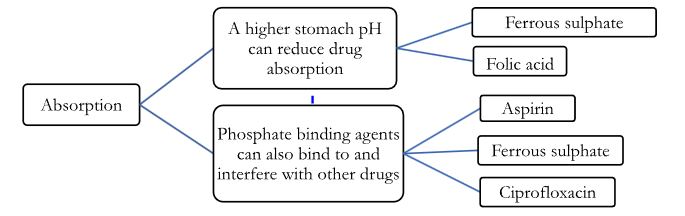
Hydrolysis of excess urea in renal impairment causes increased ammonia production in the stomach, which buffers hydrochloric acid and raises pH. A higher stomach pH can reduce drug absorption of ferrous sulphate and aspirin.
If phosphate-binding agents are administered for renal impairment, such as aluminium hydroxide, these can also bind to and interfere with other drugs such as aspirin, ferrous sulphate, and ciprofloxacin.
Distribution
The Volume of distribution (Vd) is a proportionality constant:
Volume of Distribution (L) = Amount of drug in the body (mg)
Based on the above equation, a drug with a high Vd tends to leave the plasma, entering the extravascular compartments of the body, meaning that a higher dose of a drug is essential to attain a given plasma concentration. (High Vd -> More distribution to other tissue)
Conversely, a drug with a low Vd tends to remain in the plasma, meaning a lower dose of a drug is necessary to attain a given plasma concentration. (Low Vd -> Less distribution to other tissue)
Fluid retention in renal impairment can lead to the expansion of both the extracellular and intravascular fluid compartments, resulting in an increased Vd for numerous drugs. For drugs which are usually distributed in these compartments, e.g. atenolol, the plasma drug concentrations are consequently reduced.
Alternatively, some drugs which act by binding to tissues have a reduced ability to do so, e.g. decreased binding of digoxin to skeletal muscle results in a reduced Vd, which can increase the plasma concentration of the drug from a set dose.
Acidic compounds build up in renal impairment, causing competition with drugs for binding sites on proteins, e.g. albumin. Serum albumin levels are also reduced in nephrotic syndrome, meaning that the ratio of free to bound drug is increased, and the levels of free drug are therefore higher. Reduced protein binding affects warfarin, diazepam, and phenytoin.
Metabolism
The majority of drugs are excreted from the kidneys either unchanged or as more water-soluble compounds after being metabolised in the liver. Insulin is filtered at the glomerulus and almost completely reabsorbed and degraded by cells lining the proximal convoluted tubules, there is therefore reduced insulin metabolism in renal impairment.
Excretion
Several factors affect the rate of renal excretion of drugs:
- Glomerular filtration
- Active tubular secretion
- Active tubular absorption
- Passive diffusion
A reduction in GFR (glomerular filtration rate) can lead to the accumulation of active metabolites and unaltered drugs, such as digoxin, gentamicin, and morphine.
Complete Guide to Clinical Genetics ST3 Application and Recruitment (2027)
Written by Medibuddy. Last updated: October 2026. Clinical Genetics is

Complete Guide to Clinical Radiology ST3 Application and Recruitment (2027)
Recruitment paused: NHS England is not running Clinical Radiology ST3+ recru

Complete Guide to Paediatric Surgery ST3 Application and Recruitment in United Kingdom (2026)
Written by Medibuddy. Last updated: October 2026. If you’re planning


Take your subscriptions with you
Our mobile app allows you to access your interview and exam question banks wherever you are.

