


 Close
Close
 7th June 2025
Hidradenitis suppurativa
Hidradenitis suppurativa (HS) is a chronic inflammatory disease occurring in the apocrine follicles causing painful, inflamed nodules and sterile abscesses. In Europe it has an estimated prevalence of 1%. Early diagnosis and treatment aim to minimise progression and scarring.
Cause
The aetiology is not fully understood, but proposed contributors and associations include:
- Immune factors – immune system activation from occluded hair follicles forming painful nodules and abscess rupture leading to sinus tracts, scarring and tissues destruction; complex interactions with the skin microbiome.
- Genetics – family history is seen in 30% of cases.
- Hormones – clearly more common in women in Western populations but this may not be reflected elsewhere; can vary with menstrual cycle and pregnancy.
- Smoking – thought to be due to hair follicles being more likely to be blocked.
- Obesity – friction and sweating in skin folds with hormonal and pro-inflammatory changes may promote HS.
- Other diseases – co-existing metabolic syndrome, type 2 diabetes mellitus, atherosclerosis, spondyloarthropathy, inflammatory bowel disease, depression and cardiovascular disease commonly seen. Can be part of a rare autoinflammatory syndrome, e.g. PASH (pyoderma gangrenosum, acne, suppurative hidradenitis), PAPASH (pyogenic arthritis, pyoderma gangrenosum, acne, suppurative hidradenitis).
Diagnosis
History and Examination
- Onset
- 18-39 years of age usually
- Site
- Intertriginous skin of axillary, groin, perianal, perineal and inframammary regions
- Double- headed open comedones
- Inflamed nodules
- Solitary lesion initially before multiple sites affected
- Recurrences common
- Develop into pustules and rupture with purulent discharge
- Abscesses
- Sinus tracts or fistulae (draining skin tunnels)
- Chronic as recurrence in same regions
- Scar formation
- Due to healing with dense fibrosis
- Discomfort or pain which can be severe
- Malodour
- Disfigurement
- Reduced quality of life
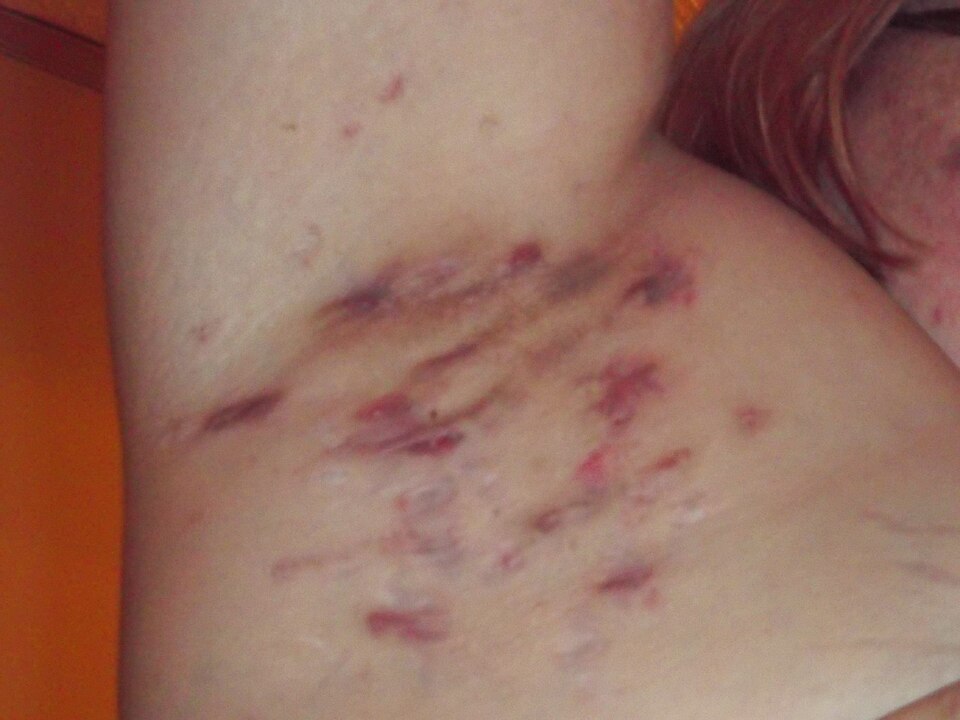 Image Source: Wikimedia Commons (2012). Lesions from Hidradenitis Suppurativa, Licensed under a creative commons licence. Available for free at: https://commons.wikimedia.org/wiki/File:Lesions_from_hidradenitis_suppurativa.jpg (Accessed 23 May 2025).
Classification
Severity of HS can be classified using Hurley staging which can help guide the type of treatment.
- Hurley Stage 1 (mild) – single or multiple, discrete abscesses and inflammatory nodules. There is no scarring or sinus tract formation.
- Hurley Stage 2 (moderate) – single or multiple, discrete abscesses and inflammatory nodules. There is scarring and widely separated sinus tracts.
- Hurley Stage 3 (severe) – multiple and extensive interconnected scars with or without active inflamed lesions.
Investigation
Hidradenitis suppurativa is a clinical diagnosis based on symptoms and signs. However, the following investigations may be useful:
- Bacterial swab – usually negative
- Blood tests if secondary infection is suspected or to exclude diabetes mellitus
- Skin biopsy – occasionally undertaken to exclude squamous cell carcinoma and differentiate from other inflammatory diseases such as Crohn’s disease.
- MRI scan – used in severe disease to check sinus tract path and plan surgery.
Management
Management depends on the severity of disease and impact on quality of life. Treatment is split into general advice, medical and surgical treatment. The main aim is to reduce new and existing lesions, sinus tracts and scarring. However, there is a lack of curative treatment.
General advice
- Good hygiene – antiseptic cleansers are often recommended
- Antiperspirants
- Loose-fitting cotton clothing
- Avoid shaving affected areas
- Minimise heat, humidity, sweating, trauma, friction and irritation
- Weight reduction if overweight or obese
- Smoking cessation
Medical treatment (high-quality evidence is limited)
- Intralesional corticosteroid
- Sometimes used for acute, painful lesions
- Antibiotics
- Topical
- For mild disease
- Clindamycin lotion
- Systemic
- Lymecycline, doxycycline or macrolide, usually used for prolonged durations such as 3-6 months
- Clindamycin and rifampicin, usually for 10-12 weeks
- Topical
- Biological therapies
- For moderate to severe, refractory HS
- Anti-TNF (adalimumab or infliximab)
- Anti-interleukin-17A (secukinumab)
- For moderate to severe, refractory HS
- Anti-androgens (for women)
- Combined oral contraceptive pill
- Spironolactone
- Dapsone
- Metformin
- Retinoid (acitretin – unsuitable for women of child-bearing potential)
Surgical treatment
- Deroofing of sinus tracts
- Localised excision of discrete chronic lesions
- En bloc resection of an entire zone (e.g. axilla – for severe disease)
Prognosis
- Natural history is variable but often there is gradual worsening
- Treatment aims to control symptoms and reduce progression of disease
- High recurrence rate of disease despite treatment
Complete Guide to Clinical Genetics ST3 Application and Recruitment (2027)
Written by Medibuddy. Last updated: October 2026. Clinical Genetics is

Complete Guide to Clinical Radiology ST3 Application and Recruitment (2027)
Recruitment paused: NHS England is not running Clinical Radiology ST3+ recru

Complete Guide to Paediatric Surgery ST3 Application and Recruitment in United Kingdom (2026)
Written by Medibuddy. Last updated: October 2026. If you’re planning


Take your subscriptions with you
Our mobile app allows you to access your interview and exam question banks wherever you are.

