


 Close
Close
 6th August 2024
Seizures and seizure-like activity
Overview of seizures and seizure-like activity
Seizures are defined as transiently occurring events, classically behavioural and/or motor disturbances, secondary to abnormal excessive or synchronised electrical activity within neuronal networks. They may occur at any age and may be secondary to a systemic or brain-specific insult, epilepsy, or have an unknown aetiology.
A single seizure does not constitute a diagnosis of epilepsy – this is only diagnosed when two unprovoked seizures occur less than 24 hours apart, one unprovoked seizure occurs with a high risk of recurrence (e.g. with a focal lesion), or an epilepsy syndrome is diagnosed.
Classification
When assessing patients presenting with seizures or seizure-like activity, an important step to establishing possible causes is to classify the nature of the seizure:
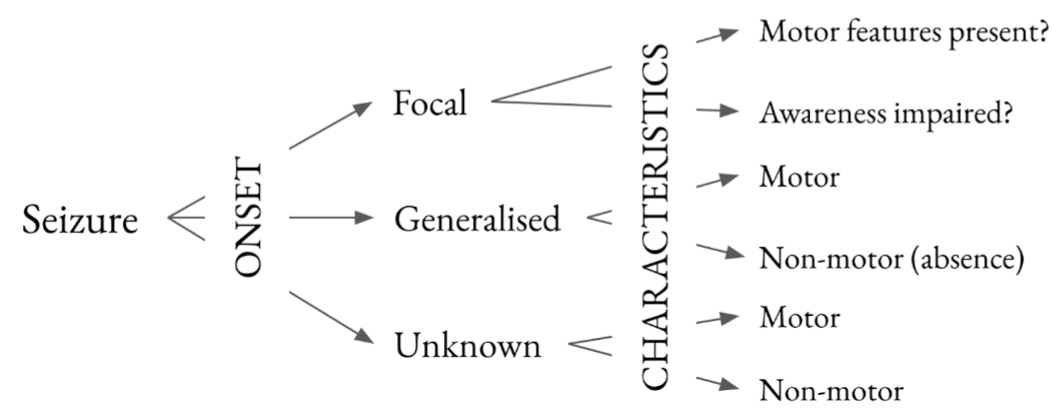
Adapted from Scheffer I, Berkovic S, Capovilla G, Connolly M, French J, Guilhoto L et al. ILAE classification of the epilepsies: Position paper of the ILAE Commission for Classification and Terminology. Epilepsia. 2017;58(4):512-521
Overview of causes of seizures
| Primary neurological | Epilepsy (including secondary to focal lesions, genetic syndromes, and degenerative processes)
Intracranial haemorrhage Cerebral venous sinus thrombosis Acute stroke Hypoxic-ischaemic brain injury Traumatic brain injury |
| Secondary causes | Hypoxia
Malignant hypertension Eclampsia Extremes of: glucose, Na⁺, Ca²⁺, Mg²⁺ (consider effects of medications, e.g. PPIs on Na⁺, Mg²⁺) Hyperthyroidism Uraemia Drug and alcohol intoxication/withdrawal Intercurrent illness in those with known seizure disorders Rare causes: Acute intermittent porphyria Thrombotic thrombocytopaenic purpura Posterior reversible encephalopathy syndrome (PRES) |
Diagnosis and management
Clinical features of seizures
It is important to elicit features before, during, and after the episode being reported. Premorbid state and any prodromal illness are also key features and may guide towards identification of a precipitant, as well as helping to differentiate a true seizure from an alternative explanation. Collateral history is, once again, essential.
| Focal | Generalised | |
|---|---|---|
| Clinical features | Aura
Automatism: lip smacking, chewing, fidgeting Sensory disturbance (e.g. visual) Speech difficulty Post-ictal period |
Aura
Absence Motor features: tonic-clonic, myoclonic Tongue biting Incontinence Post-ictal period |
| Important syndromes | Jacksonian march: focal epilepsy syndrome affecting primary motor cortex (PMC) resulting in progression of focal features as abnormal activity spreads through PMC
Todd’s paresis: post-ictal weakness classically seen in contralateral limb to focus of seizure; also associated with generalised seizures |
Juvenile myoclonic epilepsy: manifests in teenage years with myoclonus (which can be confused with clumsiness) and progresses to generalised epilepsy in most
May be associated with developmental and inherited syndromes, particularly errors of metabolism and mitochondrial disease |
Investigation of seizures
The approach should be as per that to a patient with altered conscious level. It is important to rule out potential precipitants with bedside investigations (e.g. glucose, electrolytes). Potential effects of existing illnesses or medication must be considered, e.g. hypertension, immunosuppression or renal failure may suggest PRES; disturbance to sodium and/or magnesium as a result of PPI use etc.
As with all acute neurological presentations, first-line imaging is CT brain. This may demonstrate a precipitating lesion (e.g. tumour, haemorrhage), but MRI provides the best resolution to demonstrate epileptogenic foci (e.g. in mesial temporal lobe or hippocampus).
EEG is an important facet in the diagnosis of epilepsy. It may be normal but can demonstrate abnormalities or epileptogenic discharges if taken during an event so should be combined with imaging studies. In cases where a precipitating factor is suspected, EEG can be carried out with provocation, e.g. for photosensitive epilepsy.
Management of seizures
Anti-epileptic drugs are not usually indicated after a first seizure unless there is thought to be a high risk of recurrence, e.g. if a precipitating lesion is identified.
Be aware of drug-drug interactions impairing the effectiveness of AEDs – many are metabolised via the cytochrome P450 pathway. This should be considered carefully when a patient with previously well-controlled epilepsy presents with a new seizure.
| Focal | Generalised |
|---|---|
| First line if male or woman beyond childbearing years: lamotrigine or carbamazepine
If woman of childbearing age: lamotrigine Second line: levetiracetam, oxcarbazepine |
Benzodiazepines to terminate seizure with later consideration of anti-epileptic drugs
Cause specific, e.g. MgSO₄ for eclampsia, correction of Na⁺ (hypertonic saline if causing seizures)/Ca²⁺/Mg²⁺/glucose First line if male or woman beyond childbearing years: sodium valproate If woman of childbearing age: lamotrigine Second line: carbamazepine, oxcarbazepine |
It is important to be aware of the impact of a seizure on a patient’s eligibility to drive following the event. In broad summary: patients must not drive a car or motorcycle for 6 months after an isolated or provoked seizure (unless there is a factor that is likely to drive recurrence, i.e. a precipitating lesion) or for 12 months after the most recent recurrent seizure. This is much more stringent for bus and lorry driving: patients must not drive for 5 and 10 years for isolated and recurrent seizures respectively, and may not be reliant on anti-epileptic drugs.
Status epilepticus
Status epilepticus is a medical emergency defined as a seizure lasting more than 5 minutes or recurrent seizures without recovery in between.
Patients should be treated with a benzodiazepine (IV preferred, buccal or rectal if no IV route available) after the first 5 minutes and then re-treated after 5 minutes if the seizure does not terminate. If this is ineffective, second line agents (anti-epileptic drugs: levetiracetam, phenytoin, or valproate) should be given. Patients for whom this is ineffective will require general anaesthesia with intubation and ventilation.
Status epilepticus may be non-convulsive – the patient may appear to be simply comatose with no other explanation. There may be limited or subtle features to point towards this diagnosis, though examination may reveal, for example, subtle twitching or eye movement abnormalities. EEG confirmation is required.
Psychogenic non-epileptic seizures
These are involuntary behavioural and/or motor responses to triggers, which may clinically resemble a seizure. The aetiology is not entirely understood, but there is thought to be a likely psychological mechanism. Psychosocial stressors may trigger these events.
Key features that differentiate these from true seizure events include:
- Unusual seizure-type movements – especially side-to-side movement of the head
- Eye closure with resistance to eye opening
- Normal respiratory and heart rates, lack of cyanosis
- Rapid recovery of consciousness following the event
- Long duration
- Normal prolactin and CK after the event (though sensitivity is variable)
Video EEG may be helpful and will demonstrate normal electrical activity during episodes. Neuroimaging is typically recommended to exclude an epileptogenic lesion.
One of the mainstays of management is patiently and supportively explaining the diagnosis to the patient, usually with psychotherapeutic support.
References
- Duncan R. Psychogenic non-epilectic seizures: etiology, clinical features, and diagnosis. UpToDate [Internet]. Eds: Garcia P, Dashe J. 2021 [cited 1 December 2021]. Available from: https://www.uptodate.com/contents/psychogenic-nonepileptic-seizures-etiology-clinical-features-and-diagnosis
- International League Against Epilepsy. Diagnostic Manual [Internet]. Epilepsydiagnosis.org. 2020 [cited 1 December 2021]. Available from: https://www.epilepsydiagnosis.org/index.html
- Jirsch J, Hirsch L. Non-convulsive status epilepticus: classification, clinical features, and diagnosis. UpToDate [Internet]. Eds: Garcia P, Edlow J, Dashe J. 2021 [cited 1 December 2021]. Available from: https://www.uptodate.com/contents/nonconvulsive-status-epilepticus-classification-clinical-features-and-diagnosis
- Manji H, Connolly S, Kitchen N, Lambert C, Mehta A. Oxford Handbook of Neurology [Internet]. 2nd ed. Oxford: Oxford University Press; 2014 [cited 29 November 2021]. Available from: https://oxfordmedicine.com/view/10.1093/med/9780199601172.001.0001/med-9780199601172
- National Institute for Health and Clinical Excellence. CG137: Epilepsies: diagnosis and management [Internet]. 2012 [cited 1 December 2021]. Available from: https://www.nice.org.uk/guidance/cg137/chapter/1-Guidance
- Schachter S. Evaluation and management of the first seizure in adults. UpToDate [Internet]. Eds: Garcia P, Edlow J, Dashe J. 2021 [cited 1 December 2021]. Available from: https://www.uptodate.com/contents/evaluation-and-management-of-the-first-seizure-in-adults
- Stone J. Functional (Dissociative) Seizures – Functional Neurological Disorder (FND) [Internet]. Neurosymptoms.org. 2021 [cited 1 December 2021]. Available from: https://www.neurosymptoms.org/en_GB/symptoms/fnd-symptoms/dissociative-non-epileptic-attacks-blackouts/
Complete Guide to Clinical Genetics ST3 Application and Recruitment (2027)
Written by Medibuddy. Last updated: October 2026. Clinical Genetics is

Complete Guide to Clinical Radiology ST3 Application and Recruitment (2027)
Recruitment paused: NHS England is not running Clinical Radiology ST3+ recru

Complete Guide to Paediatric Surgery ST3 Application and Recruitment in United Kingdom (2026)
Written by Medibuddy. Last updated: October 2026. If you’re planning


Take your subscriptions with you
Our mobile app allows you to access your interview and exam question banks wherever you are.

