


 Close
Close
 6th August 2024
Overview of seizures and seizure-like activity
Seizures are defined as transiently occurring events, classically behavioural and/or motor disturbances, secondary to abnormal excessive or synchronised electrical activity within neuronal networks. They may occur at any age and may be secondary to a systemic or brain-specific insult, epilepsy, or have an unknown aetiology.
A single seizure does not constitute a diagnosis of epilepsy – this is only diagnosed when two unprovoked seizures occur less than 24 hours apart, one unprovoked seizure occurs with a high risk of recurrence (e.g. with a focal lesion), or an epilepsy syndrome is diagnosed.
Classification
When assessing patients presenting with seizures or seizure-like activity, an important step to establishing possible causes is to classify the nature of the seizure:
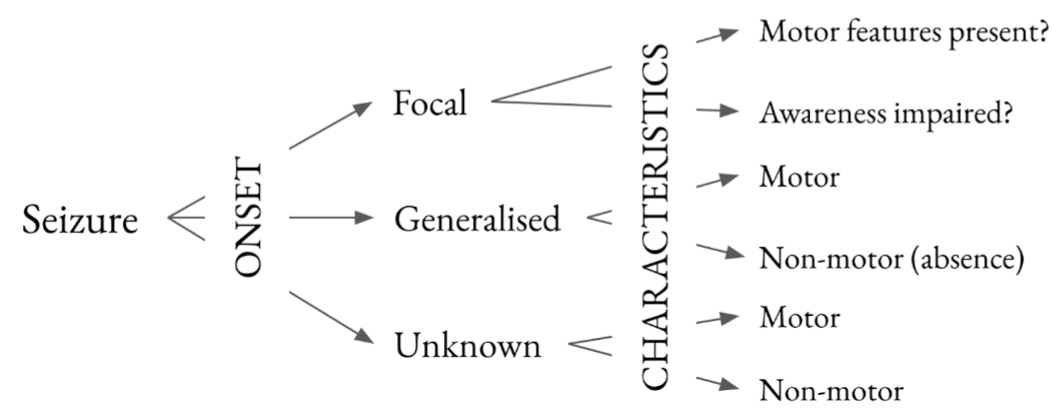
Adapted from Scheffer I, Berkovic S, Capovilla G, Connolly M, French J, Guilhoto L et al. ILAE classification of the epilepsies: Position paper of the ILAE Commission for Classification and Terminology. Epilepsia. 2017;58(4):512-521
Overview of causes of seizures
| Primary neurological | Epilepsy (including secondary to focal lesions, genetic syndromes, and degenerative processes)
Intracranial haemorrhage Cerebral venous sinus thrombosis Acute stroke Hypoxic-ischaemic brain injury Traumatic brain injury |
| Secondary causes | Hypoxia
Malignant hypertension Eclampsia Extremes of: glucose, Na⁺, Ca²⁺, Mg²⁺ (consider effects of medications, e.g. PPIs on Na⁺, Mg²⁺) Hyperthyroidism Uraemia Drug and alcohol intoxication/withdrawal Intercurrent illness in those with known seizure disorders Rare causes: Acute intermittent porphyria Thrombotic thrombocytopaenic purpura Posterior reversible encephalopathy syndrome (PRES) |
Complete Guide to Clinical Genetics ST3 Application and Recruitment (2027)
Written by Medibuddy. Last updated: October 2026. Clinical Genetics is

Complete Guide to Clinical Radiology ST3 Application and Recruitment (2027)
Recruitment paused: NHS England is not running Clinical Radiology ST3+ recru

Complete Guide to Paediatric Surgery ST3 Application and Recruitment in United Kingdom (2026)
Written by Medibuddy. Last updated: October 2026. If you’re planning


Take your subscriptions with you
Our mobile app allows you to access your interview and exam question banks wherever you are.

