


 Close
Close
 10th May 2025
Catecholaminergic Polymorphic Ventricular Tachycardia
Catecholaminergic polymorphic ventricular tachycardia (CPVT) is a heritable disorder characterized by catecholamine induced bidirectional VT and polymorphic VT in the absence of structural heart disease or ischaemia.
Clinical feature
- Bidirectional VT or polymorphic VT induced by physical activity or emotional stress
- Most patients have normal ECG and structurally normal heart
- Two main genetic types: dominant disease due to mutation of gene encoding RYR2 receptor and recessive disease due to mutation of gene encoding CASQ2
Investigations
- Exercise stress test: Elicits bidirectional or polymorphic VT (Figure-4)
- Genetic testing
- Epinephrine or isoprenaline challenge may be considered when exercise testing is not possible
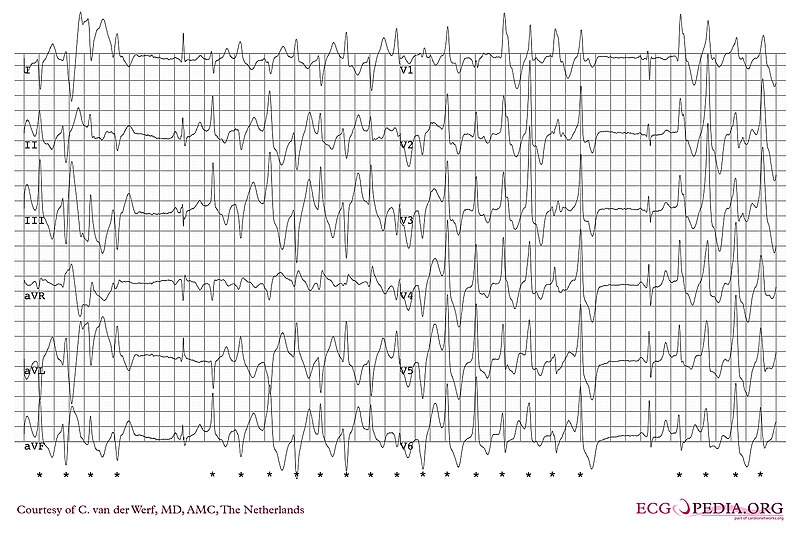
Image Source: Wikimedia Commons (2010). Catecholaminergic polymorphic ventricular tachycardia, Licensed under a creative commons licence. Available for free at: https://commons.wikimedia.org/wiki/Category:Catecholaminergic_polymorphic_ventricular_tachycardia#/media/File:ECG000033_(CardioNetworks_ECGpedia).jpg (Accessed 7 May 2025).
Management
- Avoidance of competitive sports, strenuous exercise and exposure to stressful environments is recommended to all patients
- Non-selective beta-blockers (nadolol or propranolol) are recommended in all patients.
- ICD implantation is indicated in patients with aborted cardiac arrest in combination with beta-blockers and flecainide
- Left cardiac sympathetic denervation or Flecainide can be considered when above measures fail.
Complete Guide to Clinical Genetics ST3 Application and Recruitment (2027)
Written by Medibuddy. Last updated: October 2026. Clinical Genetics is

Complete Guide to Clinical Radiology ST3 Application and Recruitment (2027)
Recruitment paused: NHS England is not running Clinical Radiology ST3+ recru

Complete Guide to Paediatric Surgery ST3 Application and Recruitment in United Kingdom (2026)
Written by Medibuddy. Last updated: October 2026. If you’re planning


Take your subscriptions with you
Our mobile app allows you to access your interview and exam question banks wherever you are.

