


 Close
Close
 23rd May 2025
Craniopharyngioma
Craniopharyngiomas are benign non-glial epithelial tumours arising from remnants of Rathke’s pouch. These tumours often grow above the pituitary gland in the sellar/suprasellar space adjacent to the optic chiasm and often lead to a deficiency of anterior pituitary hormones. They account for 5-10% brain tumours in children and 1-3% of all adult intracranial tumours. The aetiology is unknown.
Classification
Craniopharyngiomas are classified based on pathology:
- Adamantinous type (>80%): Adamantinous epithelium, keratin nodules, poorly demarcated from brain tissue, associated withs CTNNB1 gene mutation
- Squamous papillary type (<20% of tumours): Squamous epithelium with papillaries, well demarcated from brain tissue, rare in children, associate with BRAF oncogene mutation
Clinical Features
- Visual disturbances
- Headache
- Intracranial hypertension: nausea, vomiting, double vision
- Endocrine: Symptoms of hypogonadotrophic hypogonadism (as listed above, galactorrhoea
- Paediatric: macrocephaly and hydrocephalus (prior to fusion of intracranial sutures) and growth failure
Investigations
- Visual field testing
- MRI brain with contrast
- Serum: PRL, GH, IGF-1, LH, FSH, TSH, morning testosterone, morning ACTH and cortisol, U&Es
- Paired urine serum osmolality
- Can consider tissue histology following surgical biopsy/resection
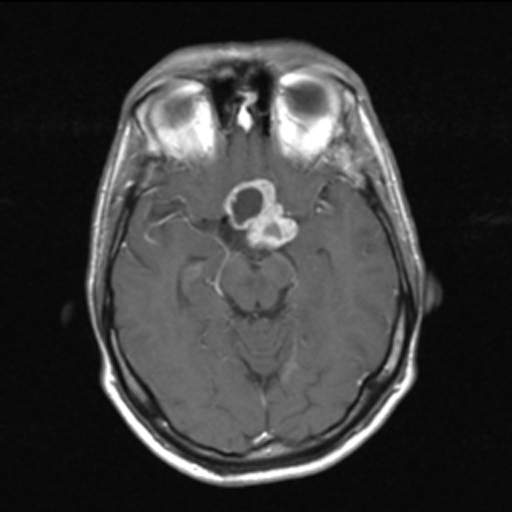
Image Source: Wikimedia Commons (2011). Craniopharyngioma, Licensed under a creative commons licence. Available for free at: https://commons.wikimedia.org/w/index.php?curid=15959020 (Accessed 13 May 2025).
Management
- The exact type of surgical management (biopsy only, cyst aspiration, CSF shunting, or tumour resection) depends on tumour size and location
- Post-operative ophthalmology review will be required
- Hormonal replacement therapy
- Follow-up is done every 6-12 months and involves MRI brain scans as well as endocrinology review
Complications
- Pituitary hormone deficiencies
- Diabetes insipidus
- Visual impairment
- Rarer complications include: seizures, hypothalamic injury, cognitive dysfunction
Complete Guide to Clinical Genetics ST3 Application and Recruitment (2027)
Written by Medibuddy. Last updated: October 2026. Clinical Genetics is

Complete Guide to Clinical Radiology ST3 Application and Recruitment (2027)
Recruitment paused: NHS England is not running Clinical Radiology ST3+ recru

Complete Guide to Paediatric Surgery ST3 Application and Recruitment in United Kingdom (2026)
Written by Medibuddy. Last updated: October 2026. If you’re planning


Take your subscriptions with you
Our mobile app allows you to access your interview and exam question banks wherever you are.

