


 Close
Close
 23rd May 2025
Cushing Syndrome
Cushing syndrome is a rare disorder characterised by an excess production of cortisol, often secondary to an excess of ACTH production. It has an incidence of 0.7-2.4 per million population per year. It affects females more than males at a ratio of 3:1. Cushing’s disease is Cushing syndrome caused by an ACTH secreting pituitary tumour, affecting more males than females at a ratio of 5:3.
Risk factors
- Hypertension
- Uncontrolled diabetes
- Osteoporosis
- Adrenal masses
Causes
ACTH Dependent causes are due to an overproduction of ACTH which stimulates increased synthesis of cortisol. Causes include:
- Cushing’s disease (70-80%). This has been linked to a mutation in the gene ubiquitin-specific protease 8 on chromosome 15 (USP8) which increases risk of developing pituitary adenoma
- Adrenal adenoma (10%). Linked to mutations in the cAMP/PKA pathway
- Ectopic secretion of ACTH or CRH by non-pituitary tumours (~10%)
- Adrenal carcinoma (1%)
ACTH Independent causes result in overproduction of cortisol by the adrenal glands despite suppressed ACTH levels. Causes include:
- Adrenal adenoma
- Bilateral adrenal hyperplasia
- Adrenal carcinomas (rare). Often presents as a rapidly growing adrenal mass
- Primary pigmented nodular adrenocortical disease (PPNAD)
Exogenous corticosteroids, e.g., prednisolone, can also cause features of Cushings.
Clinical Features
- Facial plethora and facial rounding
- Skin: Purple striae, atrophy, hyperpigmentation (due to increased ACTH rather than cortisol), acanthosis nigricans, cutaneous fungal infections e.g., tinea versicolor
- Metabolic: Diabetes/glucose intolerance, obesity with supraclavicular fullness (due to deposition of subcutaneous fat)
- Cardiovascular: Increased risk of hypertension, venous thromboembolism, heart failure and dilated cardiomyopathy
- Musculoskeletal: Osteoporosis, proximal muscle wasting and weakness,
- Mood changes
- Irregular menstruation
- Signs of androgen excess in females, whose main source of androgens are the adrenals, such as: hirsutism, acne, changes in libido, temporal balding, deep voice, virilization. Note the testes are the main source of androgens for men so they do not show signs of androgen excess.
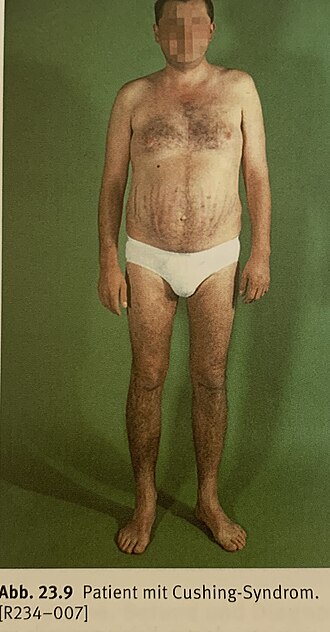
Image Source: Wikimedia Commons (2020). Patient with Cushing-Syndrom, Licensed under a Creative Commons licence. Available for free at: https://commons.wikimedia.org/w/index.php?curid=90182292 (Accessed 13 May 2025).
Diagnosis
- First line is the dexamethasone suppression test. For the low dose test, 1mg of dexamethasone is given at 11pm and plasma cortisol and dexamethasone level are measured at 8am. The latter is measured to ensure adequate levels are achieved, especially in extremely obese patients. For a positive result, morning cortisol levels must be >1.8 micrograms/dL
- If the patient is taking drugs affecting the metabolism of dexamethasone e.g., phenytoin, carbamazepine, rifampicin, and cimetidine, 24-hour urinary free cortisol can be measured.
- Late-night salivary cortisol. Saliva sample taken between 11pm-12am. Can be repeated twice on two separate nights for greater sensitivity. Elevated cortisol levels suggest Cushings.
- Once a diagnosis has been established, morning plasma ACTH testing can be done. Suppressed ACTH (levels <1 picomol/L) suggest ACTH-independent Cushings due to adrenal pathology. No suppression (levels >4 picomol/L) indicates ACTH-dependent Cushings due to pituitary tumour or ectopic source of ACTH production.
- To differentiate between Cushing’s disease and pseudo-Cushing syndrome (physiological hypercortisolism) a CRH stimulation test is done. 0.5mg of oral dexamethasone is administered 6 hourly for 48 hours. Two hours after the last dose, 1 mcg/kg of CRH is given IV. Serum cortisol is measured 15 minutes later. If glucocorticoid suppression is overcome, a diagnosis of Cushing’s disease rather than pseudo-Cushing syndrome is suspected.
Other investigations
- Urine pregnancy test to exclude pregnancy
- Serum glucose
- Elevated plasma dehydroepiandrosterone sulphate (DHEAS) levels could suggest adrenal carcinoma
- Pituitary MRI if ACTH dependent Cushings
- If confirmed pituitary lesion, can attempt inferior petrosal sinus sampling. Blood sample taken from sinus and plasma at the same time. If central/peripheral ACTH ratio is >2:1 the causative pathology lies in the pituitary gland. Otherwise, the source is ectopic
- Adrenal CT if ACTH independent Cushings
- Can consider CT TAP and/or PET scan if considering ectopic source of pathology
Management
Treating ACTH secreting pituitary tumour:
- 1st line: transsphenoidal pituitary adenectomy.
- Note, medical therapy with: somatostatin analogue e.g., Pasiretoride; dopamine agonist e.g., cabergoline; steroidogenesis inhibitor e.g., osilodrostat, or glucocorticoid antagonists e.g., mifepristone or ketoconazole, could be used prior to surgery for severe Cushings
- Post-surgical corticosteroid replacement therapy with hydrocortisone
- Other hormones may also need to be replaced with levothyroxine testosterone/oestradiol, recombinant somatropin, desmopressin
- If hormone replacement fails, repeat transsphenoidal pituitary adenectomy can be considered
- If no success, pituitary radiotherapy can be attempted
- If the disease is still uncontrolled and/or the patient is not suitable for reoperation, a bilateral adrenalectomy can be done. However, this can increase the risk of Nelson syndrome
Treating ectopic ACTH/CRH tumours:
- 1st: Surgical resection/ablation of tumour
- Steroidogenesis inhibitor therapy or a glucocorticoid receptor antagonist can be used prior to surgery in severe Cushing’s, e.g. ketoconazole
- If surgical resection cannot be performed, bilateral adrenalectomy can be considered. After this, permanent post-surgical corticosteroid therapy will be required
- Chemo/radiotherapy, or medical therapy alone, can be considered
Treating adrenal pathology:
- 1st: Unilateral adrenalectomy/tumour resection. If disease is bilateral, a bilateral adrenalectomy is first line.
- Like the above, medical therapy with steroidogenesis inhibitors can be considered before surgery in severe cases
- Chemo/radiotherapy, or medical therapy alone, can be considered
Prognosis and Monitoring
- Patients in the first week post-pituitary adenectomy require monitoring of morning cortisol levels (sample taken 24 hrs post last dose of corticosteroid). Low levels of cortisol predict remission
- Recurrence of ACTH dependent Cushings occurs in 5-26% of patients within 5 years
Therefore, screening at 6-12 months using one of the diagnostic tests listed above is required. Late night salivary cortisol is the most sensitive test to detect recurrence.
Complete Guide to Clinical Genetics ST3 Application and Recruitment (2027)
Written by Medibuddy. Last updated: October 2026. Clinical Genetics is

Complete Guide to Clinical Radiology ST3 Application and Recruitment (2027)
Recruitment paused: NHS England is not running Clinical Radiology ST3+ recru

Complete Guide to Paediatric Surgery ST3 Application and Recruitment in United Kingdom (2026)
Written by Medibuddy. Last updated: October 2026. If you’re planning


Take your subscriptions with you
Our mobile app allows you to access your interview and exam question banks wherever you are.

