


 Close
Close
 23rd May 2025
Diabetes Insipidus
Diabetes insipidus (DI) is a disorder that leads to an increased production of dilute urine, polydipsia and can include nocturia. It is rare, with a global prevalence of 1 per 25,000 of the population.
Types of DI:
- Cranial/Central: Impaired production/transportation/release of ADH. Caused by disorders in areas responsible for ADH secretion, such as hypothalamic osmoreceptors, supraoptic/paraventricular nuclei or the superior part of the supraoptic hypophyseal tract. Pathology in the neurohypophysis alone often does not cause DI as ADH produced in the hypothalamus can enter the systemic circulation.
- Nephrogenic: Renal collecting ducts are resistant to ADH
- Gestational: Occurs during pregnancy
Aetiology
Cranial DI
- Transsphenoidal surgery for pituitary adenoma
- Craniopharyngioma
- Lesions to the pituitary stalk
- Traumatic brain injury
- Subarachnoid haemorrhage affecting the anterior communicating artery supplying the anterior hypothalamus
- Congenital hypothalamic-pituitary defects
- Wolfram syndrome: Autosomal recessive progressive neurodegenerative disorder leading to diabetes mellitus, optic atrophy, sensorineural deafness and DI
- Associated with autoimmune disorders e.g., Hashimoto’s thyroiditis
- Medications e.g., phenytoin
- Late complication of meningitis/encephalitis
Nephrogenic DI
- Lithium therapy
- Chronic kidney disease
- Renal amyloidosis
- Renal sarcoidosis
- Associated with chronic hypercalcaemia/ hypokalaemia
- Genetics: mutations AVPR2 receptor (X linked recessive) or AQP2 gene (autosomal recessive)
Initial Investigations
- Paired urine serum osmolality: Low urine (<300 mmol/kg) and high serum osmolality
- Urea and electrolytes, calcium: Assesses renal function and electrolyte abnormalities
- 24 hr urine collection to measure volume: >3L in 24 hrs
- To rule out diabetes mellitus: urine dipstick to test for glucose and serum glucose levels
Diagnostic Tests
- 1st Water deprivation test
- Patient deprived of fluids for 8 hours. Every hour serum osmolality, urine osmolality and urine volume are measured
- Contraindications: Renal insufficiency, uncontrolled diabetes mellitus, uncorrected adrenal or thyroid hormone deficiency
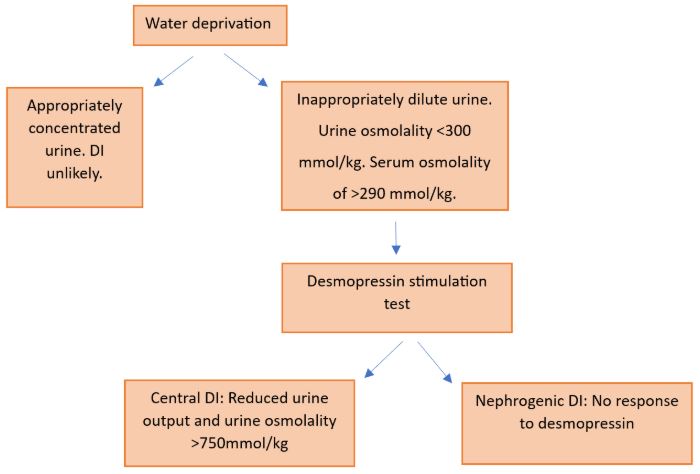
- DI patients are unable to concentrate their urine in response to dehydration so results show inappropriately dilute urine with osmolality <300 mmol/kg and a serum osmolality of >290 mmol/kg
- 2nd Desmopressin stimulation test
- Done after positive water deprivation test
- 2 micrograms desmopressin administered subcutaneously. Every hour for 4 hours serum osmolality, urine osmolality and urine volume are measured
- Patients with central DI will have a reduced urine output and increased urine osmolality (>750 mmol/kg) in response to desmopressin
- Patients with nephrogenic DI show no response to desmopressin
- Hypertonic saline stimulated test can be considered
- Baseline copeptin level >24.1 picomol/L diagnoses nephrogenic DI
- After infusing 3% sodium chloride, a copeptin level >4.9 picomol/L diagnoses central DI
Further investigations to be considered
- MRI brain with contrast
- Genetic testing
- Pituitary hormone levels
Diagram for Diagnosis of Diabetes Insipidus
Management
- Hypernatremia: treat with IVF e.g., 5% dextrose
- Central DI: Desmopressin
- Nephrogenic DI: Adequate fluid intake to match losses, treatment of underlying cause. Can consider low sodium diet (<500mg/day), thiazide diuretics or indomethacin to reduce urine output
Complete Guide to Clinical Genetics ST3 Application and Recruitment (2027)
Written by Medibuddy. Last updated: October 2026. Clinical Genetics is
Clinical Genetics ST3

Complete Guide to Clinical Radiology ST3 Application and Recruitment (2027)
Recruitment paused: NHS England is not running Clinical Radiology ST3+ recru
Clinical Radiology ST3

Complete Guide to Paediatric Surgery ST3 Application and Recruitment in United Kingdom (2026)
Written by Medibuddy. Last updated: October 2026. If you’re planning
Paediatric Surgery ST3


Take your subscriptions with you
Our mobile app allows you to access your interview and exam question banks wherever you are.

