


 Close
Close
 23rd November 2023
Moral Development
Freud’s Psychoanalytic Theory
Freud’s account of moral development is closely related to other aspects of his psychoanalytic theory. In particular, the structural theory of the mind and the stages of psychosexual development.
Structural theory of the mind
Freud believed the mind or psychic apparatus comprises three parts: id, ego and superego. (Please note this is different from Freud’s topographical model of the mind, which is divided into three regions: the conscious system, the preconscious system and the unconscious system – Illustrated in the Interpretation of Dreams).
The id: ‘contains everything that is inherited, that is present at birth, that is laid down in the constitution, and above all, therefore, the instincts’ (Freud, 1923). The two major id instincts are sexuality and aggression. The id is governed by the pleasure principle.
The ego: can be thought of as the ‘executive’ part of the personality, the planning, decision-making, rational and logical part of us. It is governed by the reality principle. While the id demands immediate gratification of our needs and impulses, the ego will postpone satisfaction until the appropriate time and place. The ego spans all three topographical dimensions – conscious, preconscious and unconscious. Logical and abstract thinking and verbal expression are associated with the conscious and preconscious function of the ego, whereas the defence mechanisms reside in the unconscious part of the ego. ‘The ego represents reason and common sense, in contrast to the id, which contains the passions’ (Freud, 1923).
The superego: the third component of the tripartite structural model, the superego, establishes and maintains an individual’s moral conscience on the basis of a complex system of ideals and values internalised from parents. The components of the superego are the ego-ideal and the conscience. The ego-ideal promises the ego rewards (pride and high self-esteem) for good behaviour, whereas the conscience threatens the ego with punishment (in the form of guilt) for bad behaviour. These correspond to the rewarding and punishing parents, respectively. Freud viewed the superego as the heir to the Oedipus complex (discussed later in this chapter). Children internalise parental values and standards at about the ages of 5 or 6 years. The superego then acts as an agency that provides ongoing scrutiny of a person’s behaviour, thoughts and feelings.
Freud’s stages of psychosexual development
- Oral Stage (0 to 18 months) – Earliest stage of development where infants’ needs, perception and modes of expression are primarily centred in the mouth, lips, tongue and other organs related to the oral zone and around the sucking reflex. Two substages– incorporative and aggressive. Envy and jealousy are often associated with oral traits. Successful resolution provides a sense of self reliance and self-trust. The ego develops at this stage.
- Anal stage (1 ½ to 3 years) – Anal cavity and sphincter muscles are the main source of pleasure. Two substages– expulsion and retention. Anal characteristics are defences are typically seen in obsessive-compulsive neuroses. Also, ambivalence and sadomasochistic tendencies are associated. Successful resolution provides the basis for the development of personal autonomy.
- Phallic stage (3 to 5 yrs) – Genitals become organs of interest; masturbation-like activity noted. Children become aware of anatomical sex differences. Which marks the onset of the Oedipus complex. The name derives from the Greek tragedy Oedipus Rex, in which Oedipus kills his father to marry his mother. Both boys and girls experience conflicting emotions in relation to their parents. How successfully these conflicts are resolved is crucial for future personality development. Several important concepts related to this stage are discussed later in this chapter. Abraham divided this into early partial genital (true phallic phase) and later mature genital phase.
- Latency stage (5 to puberty approx. 11yrs) – The sexual preoccupation of earlier stages are repressed. Socialisation and interest in peers are seen. Sexual energy sublimated towards school work, hobbies and friends. Superego develops in this stage, and the balance between the id, ego and superego is greater than at any other time in a child’s life.
- Genital stage (puberty onwards) – Latency represents the calm before the storm of puberty. The relative harmony within the child’s personality is disrupted by the id’s powerful new demands in the form of heterosexual desires; genital sexuality is born.
The Oedipus complex, identification and the superego
A boy, like a girl, takes his mother as his first love-object. Starting at about three, a boy’s love for his mother becomes increasingly passionate. The boy is also jealous of his father, who already ‘possesses’ her, and wants him out of the way so that he can have his mother all to himself. However, his father is bigger and more powerful, and he eventually becomes afraid that his father will punish him by cutting off his penis (fear of castration/castration anxiety). He reaches this conclusion partly from the observation that females don’t have a penis. To resolve the dilemma, the boy represses his desire for his mother and his hostility towards his father and identifies with his father (identification with the aggressor). With this, the boy acquires his superego and male role.
As for a girl, the Oedipus complex (sometimes referred to as the Electra complex) begins with the belief that she has already been castrated. She blames her mother for the loss and wants what males have (penis envy). Of note, the idea of penis envy was interpreted by later researchers as a girl’s yearning for a boy’s social status. Freud was less sure about how the girl internalised her mother and acquired identification and superego. He suggested the girl may fear the loss of her mother’s love. To keep the mother alive in her, she internalises her and becomes the nice girl she wants her to be (anaclitic identification). Freud said the motive being less powerful in the girl, she develops a weaker superego.
His claim that females have a weaker superego and their identity as separate independent persons is less developed in Freud’s study, which was criticised by later researchers.
Case study on Oedipus complex
Freud cited his case study involving Little Hans (1909) in support of his theory of the Oedipus complex. The 5-year-old developed a phobia of being bitten by a horse, which Freud interpreted as a fear of castration. The case of Little Hans was particularly important because he was Freud’s only child patient. Though his particular claim regarding ‘Little Hans’ was not well supported with evidence, later research suggested attachment studies, such as by Bolwby (1973), provided a good deal of support for the basic psychoanalytic hypothesis that the quality of a child’s earliest relationships affect the whole course of later development (Bee, 2000) remain as a lasting legacy of Freud’s moral developmental study.
References
- Gross, R. (2020). Psychology: the science of mind and behaviour (8th ed.). Hodder.
- Freud, S. (1989). The ego and the id. TACD Journal, 17(1), 5–22. The translation of the classic text was originally published in German in 1923.
- Freud, S. The Interpretation of Dreams. Translated by A.A. Brill, Wordsworth Editions, 1997. Edited and with an introduction by Harold Bloom. (2007). Sophocles’ Oedipus Rex. New York: Chelsea House
Cognitive-Developmental Theories
Cognitive-developmental theories maintain that the reasons underlying behaviour, rather than the behaviour itself, make it right or wrong. Here, we shall discuss Piaget, Kohlberg and Eisenberg’s theory of moral development; all three are within the cognitive-developmental framework.
Piaget’s theory
Piaget argued morality develops gradually during childhood and adolescence. However, he categorically did not use the concept of the developmental stage in relation to moral development. Rather, he differentiated two types of moral orientations, namely heteronomous and autonomous. (Please note this is different from Piaget’s stages of cognitive development: Sensorimotor, preoperational, concrete operational and formal operational).
Summary of Piaget’s theory of moral development
| Understanding rules | Moral judgement and punishments | |
| 5-9 year-olds: Heteronomous moral orientation (‘subject to another’s law and rule’) | Rules represent an external law; they are sacred and unchangeable.
Unilateral respect (unconditional obedience to parents or other adults). |
External responsibility holds for crime; severity of outcome or loss decides the degree of punishment warranted.
Moral realism: Punishment is accepted because it comes from an authority figure. Belief in collective punishment and expiatory punishment. Immanent justice: The World is just – a misfortune will punish the deserved for a misdeed. |
| 10-year-olds and above: Autonomous moral orientation (‘subject to one’s own law or rules) | The product of social agreement.
Mutual respect (disagreements with peers have to be negotiated and resolved). |
Mutual respect for the self-invented law: could be changed by consensus and for fairness.
Belief in the principle of reciprocity (making good the loss/damage). Moral relativism: justice not tied to authority. No longer believe in immanent justice or collective punishment. |
An evaluation of Piaget’s theory
Piaget’s theory has a gender bias towards male children, which is also apparent in Kohlberg’s theory. The change from heteronomous to autonomous morality occurs because of a shift at about seven years of age from egocentric to operational thoughts. This suggests cognitive development is necessary for moral development, and the latter lags about 2 years behind the former. Many of the age trends that Piaget described are supported by later research, including cross-cultural data, mainly from African countries.
Kohlberg’s theory
Kohlberg’s theory has dominated the field of moral reasoning for more than 30 years. He was greatly influenced by Piaget and, like him, believed morality develops gradually during childhood and adolescence. Also, like Piaget, he was more interested in people’s reasons for their moral judgement than the judgement itself. He assessed moral reasoning through the use of moral dilemmas, which typically involve a choice between two alternatives, both of which would be considered socially unacceptable. One of the most famous dilemmas concerns ‘Heinz’.
| An example of a moral dilemma (from Kohlberg, 1984) |
A story of a middle-aged, ordinary middle-class man called Heinz is considered as an example. His wife suffers from a dreadful disease. Doctors believe that a special drug, which was invented recently and is available at the BIG pharma store, can only save his wife. When Heinz went to buy the drug, the drug seller said the cost was around 4,000 dollars, while the actual manufacturing cost of the drug was 400 dollars. Heinz borrowed the money from friends and lenders and could finally collect only 2,000 dollars. Though Heinz pleaded a lot, the greedy drug seller refused to sell the drug at a low cost. Now, Heinz had no other option but to steal the drug from the shop to save the life of his wife.
|
Kohlberg’s three levels and six stages of moral development
Kohlberg’s original study (beginning in 1956) involved 72 Chicago boys (10-16), 58 of whom were followed up at three yearly intervals for 20 years. Based on the answers given by this sample to the Heinz and other dilemmas, Kohlberg identified 6 stages of moral development, spanning 3 levels of moral reasoning.
- Level 1 Pre-conventional morality (7-12 years to middle childhood) – In this stage, the children decide right or wrong according to the consequences. If an action leads to punishment, it must be bad, and if it leads to reward, it must be good.
Stages:
– Punishment and obedience orientation – Obedience to rules to avoid punishment.
– Reward orientation / Instrumental relativism – What brings rewards is right. ‘Tit for tat’ approach seen.
- Level 2 Conventional morality (approximately 13-16 years) – Here, the children believe that social rules and the expectations of others determine what acceptable or unacceptable behaviour is.
Stages:
– Concordance orientation – What pleases others is right. What the majority thinks is right. It’s also called good boy / nice girl orientation. Conforms to avoid disapproval and meet the expectations of others. Being good is as important as having good motives and showing concern.
– Social order or Authority orientation – Upholds laws and social rules to avoid the censure of the authorities and feelings of guilt about not doing one’s duty. Maintaining social order is the goal.
- Level 3 Postconventional morality (approximately 16-20 years) – Here, what is right is based on an individual’s understanding of universal ethical principles. These are often abstract and ill-defined, but it might include the preservation of life at all costs and the importance of human dignity.
Stages:
– Social contract or legalistic orientation – Actions guided by principles commonly agreed by one’s group as essential to public welfare (relative values) and democracy is upheld while an individual’s life is given more respect than written codes of law.
– Universal ethical orientation – Actions guided by self-chosen ethical principles. Laws and social principles are usually valid because they are based on these principles. Social rules can be broken if universal morality is not upheld.
Level 3 cannot be considered a part of the normal or expected course of development and instead represents a philosophical ideal. Only 15% of the adult population eventually achieve level 3.
An evaluation of Kohlberg’s theory
Research showed young children’s understanding of moral regulation is far more sophisticated than implied by Kohlberg’s stages. Children have experience of sharing food and toys with friends, which is translated into implicit principles. However, they have little experience in issues raised by Kohlberg in moral dilemmas, so their reasoning is rather muddled (Hart et al., 2013).
Kohlberg’s model is also accused of being Eurocentric and androcentric. Some researchers suggest male morality is based on abstract principles of law and justice and women’s is based on compassion and care (Gilligan’s theory of ethics of care). However, the claim was refuted by later research (Walker, 1996). It’s widely accepted that gender difference in morality is less important than the kind of dilemmas being considered.
The relationship between Kohlberg’s stages, Piaget’s types of moral development, and Piaget’s stages of cognitive development
| Kohlberg’s level of moral development | Age group included within Kohlberg’s developmental levels | Corresponding type of morality (Piaget) | Corresponding stages of cognitive development (Piaget) |
| Preconventional –
(stages 1 and 2) |
Most 9-year-old and below.
Some above 9. |
Heteronomous (5-9/10). | Pre-operational (2-7). |
| Conventional –
(stages 3 and 4) |
Most adolescents and adults. | Heteronomous plus autonomous. | Concrete operational (7-11). |
| Post-convention –
(stages 5 and 6) |
10-15% of the adult population. | Autonomous (10 and above). | Formal operational (11 and above). |
Eisenberg’s theory of prosocial moral reasoning
Kohlberg’s concept of moral reasoning is prohibition-oriented. In the case of Heinz, for example, one prohibition (stealing) is pitted against another (allowing his wife to die). But not all ‘moral conflicts’ are like this. Eisenberg argued that if we want to understand the developmental change in helping or altruism, we need to examine children’s reasoning when faced with a conflict between their own needs and those of others in a context where the role of laws, rules, and the dictates of authority are minimal. This describes prosocial moral reasoning.
In a series of studies in the 1980s, Eisenberg presented children of different ages (and sometimes followed up to early adulthood) with illustrated hypothetical stories like the one below. Based on children’s responses to this and other similar dilemmas, Eisenberg identified six stages of prosocial moral reasoning.
| Hypothetical story used by Eisenberg to assess prosocial reasoning |
| A girl named Mary was going to a friend’s birthday party. On her way, she sees a girl who has fallen down and hurt her leg. The girl asks Mary to go to her home and get her parents so the parents can take her to the doctor. But if Mary does run and get the child’s parents, she will be late for the birthday party and miss the ice cream, cake and all the games. What should Mary do? Why? |
| Stages of Prosocial Moral Reasoning |
| Level 1 (hedonistic, self focused orientation) – The individual is concerned with selfish, pragmatic consequences rather than moral considerations. What’s right is whatever is instrumental in achieving the actor’s own desires/ends. Reasons for helping / not helping includes direct gain for the self, expectations of future reciprocity and concern for others whom the actor needs and/or likes.
Predominant mode for preschoolers and young primary schoolers. |
| Level 2 (needs of others orientation) – The individual expresses concern for the physical, material and psychological needs of the others, even though these conflict with his / her own needs. For example, she should help because the girl’s leg is bleeding, and she should go to the doctor. This concern is expressed in the simplest terms and without the evidence of self-reflective role-taking, verbal expression of sympathy or reference to internalised affect, such as guilt.
Predominant mode for many preschoolers and primary schoolers. |
| Level 3 (approval or interpersonal orientation and/or stereotyped orientation) – Stereotyped image of a good or bad person and behaviour and/or consideration of others’ approval or acceptance are used in justifying prosocial or non-helping behaviour. For example, it’s nice to help, or family would think she did the right thing.
Predominant for some primary schoolers and secondary school students. |
| Level 4a (self-reflective empathic orientation) – The individual’s judgement includes evidence of self-reflective sympathetic responding, role-taking, concern with others’ humanness, and/or guilt or positive affect related to one’s actions. For example, she cares about people, or she would feel bad if she did not help.
Predominant mode for a few older primary schoolers and many secondary school students. |
| Level 4b (transitional level) – The individual’s justification for helping / not helping involves internalised values, norms, duties or responsibilities or refers to the need to protect the rights and dignity of others. But these are not clearly or strongly stated. For example, it’s just something she has learnt and feels.
Predominant mode for a minority of people of secondary school age or older. |
| Level 5 (strongly internalised stage) – As in the 4b, but internalised values and norms are much more strongly stated. Additional justification for helping include a desire to honour individual and societal contractual obligations, improve the condition of society and belief in the dignity, rights and equality of all human beings. For example, she’d feel bad if she didn’t help because she’d know she didn’t live up to her values.
Predominant mode for a very small minority of secondary-school students and no primary schoolers. |
Role of emotion in prosocial behaviour
It’s been implicated that emotion, in particular empathy, has an important role in prosocial behaviour. People who respond to someone sympathetically / empathically (associated with lower heart rate) are more likely to help than those who experience personal distress (associated with accelerated heart rate).
There is a clear relationship between emotional regulation of parents and in their children, with sympathetic parents having sympathetic children. Democratic warm and reasoning parenting is associated with an increased capacity for children’s prosocial behaviour, and autocratic, cold, harsh and inconsistent parenting predicts children’s antisocial tendencies (Coie and Dodge 1998).
An important aspect of Eisenberg’s theory is that emotion is seen as the basis of moral development, moving away from Kohlberg’s theory and returning to Piaget’s, in which feelings of mutual respect and empathy were seen as central.
References
- Gross, R. (2020). Psychology: the science of mind and behaviour (8th ed.). Hodder.
- Piaget, J. (1965). The moral judgement of the child. New York: Free Press. (First published in London: Kegan Paul, 1932).
- Kohlberg, L. , & Candee, D. (1984). The relationship of moral judgement to moral action. In W. Kurtines & J. Gewirtz (Eds.), Morality, moral behaviour and moral development (pp. 52-73). New York: John Wiley.
- Eisenberg, N. , Lennon, R., & Roth, K. (1983). Prosocial development: A longitudinal study. Developmental Psychology, 19, 846-855.
- Coie, J. D., & Dodge, K. A. (1998). Aggression and antisocial behaviour. In W. Damon & N. Eisenberg (Ed.), Handbook of child psychology: Social, emotional, and personality development (pp. 779–862). John Wiley & Sons, Inc.
Social Learning Theory
Social learning theories originated in the US as an attempt to reinterpret certain aspects of Freud’s psychoanalytic theory in terms of learning theory (classical and operant conditioning). SLT focuses on human social behaviour, which is different from the studies on orthodox learning (or conditioning) theory and has been applied to many aspects of aggression, gender and morality.
The role of cognitive factors in observational learning
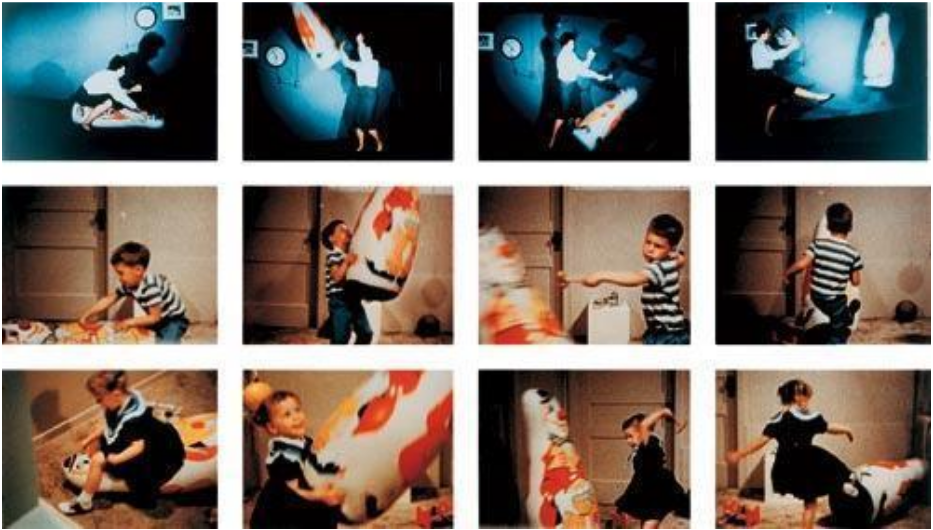
Observational learning takes place without any reinforcement; mere exposure to the model is sufficient for learning to occur. However, whether the model’s behaviour is imitated depends partly on the consequences of the behaviour for both the model and the learner. Reinforcement is important only insofar as it affects performance (not the learning itself). It provides the learner with information about the likely consequences of certain behaviours under certain conditions, which may be pleasant (reinforcement) or unpleasant (punishment). Bandura identifies five major cognitive modelling variables that influence the likelihood of learning and/or performance: attention, encoding into memory, long-term memory storage, reproducing the observed behaviour and motivation (including self-reinforcement). His conclusion came after a series of experiments, the most famous of which is the Bobo Doll experiment illustrated here.
Bobo doll experiment |
| Bandura (1961) tested 36 boys and 36 girls from the Stanford University nursery school aged between 3 and 6 years old as a part of a controlled experiment to investigate social behaviour (in this case, aggression). In the experimental conditions, children were individually shown into a room containing toys for 10 minutes while either: 24 children (12 boys and 12 girls) watched a male or female model behaving aggressively towards a toy called a ‘Bobo doll’ (a life sized inflatable clown doll). The adults attacked the Bobo doll in a distinctive manner – they used a hammer in some cases and, in others, threw the doll in the air and shouted ‘Pow, Boom.’Another 24 children (12 boys and 12 girls) were exposed to a non-aggressive model who played in a quiet and subdued manner for 10 minutes (playing with a tinker toy set and ignoring the bobo-doll). The final 24 children (12 boys and 12 girls) were used as a control group and not exposed to any model at all. The result was that the children who observed the aggressive model made far more imitative aggressive responses than those in the non-aggressive or control groups.
The Bobo doll experiment demonstrated that children are able to learn social behaviour, such as aggression, through the process of observational learning. By watching the behaviour of another person it also has an important implication of media violence on children.
Image Source: Wikimedia Commons (2016). Bobo Doll Deneyi, Licensed under a creative commons licence. Available for free at: https://commons.wikimedia.org/wiki/File:Bobo_Doll_Deneyi.jpg (Accessed on: 17 October 2023). |
Concepts of self-evaluation, self-monitoring and self-efficacy in moral development
According to Bandura, children learn both overt behaviour and abstract skills through modelling. For example, the rule underlying a model’s behaviour can be extracted from observing the behaviour without the rule being explicit or articulated. In this way, a child can acquire attitudes, values, expectancies, ways of solving problems and standards of self-evaluation.
By incorporating or internalising the societal standards into itself, the child can monitor its own behaviours in terms of these standards. This self-monitoring ensures that behaviour is regulated even in the absence of reinforcement. This mirrors Freud’s view of the superego.
Self-efficacy refers to our belief that we can act effectively and exercise some control over events that influence our lives. For example, if we feel the model’s actions are within our capabilities, then we may attempt to imitate them, but a low sense of self-efficacy is likely to inhibit us. This is crucially important for motivation.
An evaluation of social learning theories
Bandura’s claim that behaviour can be understood only by taking the learner’s self-concept, self-monitoring, self-efficacy and other mediating variables into account is the strength of SLT. These make the theory far less mechanical than Skinner’s, for example (orthodox learning theory). ‘Behaviour partly creates the environment, and the environment, in turn, influences the behaviour’ (Bandura, 1973). This view is called reciprocal determinism. People are both products and producers of their environment.
The evolutionary function of morality
The universal nature of morality in human culture suggests that it’s part of our human nature. According to Haidt and Joseph (2008), there are five moral domains (harm/care, fairness/reciprocity, in-group / loyalty, authority/respect, and purity/sanctity) that are innate and universal but which can be modified by cultural learning. The evolutionary advantage of these moral senses is understood in terms of group selection: that is, moral behaviour is beneficial to the species as a whole. According to Workman and Reader (2004), ‘morality might therefore be a system that protects the individual’s sense of fairness, hierarchy and purity and enables us to thrive within our groups and engage in reciprocal altruism.’
Conclusions
As we noted in the introduction, different psychological theories attempt to answer quite different questions about moral development. To the extent that all these questions are relevant to understanding the full complexity of moral development, psychoanalytic theory, cognitive behavioural theories, and SLT all make significant contributions to our understanding of this critically important aspect of socialisation.
References
- Bandura, A. (1973). Aggression: A social learning analysis. Prentice-Hall.
- Gross, R. (2020). Psychology: the science of mind and behaviour (8th ed.). Hodder.
- Workman, L & Reader, W. (2004). Evolutionary Psychology: An Introduction. 1-417.
- Haidt, J & Joseph, C. (2008). The Moral Mind: How Five Sets of Innate Intuitions Guide the Development of Many Culture-Specific Virtues, and Perhaps Even Modules. The Innate Mind, Volume 3, Foundations and the Future.
Complete Guide to Clinical Genetics ST3 Application and Recruitment (2027)
Written by Medibuddy. Last updated: October 2026. Clinical Genetics is

Complete Guide to Clinical Radiology ST3 Application and Recruitment (2027)
Recruitment paused: NHS England is not running Clinical Radiology ST3+ recru

Complete Guide to Paediatric Surgery ST3 Application and Recruitment in United Kingdom (2026)
Written by Medibuddy. Last updated: October 2026. If you’re planning


Take your subscriptions with you
Our mobile app allows you to access your interview and exam question banks wherever you are.

