


 Close
Close
 23rd November 2023
Social Learning Theory
Social learning theories originated in the US as an attempt to reinterpret certain aspects of Freud’s psychoanalytic theory in terms of learning theory (classical and operant conditioning). SLT focuses on human social behaviour, which is different from the studies on orthodox learning (or conditioning) theory and has been applied to many aspects of aggression, gender and morality.
The role of cognitive factors in observational learning
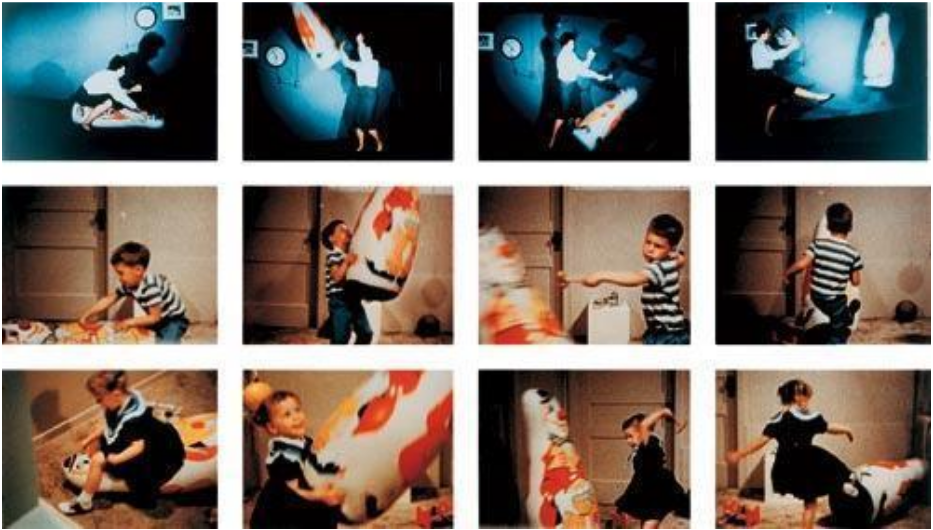
Observational learning takes place without any reinforcement; mere exposure to the model is sufficient for learning to occur. However, whether the model’s behaviour is imitated depends partly on the consequences of the behaviour for both the model and the learner. Reinforcement is important only insofar as it affects performance (not the learning itself). It provides the learner with information about the likely consequences of certain behaviours under certain conditions, which may be pleasant (reinforcement) or unpleasant (punishment). Bandura identifies five major cognitive modelling variables that influence the likelihood of learning and/or performance: attention, encoding into memory, long-term memory storage, reproducing the observed behaviour and motivation (including self-reinforcement). His conclusion came after a series of experiments, the most famous of which is the Bobo Doll experiment illustrated here.
Bobo doll experiment |
| Bandura (1961) tested 36 boys and 36 girls from the Stanford University nursery school aged between 3 and 6 years old as a part of a controlled experiment to investigate social behaviour (in this case, aggression). In the experimental conditions, children were individually shown into a room containing toys for 10 minutes while either: 24 children (12 boys and 12 girls) watched a male or female model behaving aggressively towards a toy called a ‘Bobo doll’ (a life sized inflatable clown doll). The adults attacked the Bobo doll in a distinctive manner – they used a hammer in some cases and, in others, threw the doll in the air and shouted ‘Pow, Boom.’Another 24 children (12 boys and 12 girls) were exposed to a non-aggressive model who played in a quiet and subdued manner for 10 minutes (playing with a tinker toy set and ignoring the bobo-doll). The final 24 children (12 boys and 12 girls) were used as a control group and not exposed to any model at all. The result was that the children who observed the aggressive model made far more imitative aggressive responses than those in the non-aggressive or control groups.
The Bobo doll experiment demonstrated that children are able to learn social behaviour, such as aggression, through the process of observational learning. By watching the behaviour of another person it also has an important implication of media violence on children.
Image Source: Wikimedia Commons (2016). Bobo Doll Deneyi, Licensed under a creative commons licence. Available for free at: https://commons.wikimedia.org/wiki/File:Bobo_Doll_Deneyi.jpg (Accessed on: 17 October 2023). |
Concepts of self-evaluation, self-monitoring and self-efficacy in moral development
According to Bandura, children learn both overt behaviour and abstract skills through modelling. For example, the rule underlying a model’s behaviour can be extracted from observing the behaviour without the rule being explicit or articulated. In this way, a child can acquire attitudes, values, expectancies, ways of solving problems and standards of self-evaluation.
By incorporating or internalising the societal standards into itself, the child can monitor its own behaviours in terms of these standards. This self-monitoring ensures that behaviour is regulated even in the absence of reinforcement. This mirrors Freud’s view of the superego.
Self-efficacy refers to our belief that we can act effectively and exercise some control over events that influence our lives. For example, if we feel the model’s actions are within our capabilities, then we may attempt to imitate them, but a low sense of self-efficacy is likely to inhibit us. This is crucially important for motivation.
An evaluation of social learning theories
Bandura’s claim that behaviour can be understood only by taking the learner’s self-concept, self-monitoring, self-efficacy and other mediating variables into account is the strength of SLT. These make the theory far less mechanical than Skinner’s, for example (orthodox learning theory). ‘Behaviour partly creates the environment, and the environment, in turn, influences the behaviour’ (Bandura, 1973). This view is called reciprocal determinism. People are both products and producers of their environment.
The evolutionary function of morality
The universal nature of morality in human culture suggests that it’s part of our human nature. According to Haidt and Joseph (2008), there are five moral domains (harm/care, fairness/reciprocity, in-group / loyalty, authority/respect, and purity/sanctity) that are innate and universal but which can be modified by cultural learning. The evolutionary advantage of these moral senses is understood in terms of group selection: that is, moral behaviour is beneficial to the species as a whole. According to Workman and Reader (2004), ‘morality might therefore be a system that protects the individual’s sense of fairness, hierarchy and purity and enables us to thrive within our groups and engage in reciprocal altruism.’
Conclusions
As we noted in the introduction, different psychological theories attempt to answer quite different questions about moral development. To the extent that all these questions are relevant to understanding the full complexity of moral development, psychoanalytic theory, cognitive behavioural theories, and SLT all make significant contributions to our understanding of this critically important aspect of socialisation.
References
- Bandura, A. (1973). Aggression: A social learning analysis. Prentice-Hall.
- Gross, R. (2020). Psychology: the science of mind and behaviour (8th ed.). Hodder.
- Workman, L & Reader, W. (2004). Evolutionary Psychology: An Introduction. 1-417.
- Haidt, J & Joseph, C. (2008). The Moral Mind: How Five Sets of Innate Intuitions Guide the Development of Many Culture-Specific Virtues, and Perhaps Even Modules. The Innate Mind, Volume 3, Foundations and the Future.
Complete Guide to Clinical Genetics ST3 Application and Recruitment (2027)
Written by Medibuddy. Last updated: October 2026. Clinical Genetics is

Complete Guide to Clinical Radiology ST3 Application and Recruitment (2027)
Recruitment paused: NHS England is not running Clinical Radiology ST3+ recru

Complete Guide to Paediatric Surgery ST3 Application and Recruitment in United Kingdom (2026)
Written by Medibuddy. Last updated: October 2026. If you’re planning


Take your subscriptions with you
Our mobile app allows you to access your interview and exam question banks wherever you are.

