


 Close
Close
 23rd November 2023
Types of Attachment – Secure and Insecure
Whilst Bowlby is often considered the father of attachment theory, Mary Ainsworth is often said to be the co-founder. Her work provided empirical evidence for Bowlby’s theories about attachment.
The strange situation test
This experiment of Ainsworth’s was an observational study of the behaviours of infants when exposed to various ‘strange situations’, which are stressful for the infant and, therefore, induce attachment behaviours. The observers scored various aspects of these behaviours and used those to categorise them into types of attachment, with particular reference to a ‘secure’ attachment or an ‘insecure’ attachment. The experiment is applicable to infants between 9 and 18 months old.
It was done in an experimental room, with an observer watching through one-way glass. There are eight phases/episodes to the experiment, consisting of two separations and two reunions. These episodes are described below:
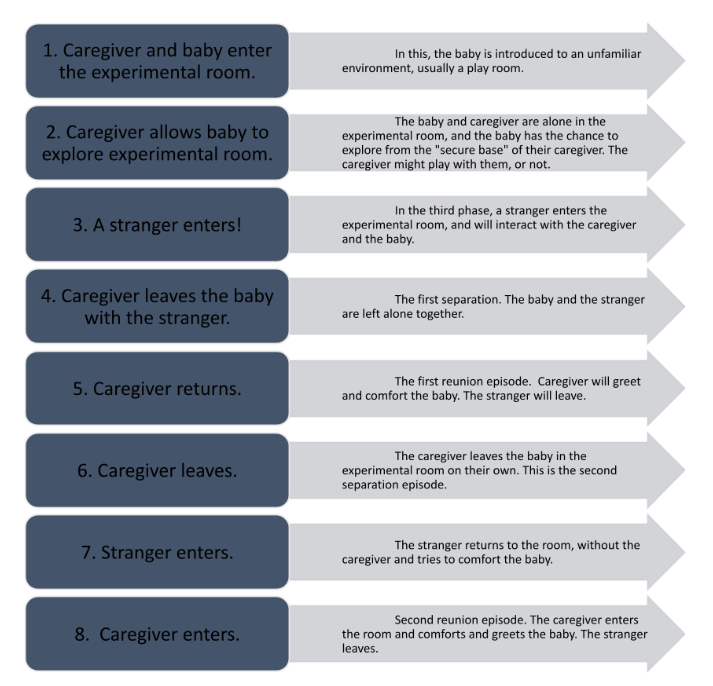
Types of attachment
From the strange situation test, they formulated different types of attachment in these infants. Overall, they noted lots of types but categorised these into three broad groups. Types A, B and C were identified by Ainsworth in the original experiments, Type D was added later.
| Type A: Anxious avoidant | Insecure | This group don’t appear too upset when the caregiver leaves and doesn’t show much of a reaction when they return either. However, the child is also not exploring freely. They are equally comforted by the stranger and the caregiver. |
| Type B: Secure | Secure | The child is upset by the separation but demands and receives comfort from the caregiver on their return. They could then continue with their explorative play. They use their caregiver as a safe base to explore. |
| Type C: Anxious resistant / Ambivalent | Insecure | The child is excessively upset by the separation, and when the caregiver returns, it may push them away and resist contact and comfort from them. They struggle to return to their activity on the return of the caregiver. They show fear about the stranger. |
| Type D: Disorganised | Insecure | These are the most bizarre presentations, where the child seems chaotic and confused. Videos will show a distressing picture of a frozen paralysis, with a dazed expression or repetitive movements. |
Note from the author: I would really recommend searching for videos on the Strange Situation Test – Whilst I hope I have described the procedure and attachment behaviours adequately, nothing can replace seeing it for yourself!
Development into adulthood
Bowlby and Ainsworth predicted that the attachment shown by an adult is a continuation of their attachment in infancy. In other words, our ability to relate to others is something we learn early in life, and we take this forward into our adult relationships.
Dr Mary Main developed a semi-structured interview for adults, called the Adult attachment interview, which classified attachment styles in adults based on the attachment styles defined in Ainsworth’s experiments. It’s an interview with 15 questions, and the responses are analysed based on the content of their speech, but also their language, grammar and flow of speech.
| Secure-autonomous (coherent-collaborative) | Same as Type B: Secure in infants.
The adult values attachment whilst also being able to be objective about their previous relationships and events. They are generally coherent and collaborative during the interview process. |
| Dismissing | Same as Type A: Anxious-avoidant.
They are not coherent during the interview. They are dismissing of previous relationships and make generalisations about the normality of their experiences that are not consistent with the examples they give. |
| Preoccupied/entangled | Same as Type C: Anxious-resistant.
Also, he was not coherent during the interview. They are often preoccupied by past experiences and express intense emotions about these. Sentences are long and vague. |
| Unresolved/disorganised | Same as Type D: Disorganised.
During discussions of loss or abuse, the adult loses their sense of logical speech and may lapse into ‘micro-dissociative episodes’. |
References
- Ainsworth, M. et al. (1978/2015). ‘Patterns of attachment: A psychological study of the strange situation: Psychology Press Classic Edition.’. Routledge.
- George, C. Kaplan, N. & Main, M. (1996). Adult Attachment Interview. Unpublished manuscript, Department of Psychology, University of California.
- Gomez, L. (1997). An Introduction to Object Relations. Free Association Books.
- Van Rosmalen, L. et al. (2015). ‘Ainsworth’s Strange Situation Procedure: The origin of an instrument’. Journal of the History of the Behavioral Sciences. 51:3. 261–284.
Complete Guide to Clinical Genetics ST3 Application and Recruitment (2027)
Written by Medibuddy. Last updated: October 2026. Clinical Genetics is

Complete Guide to Clinical Radiology ST3 Application and Recruitment (2027)
Recruitment paused: NHS England is not running Clinical Radiology ST3+ recru

Complete Guide to Paediatric Surgery ST3 Application and Recruitment in United Kingdom (2026)
Written by Medibuddy. Last updated: October 2026. If you’re planning


Take your subscriptions with you
Our mobile app allows you to access your interview and exam question banks wherever you are.

