


 Close
Close
 26th October 2023
Attitudes, Aggression and Altruism
Attitudes
Defining attitudes
There are many different ways to define the concept of an attitude. It might seem a bit of a ‘fluffy’ concept, but there are luckily various psychological theories that can help us make sense of them for the purposes of MRCPsych.
We all hold beliefs – conscious or unconscious – about many things around us, but some will be held more strongly than others. The strength of attitude is linked to the value placed upon the belief, as well as any personal experiences or emotional connections to the belief.
The tripartite model of attitudes
Attitudes are thought to be made up of 3 different components:
- Affective – Feelings or emotions about the subject, e.g. Revising for Paper A makes me feel anxious.
- Behavioural – The way our behaviour is impacted, e.g. I might avoid revision.
- Cognitive – Thoughts or beliefs about the topic, e.g. I believe exams are stressful and hard work.
This is known as the ‘ABC model’ of attitudes, or the ‘tripartite model’ (tripartite, as in, ‘3 parts’) and was developed by Albert Ellis.
Functions of attitudes
Katz described four functions that attitudes serve for us as individuals in society:
1. Knowledge – Allowing us to predict what is likely to happen.
2. Adaptiveness – Helping us fit in with a social group or find approval with other people.
3. Self/ego-expressive – Forming part of our identity and communicating to others who we are.
4. Ego-defence – Protecting our self-esteem or justifying our actions or behaviour.
We are not likely to be consciously aware of the functions our attitudes serve, and it may be that the functions coexist or change over time.
Changes in attitudes
One assumption about attitudes is that they generally remain constant and unchanged unless impacted by an internal or external factor. Change in an attitude is usually a result of either cognitive dissonance or persuasion.
Cognitive dissonance theory
Psychologists describe the principle of ‘cognitive consistency’, which is based on the assumption that we as humans are wired to seek to be congruent in our attitudes, values and behaviour.
Cognitive dissonance is the sense of discomfort or distress that occurs as a result of a single individual holding attitudes or beliefs and enacting behaviours that clash with each other. The degree of discomfort or distress that we feel then motivates us to change one of the inconsistent components to bring them back in line with each other.
For example, if you steal a textbook and believe it is wrong to do so, you would feel internal discomfort: your belief (that it is wrong to steal) and your action (stealing) would conflict with each other. To resolve this conflict, one part would need to shift. This could be the belief (e.g. convincing yourself that it is not actually wrong to steal), the action (e.g. returning the textbook or paying for it), or the perception of the action (e.g. convincing yourself that what you did, didn’t count as stealing for some reason).

Image Source: Adapted from Dreamstime (no date). Resolution of Cognitive Dissonance. Available for free at: https://www.dreamstime.com/presenting-resolution-cognitive-dissonance-image226642662 (Accessed on: 18 October 2023).
The cognitive dissonance experiment
A psychologist named Leon Festinger investigated cognitive dissonance theory with an experiment in the late 1950s. Participants were initially asked to complete boring and repetitive tasks (e.g. moving pegs in a board) for an hour or so. The participants were then asked to convince a third party who had not yet completed the task that the task had been enjoyable.
They were split into 3 groups. Two received different amounts of money to tell the third party that the task had been fun (one dollar vs twenty dollars) while the other was a control group who were not rewarded. After this, participants were asked to rate their own enjoyment of the activity.
Results showed that the group receiving twenty dollars falsely told the third party they had enjoyed the task while actually rating their enjoyment levels as low. In contrast, the ‘one dollar’ group appeared to actually have convinced themselves that they had enjoyed the task, rating their own enjoyment as higher.
Festinger believed that the ‘twenty dollar’ group had felt lying to the third party was worth it to receive a good amount of money (shifted action perception), whereas the ‘one dollar’ group needed to shift their own belief about the task in order to feel okay with telling the third party false information.
Measuring attitudes
As we’ve ascertained, attitudes are quite subjective and individualised. This means they can be difficult to measure.
Let’s have a think about some of the common ways of measuring attitudes that might come up in your exam:
| Scale name | Description | Options to select |
|---|---|---|
| Thurstone scale | Unidimensional scale, indicating strength of attitude (positive or negative) | Numerical scale |
| Likert Scale | Bidimensional scale, with options for levels of agreement or disagreement | ‘Strongly agree’, ‘agree’ etc. |
| Osgood’s semantic differential scale | Evaluating attitudes along different dimensions in between opposing adjectives (e.g. strong to weak; active to passive) | Numerical scale in between the opposite adjectives |
| Guttman scale | Stepwise unidimensional scale, each level involves agreeing with the previous ones | Numerical scale from 0 upwards |
References
- Maio G, Haddock, G. The psychology of attitudes and attitude change. SAGE Publications Ltd. 2010. https://doi.org/10.4135/9781446214299
- Prathap, S. SPMM Smart Revise. SPMM Course. 2019.
- McLeod, S. A. Attitudes and behaviour. Simply Psychology [online]. 2018, May. Available from URL: www.simplypsychology.org/attitudes.html [Accessed Feb 2023]
- Fishman J, Yang C, Mandell D. Attitude theory and measurement in implementation science: a secondary review of empirical studies and opportunities for advancement. Implementation Sci. 2021; 16(87).
Aggression
Definitions of aggression
Baron and Richardson (two social psychologists) defined aggression as ‘Behaviour that is intended to harm another individual who does not wish to be harmed.’ All parts of the definition are important as they mean that interactions such as impact sports, piercings, or pain inflicted as part of a consensual fetishistic sexual act would not be classed as aggression.
Aggression can take multiple different forms and can be subjective; one person may perceive a behaviour or act as being aggressive when another might not.
Types of aggression
There are various types of aggression which are good to understand for the exam:
- Overt aggression – Aggression that can be easily observed by someone external (e.g. pushing/shouting).
- Covert aggression – More subtle acts such as spreading rumours or excluding someone (generally more often seen in females).
- Hostile or reactive aggression – Aggression only for the purpose of harming someone.
- Instrumental or proactive aggression – Tends to be for a specific purpose (such as reaching a goal such as money or power) and can sometimes be planned in advance.
- Positive aggression – Aggression for what would potentially be seen as a ‘good reason’ such as someone defending themselves or someone else.
Theories of aggression
There are lots of varying beliefs about aggression, where it comes from, and what makes some people more aggressive than others. In order to simplify them, I have summarised the main theories in the table below. The full versions of some of the theories are more detailed than we need to learn for MRCPsych purposes, but we need to understand the basic features of the underlying theories in order to recognise and apply them.
| Name | Brief summary of theory | Key words, phrases and associated individuals |
|---|---|---|
| Psychoanalytic or ‘instinct’ theory | Belief that aggression is due to a build-up of Thanatos ‘The death instinct’ that needs to be released. | Thanatos; Freud; catharsis. |
| Evolutionary theory | Focuses on aggression as a desirable characteristic in terms of natural selection. That means aggressive and dominant individuals are more likely to pass on their genes. | Natural selection; ‘survival of the fittest’. |
| Social learning theory | Aggression is learned through observation and imitation of others (especially if there are observed rewards of aggression seen by the observer, resulting in ‘vicarious conditioning’). | Vicarious conditioning; Bandura; ‘Bobo doll’ experiment. |
| Genetic theory | Belief that the tendency to be aggressive could be inherited. Humans also inherit certain characteristics, e.g. high reactivity, impulsivity or low agreeableness, that may increase their likelihood of aggression. | Heritability; personality factors. |
| Frustration – aggression theory | Views aggression as stemming from the emotion of frustration. Later noted to be reductionist and adapted to recognise that frustration leads to a readiness to be aggressive, with a further step (e.g. an environmental cue) leading to aggression being displayed. | Dollard, Berkowitz. |
| Testosterone – serotonin theory | Belief that aggression is a result of high testosterone and low serotonin levels. | Testosterone; serotonin. |
Studying aggression
Aggression has been of interest to psychologists, other scientists and social scientists for a long period of time. Various studies have taken place over the years in attempts to help us understand aggression more. While we don’t need to learn all of these studies off by heart for the exam, it’s useful to know some of the evidence and how our view of aggression has changed over time.
Biological studies – neuroanatomical considerations
Possibly the most famous case study relevant to aggression involved a railway worker called Phineas Gage, who was involved in an industrial accident in 1848 in which a large rod of iron was blasted into his left cheek, through his brain, and out of the top of his head. He miraculously survived 12 years after this but was noted to have a significant change in his personality – described as having gone from a gentle, patient person to becoming impatient, aggressive, violent and impulsive. Modern scientists have recreated his skull (which was preserved at the time of his death) using computer software and noted the area in which Mr Gage’s brain would have been most damaged was the left frontal lobe. This damage to his frontal lobe was believed to have impacted impulse control, resulting in less restraint and more aggression.

Image Source: Wikimedia Commons (2015). Phineas Gage injury – lateral view (frontal lobe), Licensed under a creative commons licence. Available for free at: https://commons.wikimedia.org/wiki/File:Phineas_Gage_injury_-_lateral_view_(frontal_lobe).png (Accessed on: 18 October 2023).
A study by Raine et al compared neuroimaging of a group of people who had committed murder with the images of a group of people who had not, and found that those who had killed others had less activity in the frontal lobe and corpus callosum.
The limbic system – particularly the hypothalamus and amygdala – have also been implicated in aggression. (I find it interesting, but not surprising, given my experience with patients who may present as aggressive in the context of mental illness, that aggression may work through similar mechanisms as fear!). Animal models have linked high levels of aggression to increased medial amygdala activity, and structural imaging in humans has shown an association between increased right amygdala volume and reactive aggression.
These studies tend to show correlation rather than causation (partly because it’s challenging and unethical to conduct a randomised control trial that involves messing with people’s amygdalas!), so it is important to remember that we cannot definitely say that a larger amygdala causes aggression, or that aggression causes enlargement of the amygdala. Another confounding factor may influence both, but the link is certainly interesting and relevant. This also makes sense, as the limbic system is understood to be responsible for the classic ‘fight or flight’ response.
Biological studies – hormonal and chemical considerations
Wagner et al investigated testosterone and aggression in male mice in the 1970s. Using the number of times they bit or attacked other mice as a proxy outcome for aggression, Wagner et al noted that biting attacks decreased after castration, then increased again (to the level they were prior to castration) when testosterone was injected, suggesting that testosterone has a role in increasing aggression.
We cannot assume that what is true in mice is true in humans (and clearly can’t start castrating humans to make the study more relevant!). However, Dabbs et al also noted in the 1990s that prisoners who had higher levels of testosterone on blood tests were both more likely to be in prison for a violent crime and more likely to be rated as ‘tough’ by their peers.
In terms of neurotransmitters, both low serotonin and high dopamine have been implicated in aggression in humans and other species.
Social learning theory studies – Bandura and the ‘Bobo Doll’
Bandura et al conducted a series of experiments into the social learning theory of aggression in the early 1960s involving a toy called a ‘Bobo doll’ and a group of 3-6 year old children:
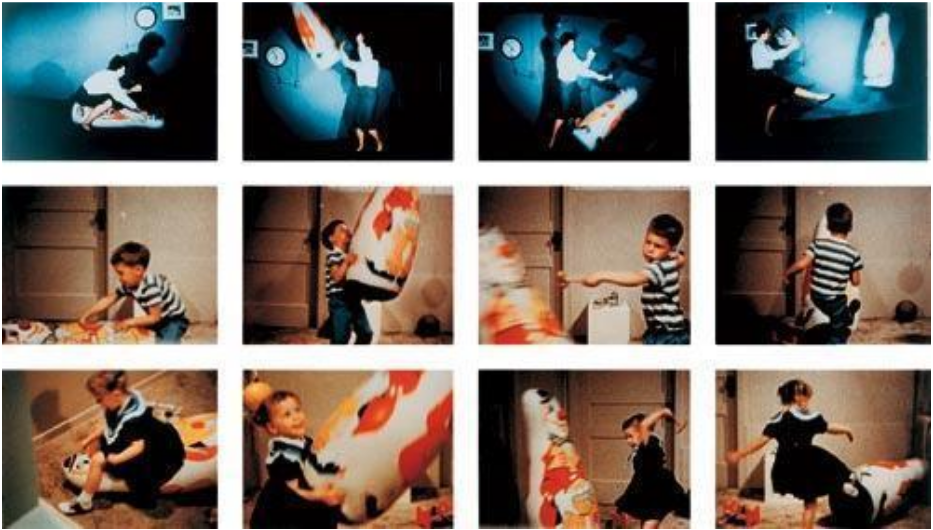
Image Source: Wikimedia Commons (2016). Bobo Doll Deneyi, Licensed under a creative commons licence. Available for free at: https://commons.wikimedia.org/wiki/File:Bobo_Doll_Deneyi.jpg (Accessed on: 17 October 2023).
The later investigations were more looking at other factors impacting the socially learned behaviour, such as whether children would copy aggressive behaviour more if it was modelled live, via people on a recording, or via cartoon versions. Bandura also conducted a further Bobo doll experiment to investigate reinforcement, involving a comparison between groups of children who observed the adult ‘models’ being rewarded for their aggression (given sweets) or punished for the aggressive behaviour (shouted at and hit with a toy golf club). These studies identified the power of vicarious reinforcement; when people learn through observing another person be either positively or negatively reinforced.
While (like a lot of psychological experiments around that time) the Bobo doll experiments were pretty ethically dodgy, they did give us a better understanding of social learning and the factors that affect it. We don’t need to know all the ins and outs of the experiments for Paper A, but it’s helpful to have a basic understanding of who conducted the experiments and what they involved and showed.
References
- Krahe B. The social psychology of aggression [eBook], 2nd ed. New York: Psychology Press; 2013.
- Birger M, Swartz M, Cohen D, Alesh Y, Grishpan C, Kotelr M. Aggression: the testosterone-serotonin link. Isr Med Assoc J. 2003 Sep;5(9):653-8.
- Haller J. The role of central and medial amygdala in normal and abnormal aggression: a review of classical approaches. Neurosci Biobehav Rev. 2018; 85:34–43.
- Farah T, Ling S, Raine A, Yang Y, Schug R. Alexithymia and reactive aggression: the role of the amygdala. Psychiatry Res Neuroimaging. 2018; 281:85–91.
Altruism and Prosocial Behaviour
The Encyclopaedia Britannica defines altruism as ‘Feelings and behaviour that show a desire to help other people and a lack of selfishness.’
It is one of the core motivators for prosocial actions and can often involve a cost to yourself; whether that is an obvious act of sacrifice (e.g. giving your own lunch to someone who is hungry) or more indirect (e.g. choosing to volunteer and then give up time that you might have been resting or watching Netflix).
Interestingly, altruism is something that does not always make biological or evolutionary sense. It can be adaptive in terms of encouraging others to be kind in return, but arguably, for altruism to be truly altruistic, it has to be carried out with no expectation of reward or reciprocation.
It can sometimes be hard to separate a kind act as part of altruism from a kind act that is carried out for more selfish reasons (and, in the real world, only the person carrying out the act can TRULY know what is motivating them). I find the table below helpful in separating the two main types of prosocial behaviour.
| Type of Behaviour | Can involve empathic concern | Activated response | Reason to help | Result |
|---|---|---|---|---|
| Altruistic behaviour | Yes | Distress felt by the other | Make the other feel better | Reduced distress in the other & a sense of accomplishment in self. |
| Egoistic behaviour | No | Personal distress | Make oneself feel better | Reduced distress in oneself. Sense of accomplishment in self. |
In reality, there will always be an element of selfishness in our kindness (even just that it increases our self-esteem or makes us feel good to be kind), but that is definitely too philosophical for our Paper A revision!
A uniquely human trait?
There has been a lot of controversy around whether or not altruism is unique to humans.
Experiments have clearly demonstrated other species showing prosocial behaviour, and it is widely accepted that various animals are likely to help others when there is no negative consequence for themselves.
However, interestingly, some studies have suggested that pro-social behaviour may no longer occur when a cost to self is introduced. Sterck, Olesen and Massen conducted a study with macaques involving low and high reward foods: if a macaque pulled one lever, they provided food to a sibling or child in an adjacent room (they received cucumber (low value) while their relative received a peanut (high value). The alternative lever for the macaques to pull provided the peanut to themselves and nothing to their relative, and this second lever was consistently selected by the macaques in the study. This suggested that prosocial or altruistic behaviour can be reduced in the presence of cost to self, which supports the idea that true altruism is unique to humans.
This could be true, or it could be our bias; after all, we are the ones investigating and would like to think that we are the most altruistic of species…
References
- Farsides T. The psychology of altruism [online]. The British Psychological Society: 2007. Available from URL: https://www.bps.org.uk/psychologist/psychology-altruism [Accessed Jan 2023]
- Batson, C.D., Fultz, J., Schoenrade, P.A. & Paduano, A. (1987). Critical self-reflection and self-perceived altruism. J. Pers. Soc. Psychol. 1987; 53:594–602.
- Hoffman M. Empathy and moral development: implications for caring and justice. Cambridge: Cambridge University Press; 2000.
- Sterck E, Olesen C, Massen J. No Costly Prosociality Among Related Long-Tailed Macaques (Macaca fascicularis). J Comparative Psychology. 2015; 129(3):275–282
Complete Guide to Clinical Genetics ST3 Application and Recruitment (2027)
Written by Medibuddy. Last updated: October 2026. Clinical Genetics is

Complete Guide to Clinical Radiology ST3 Application and Recruitment (2027)
Recruitment paused: NHS England is not running Clinical Radiology ST3+ recru

Complete Guide to Paediatric Surgery ST3 Application and Recruitment in United Kingdom (2026)
Written by Medibuddy. Last updated: October 2026. If you’re planning


Take your subscriptions with you
Our mobile app allows you to access your interview and exam question banks wherever you are.

