


 Close
Close
 26th October 2023
Aggression
Definitions of aggression
Baron and Richardson (two social psychologists) defined aggression as ‘Behaviour that is intended to harm another individual who does not wish to be harmed.’ All parts of the definition are important as they mean that interactions such as impact sports, piercings, or pain inflicted as part of a consensual fetishistic sexual act would not be classed as aggression.
Aggression can take multiple different forms and can be subjective; one person may perceive a behaviour or act as being aggressive when another might not.
Types of aggression
There are various types of aggression which are good to understand for the exam:
- Overt aggression – Aggression that can be easily observed by someone external (e.g. pushing/shouting).
- Covert aggression – More subtle acts such as spreading rumours or excluding someone (generally more often seen in females).
- Hostile or reactive aggression – Aggression only for the purpose of harming someone.
- Instrumental or proactive aggression – Tends to be for a specific purpose (such as reaching a goal such as money or power) and can sometimes be planned in advance.
- Positive aggression – Aggression for what would potentially be seen as a ‘good reason’ such as someone defending themselves or someone else.
Theories of aggression
There are lots of varying beliefs about aggression, where it comes from, and what makes some people more aggressive than others. In order to simplify them, I have summarised the main theories in the table below. The full versions of some of the theories are more detailed than we need to learn for MRCPsych purposes, but we need to understand the basic features of the underlying theories in order to recognise and apply them.
| Name | Brief summary of theory | Key words, phrases and associated individuals |
|---|---|---|
| Psychoanalytic or ‘instinct’ theory | Belief that aggression is due to a build-up of Thanatos ‘The death instinct’ that needs to be released. | Thanatos; Freud; catharsis. |
| Evolutionary theory | Focuses on aggression as a desirable characteristic in terms of natural selection. That means aggressive and dominant individuals are more likely to pass on their genes. | Natural selection; ‘survival of the fittest’. |
| Social learning theory | Aggression is learned through observation and imitation of others (especially if there are observed rewards of aggression seen by the observer, resulting in ‘vicarious conditioning’). | Vicarious conditioning; Bandura; ‘Bobo doll’ experiment. |
| Genetic theory | Belief that the tendency to be aggressive could be inherited. Humans also inherit certain characteristics, e.g. high reactivity, impulsivity or low agreeableness, that may increase their likelihood of aggression. | Heritability; personality factors. |
| Frustration – aggression theory | Views aggression as stemming from the emotion of frustration. Later noted to be reductionist and adapted to recognise that frustration leads to a readiness to be aggressive, with a further step (e.g. an environmental cue) leading to aggression being displayed. | Dollard, Berkowitz. |
| Testosterone – serotonin theory | Belief that aggression is a result of high testosterone and low serotonin levels. | Testosterone; serotonin. |
Studying aggression
Aggression has been of interest to psychologists, other scientists and social scientists for a long period of time. Various studies have taken place over the years in attempts to help us understand aggression more. While we don’t need to learn all of these studies off by heart for the exam, it’s useful to know some of the evidence and how our view of aggression has changed over time.
Biological studies – neuroanatomical considerations
Possibly the most famous case study relevant to aggression involved a railway worker called Phineas Gage, who was involved in an industrial accident in 1848 in which a large rod of iron was blasted into his left cheek, through his brain, and out of the top of his head. He miraculously survived 12 years after this but was noted to have a significant change in his personality – described as having gone from a gentle, patient person to becoming impatient, aggressive, violent and impulsive. Modern scientists have recreated his skull (which was preserved at the time of his death) using computer software and noted the area in which Mr Gage’s brain would have been most damaged was the left frontal lobe. This damage to his frontal lobe was believed to have impacted impulse control, resulting in less restraint and more aggression.

Image Source: Wikimedia Commons (2015). Phineas Gage injury – lateral view (frontal lobe), Licensed under a creative commons licence. Available for free at: https://commons.wikimedia.org/wiki/File:Phineas_Gage_injury_-_lateral_view_(frontal_lobe).png (Accessed on: 18 October 2023).
A study by Raine et al compared neuroimaging of a group of people who had committed murder with the images of a group of people who had not, and found that those who had killed others had less activity in the frontal lobe and corpus callosum.
The limbic system – particularly the hypothalamus and amygdala – have also been implicated in aggression. (I find it interesting, but not surprising, given my experience with patients who may present as aggressive in the context of mental illness, that aggression may work through similar mechanisms as fear!). Animal models have linked high levels of aggression to increased medial amygdala activity, and structural imaging in humans has shown an association between increased right amygdala volume and reactive aggression.
These studies tend to show correlation rather than causation (partly because it’s challenging and unethical to conduct a randomised control trial that involves messing with people’s amygdalas!), so it is important to remember that we cannot definitely say that a larger amygdala causes aggression, or that aggression causes enlargement of the amygdala. Another confounding factor may influence both, but the link is certainly interesting and relevant. This also makes sense, as the limbic system is understood to be responsible for the classic ‘fight or flight’ response.
Biological studies – hormonal and chemical considerations
Wagner et al investigated testosterone and aggression in male mice in the 1970s. Using the number of times they bit or attacked other mice as a proxy outcome for aggression, Wagner et al noted that biting attacks decreased after castration, then increased again (to the level they were prior to castration) when testosterone was injected, suggesting that testosterone has a role in increasing aggression.
We cannot assume that what is true in mice is true in humans (and clearly can’t start castrating humans to make the study more relevant!). However, Dabbs et al also noted in the 1990s that prisoners who had higher levels of testosterone on blood tests were both more likely to be in prison for a violent crime and more likely to be rated as ‘tough’ by their peers.
In terms of neurotransmitters, both low serotonin and high dopamine have been implicated in aggression in humans and other species.
Social learning theory studies – Bandura and the ‘Bobo Doll’
Bandura et al conducted a series of experiments into the social learning theory of aggression in the early 1960s involving a toy called a ‘Bobo doll’ and a group of 3-6 year old children:
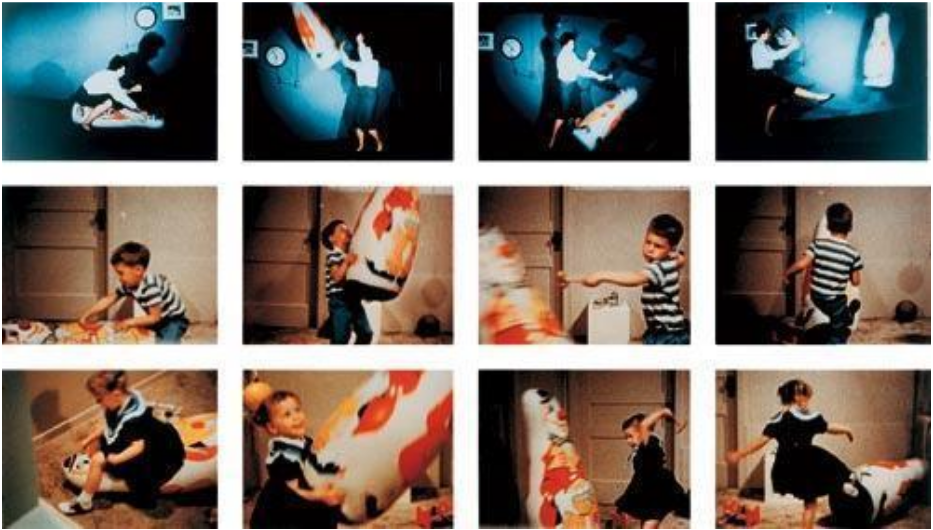
Image Source: Wikimedia Commons (2016). Bobo Doll Deneyi, Licensed under a creative commons licence. Available for free at: https://commons.wikimedia.org/wiki/File:Bobo_Doll_Deneyi.jpg (Accessed on: 17 October 2023).
The later investigations were more looking at other factors impacting the socially learned behaviour, such as whether children would copy aggressive behaviour more if it was modelled live, via people on a recording, or via cartoon versions. Bandura also conducted a further Bobo doll experiment to investigate reinforcement, involving a comparison between groups of children who observed the adult ‘models’ being rewarded for their aggression (given sweets) or punished for the aggressive behaviour (shouted at and hit with a toy golf club). These studies identified the power of vicarious reinforcement; when people learn through observing another person be either positively or negatively reinforced.
While (like a lot of psychological experiments around that time) the Bobo doll experiments were pretty ethically dodgy, they did give us a better understanding of social learning and the factors that affect it. We don’t need to know all the ins and outs of the experiments for Paper A, but it’s helpful to have a basic understanding of who conducted the experiments and what they involved and showed.
References
- Krahe B. The social psychology of aggression [eBook], 2nd ed. New York: Psychology Press; 2013.
- Birger M, Swartz M, Cohen D, Alesh Y, Grishpan C, Kotelr M. Aggression: the testosterone-serotonin link. Isr Med Assoc J. 2003 Sep;5(9):653-8.
- Haller J. The role of central and medial amygdala in normal and abnormal aggression: a review of classical approaches. Neurosci Biobehav Rev. 2018; 85:34–43.
- Farah T, Ling S, Raine A, Yang Y, Schug R. Alexithymia and reactive aggression: the role of the amygdala. Psychiatry Res Neuroimaging. 2018; 281:85–91.
Complete Guide to Clinical Genetics ST3 Application and Recruitment (2027)
Written by Medibuddy. Last updated: October 2026. Clinical Genetics is

Complete Guide to Clinical Radiology ST3 Application and Recruitment (2027)
Recruitment paused: NHS England is not running Clinical Radiology ST3+ recru

Complete Guide to Paediatric Surgery ST3 Application and Recruitment in United Kingdom (2026)
Written by Medibuddy. Last updated: October 2026. If you’re planning


Take your subscriptions with you
Our mobile app allows you to access your interview and exam question banks wherever you are.

