


 Close
Close
 27th October 2023
Intergroup Behaviour
Social identity and group membership
How do you identify yourself?
I’m not talking about ‘Hello, my name is…’; I’m talking about what groups you identify yourself as belonging to.
For example, religion, occupation and ethnicity are all groups that people use to understand and explain who they are to themselves and others.
This has led to great fascination from social psychologists, notably Henry Tajfel and John Turner, about how we self-identify as members of wider groups and the influence that has on our individual and collective behaviours.
This led to the development of the ‘Social identity theory’ by Tajfel in the 1970’s.
Social identity theory – Tajfel and Turner
The specifics of Tajfel’s theory is quite complex and way above the level of detail needed for the MRCPsych, but a basic understanding is necessary, so that is what I will describe here.
Humans are social animals, and this is the principal reason for our emergence as the dominant species on Earth. However, humans also have limited cognitive processing capacity and so use cognitive heuristics to respond to the world around us.
Due to this, the human brain naturally lends itself to categorising things, including people, based on context clues and past experiences. For example, if you were to walk into a mechanic’s office and saw a man in overalls covered in oil, it is reasonable that you would presume him to be a mechanic. Whereas, if you entered and the same man was in a tailored suit, you might not. This is how we navigate the world.
This categorising process applies not only to others but to ourselves. If you remember back to Maslow’s hierarchy of needs, once you have established the basic physiological and safety needs, the next need to be addressed is ‘belonging.’, closely followed by ‘esteem.’
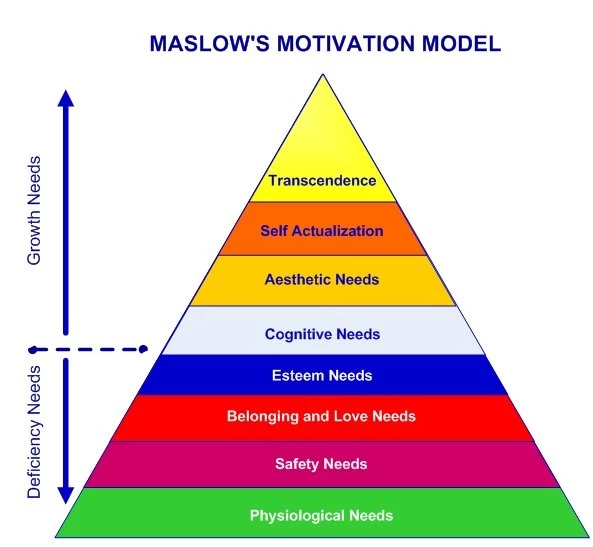
We are social animals, and the need to belong and feel valued is part of who we are. As such, we can identify with multiple social groups at once, for example, a Catholic doctor who supports Manchester United.
Once an individual has categorised themselves as a certain group, they will often adopt some of the behaviours of that group to conform to their social norms in an attempt to generate validation and a sense of ‘belonging.’
Image Source: Wikimedia Commons (2020). Expanded Maslow’s Needs, Licensed under a creative commons licence. Available for free at: https://en.wikipedia.org/wiki/File:Expanded_Maslow%27s_Needs.webp (Accessed on: 18 October 2023).
The problem comes from the fact that once we have identified ourselves as part of an ‘us,’ this inevitably leads to the formation of a ‘them.’
Intergroup conflict and prejudice
Social identity and intergroup conflict
By definition, once we establish what defines belonging to a specific group, we have inherently defined what it means to be NOT part of that group.
In social psychology, this is often referred to as the ‘ingroup’ and the ‘outgroup.’
It is felt in social identity theory that once an individual identifies as a member of a certain ‘ingroup’, then they will compare their group’s performance to the relevant ‘outgroup.’
The individual’s self-image is then tied to both their personal circumstances as well as their group’s relative performance. The better ‘their group’ is performing, the better it reflects on them as a member of it.
This felt competition leads to conflict between the groups.
It was often believed that for this to occur, there needed to be a specific competition over scarcity of resources, the most famous study of this being the ‘Robbers Cave’ study by social psychologist Muzafer Sherif.
Intergroup conflict – Sherif
Two groups of white young boys were taken to a summer camp in Robbers Cave State Park in Oklahoma in the summer of 1954. The two groups were isolated for the initial phase of the experiment, spending multiple days doing activities within their group collaboratively. The boys chose names for their groups, one group identifying as ‘The Eagles’ and the other as ‘The Rattlers.’
After several days, the groups were introduced to one another and told they would spend the next few days engaging in competition for prizes.
Over the few days of the competition, there was increasing conflict and hostility between the groups, with initial name-calling progressing to flag-burning and, ultimately, destruction and theft of property.
Once the competition days were over, the groups were brought together to engage in recreational activities. However, the conflict only seemed to further increase with multiple fights breaking out.
The groups were asked to describe the members of their ‘ingroup’ and the members of the ‘outgroup.’ Consistently, they described the members of their ‘ingroup’ in a positive light, highlighting their positive characteristics while consistently berating and criticising the members of the ‘outgroup.’
However, the groups were then forced to engage in tasks that would benefit both groups and required collaboration as one large group. Through these tasks, there was noted to be a decrease in hostile behaviour and expressed ill feelings for the other group.
The above study is often cited as an example of ‘realistic conflict theory’ in that the hostility was felt to be directly attributable to the scarcity and competition of resources, in this case, prizes. However, many debate that the mere existence of two groups led to the previously discussed relative performance comparison and resultant effects on self-esteem. It is worth noting that the hostilities began to decrease once the groups were forced to work collaboratively and, arguably, began to function as a larger singular group.
Prejudice
Prejudice is, simply put, the act of pre-judging something, usually people, before sufficient evidence for a belief can be attained.
It is often thought to be composed of three separate components: affective, cognitive and behavioural.
- Affective component – Feeling a certain emotion towards a group, i.e., hate or disgust.
- Cognitive component – Stereotypes leading to erroneous thinking about members of a group.
The psychologist Gordon Allport categorised prejudiced behaviour into the following tiers:
- Antilocution – ‘Negative speech’ such as stereotypes, badmouthing, unpleasant ‘banter.’
- Avoidance – Avoiding, ignoring, excluding.
- Discrimination – Active attempts to harm by denying access to opportunities and services.
- Physical Attack – Assault, rape, damage to physical property.
- Extermination – Total destruction or removal of the group, i.e., genocide.
It was argued by Allport that the prevalence of the actions of earlier tiers if left unchecked, can lead to the increasing frequency of activities of later tiers.
References
- Tajfel, H.; Turner, J. (1979). An integrative theory of intergroup conflict. The social psychology of intergroup relations. 33–47.
- Tajfel, H. Turner, J. (1986). The social identity theory of intergroup behaviour. Psychology of Intergroup Relations. 7–24.
- Sherif, M. et al. (1958). Superordinate Goals in the Reduction of Intergroup Conflict. American Journal of Sociology. 63(4).
- Allport, G. (1955). The nature of prejudice. Cambridge. Addison-Wesley Pub. Co.
Complete Guide to Clinical Genetics ST3 Application and Recruitment (2027)
Written by Medibuddy. Last updated: October 2026. Clinical Genetics is

Complete Guide to Clinical Radiology ST3 Application and Recruitment (2027)
Recruitment paused: NHS England is not running Clinical Radiology ST3+ recru

Complete Guide to Paediatric Surgery ST3 Application and Recruitment in United Kingdom (2026)
Written by Medibuddy. Last updated: October 2026. If you’re planning


Take your subscriptions with you
Our mobile app allows you to access your interview and exam question banks wherever you are.

